Site Banner Ads

Site Search

Search

Home Up Here Publishing

Mobile Toggle

Social Links

Facebook Instagram

Search Toggle

Search

Main navigation

  • Magazines
    • Latest Issue
    • Past Issues
    • Up Here Business
    • Visitor Guides
    • Move Up Here
  • Sections
    • People & Places
    • Arts & Lifestyle
    • History & Culture
    • Travel & Tourism
    • Nature & Science
    • Northern Jobs
  • Newsletter
  • Community Map
  • Merch
  • Our Team
  • Support
  • Subscribe/Renew

The Biggest Little City North of 60

November 2015

For four centuries, Kuukpak, located in the Western Arctic along the Mackenzie River, was the richest, busiest summer settlement around

By Tim Edwards

Archeologists excavate one of the houses at Kuukpak, located along the Mackenzie River, earlier this year. Photo courtesy of Max Friesen

Archeologists excavate one of the houses at Kuukpak, located along the Mackenzie River, earlier this year. Photo courtesy of Max Friesen

Breadcrumb

  1. Home
  2. The Biggest Little City North of 60

Food was nearby and plentiful. There were plenty of bluffs to dig into, and driftwood to turn those holes into homes. For centuries, more than 40 houses occupied the largest known Inuvialuit settlement in the Canadian Arctic, until its inhabitants left and didn’t come back in the 1800s. And now this settlement, called Kuukpak, is getting smaller every year.

“The site is huge and not fully understood and eroding badly,” says archeologist Max Friesen, “so that’s why we’re back there.” Friesen and a team of technicians and researchers have been excavating the site since 2013, surveying the region one year in a helicopter and digging the next.

His team has found a remarkable array of tools—for hunting, fishing, cutting, sewing—inside the one driftwood home they’ve fully excavated. “Because [the Inuvialuit] didn’t have to move it around, they could just continue to build and acquire more material in order to make their lives more comfortable,” says Friesen, “and more and more specialized hunting and fishing equipment means you’re going to have a more secure economy.” And they ate well. The digs have turned up bones of caribou, seals, ducks, geese, fish, and the mainstay—as well as the likely reason the Inuvialuit chose this site—beluga whales. 

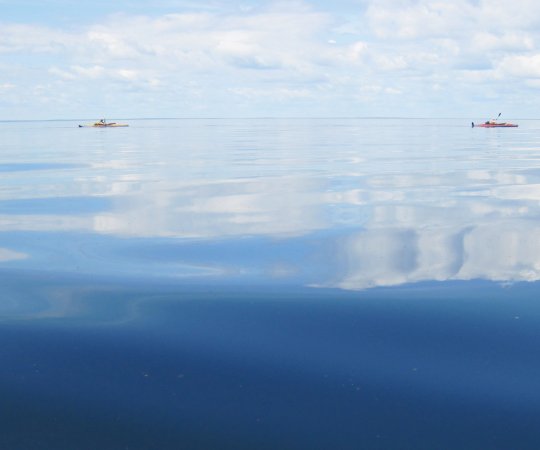
The water near Kuukpak is very shallow, and the community would balloon in the summer as nearby groups came to assist in the beluga hunt. “A line of kayakers [would form] behind the belugas and basically frighten them into the shallows where they were easily dispatched,” says Friesen.

But as it brought about Kuukpak’s beginning, the water also carried in its end. As European whalers and explorers came to the region in the 1800s, they brought with them diseases that wrought havoc upon the Inuvialuit population. The survivors left Kuukpak, where their families had lived for close to 400 years, and moved to a settlement near what is now Tuktoyaktuk. 

According to Friesen, the eroding Arctic coast at Kuukpak is reclaiming one house every five years. But as Friesen’s project will continue for another three years, and close to 26 homes remain, we’re bound to learn more about Kuukpak before it’s all gone.


[view:image_galleries=block_1=1830]
November 2015

Shawn Ryan. Photo by Chris Healey

The Gold Magnet

Shawn Ryan launched one Yukon gold rush. He's ready to do it again

By Herb Mathisen

Shawn Ryan. Photo by Chris Healey

May 28th, 2026 May 28th, 2026

November 2015

Illustration by Beth Covvey

The Helen Back Trail

How a hiking route gets its name

By Tim Edwards

Illustration by Beth Covvey

May 28th, 2026 May 28th, 2026

Related Articles

Tear Sheet

Illustration by Patrick Kane

iPods vs iGloos

The iPod revolution has taken root in the Arctic. Will it spend the end of traditional Inuit music? 

May 28th, 2026 May 28th, 2026

Tear Sheet

Photo by Gordon Greone

In the Wake of Ghost Ships

For hundreds of years, the search for a navigable passage through Arctic seas lured European explorers to their doom. 

May 28th, 2026 May 28th, 2026

UP HERE - MAR/APR 2026

----

What’s for Dinner?

The answer to that question could make the difference between life and death

May 28th, 2026 May 28th, 2026

Tear Sheet

Photo by Michael Sharpe

The Gift of Pure Water

Published in Up Here Magazine July/August 1989.

May 28th, 2026 May 28th, 2026

UP HERE - JAN/FEB 2026

Photo by Andrea Magee

They’re Still Standing

Just as the Klondike Gold Rush was ending, Thomas Fuller went on a building spree in Dawson. Have a look around

May 28th, 2026 May 28th, 2026

UP HERE - NOV/DEC 2025

-----

Come From Away

A Newfoundland tradition finds a home in Iqaluit

May 28th, 2026 May 28th, 2026
Newsletter sign-up promo image.

Stay in Touch.

Our weekly newsletter brings all the best circumpolar stories right to your inbox.

Up Here magazine cover

Subscribe Now

Our magazine showcases award-winning writing and spectacular northern photos.

Subscribe

Footer Navigation

  • Advertise With Us
  • Write for Us
  • Privacy Policy
  • Disclaimers & Legal

Contact Information

Up Here Publishing
P.O Box 1343
Yellowknife, NT
X1A 2N9  Canada
Email: info@uphere.ca

Social Links

Facebook Instagram
Funded by the Government of Canada