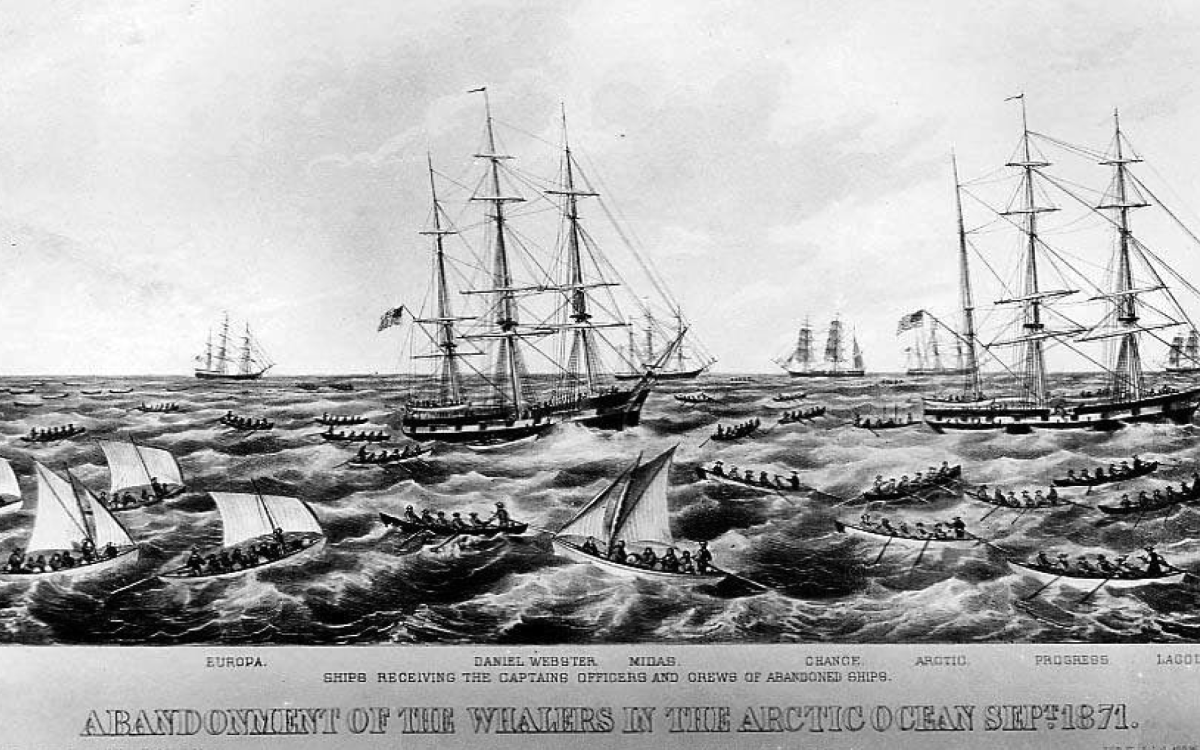
IN THE DAYS BEFORE the Daniel Webster sailed for the Arctic, the crew gathered supplies and stowed barrels of hardtack and salt pork below deck. The overpowering stench of whale oil filled the docks in New Bedford, Massachusetts, and casks of the yellowish liquid lined the wharf, often leaking between the planks. A forest of whaleship masts rose above the harbour, and the waterfront teemed with sailors.
On the morning of March 21, 1860, under clear skies and a fresh west-northwest breeze, the Daniel Webster set out for Davis Strait. Almost immediately, Captain Isaac Allen and his 41-man crew ran into bad weather. Gales and squalls battered the ship, at times forcing the crew to pull in most of the sails to keep control, while the men worked the decks in snow and spray. In June, they arrived at the edge of Cumberland Sound and spent the rest of the month inching through the pack ice. They reached Arctic Harbour in July, joining other whalers already at work.
For more than two centuries, European and, later, American whalers hunted bowhead and right whales in Davis Strait and Hudson Bay. Whale oil, rendered from blubber, lit homes, while flexible baleen was used for corsets, buggy whips and other everyday items before plastics.
The Daniel Webster crew took its first whale on July 12, but further success proved elusive. Storms swept through the sound, and whales often escaped. The ship moved from harbour to harbour, where long watches were broken by scattered sightings and few clear chances to strike. In October, freezing spray and forming ice made the whaleboats increasingly hard to handle, with the log noting “all the water that came over the boat was ice as soon as it struck.” By then, the ship had been secured for the winter in Middle Harbour.
As whaling voyages lengthened, a practice known as overwintering became increasingly common to avoid long return trips to southern ports during an already short hunting season. The crew stripped the ship, creating space by sending empty casks ashore, moving the stove below deck and rigging makeshift shelters from old sails. As the harbour froze, they banked snow against the hull for insulation and cut ice from nearby ponds and floes to melt for cooking and washing. They carried boats, anchors and other gear ashore or covered it against the ice.
Then the whalers spent their days hauling ice, tending the ship and passing the time as best they could. On November 25, 1860, the weather was fair, the winds light. Nothing in the log suggested it would be a day worth remembering. Except for the baseball game.
Richard Holley Fisher, the 46-year-old first mate from Martha’s Vineyard, kept the ship’s log. What he jotted down that day is the earliest known record of baseball in the Arctic. “The ship froze in fast and solid,” he wrote, “and some of the men out on the ice playing ball.” Fisher recorded another game on Christmas Day, with the temperature at -11°C. “The men haveing [sic] a good time,” he wrote. “Playing ball and fireing [sic] the Big gun, and having a good dinner. All the captains and crew from the other ships on board.” The Antelope lay roughly 180 metres away, and its captain, Isaac Wrisley, often walked across the ice to visit. It’s possible both crews took part in the Christmas game.
Other accounts mention baseball, too, but that’s all they note: A game was played. No box scores or lineups. Still, if you squint at baseball as it was played in 1860, you can see the outlines of the sport as we know it today. Pitchers delivered the ball underhand from a distance of about 13.7 metres (today, it’s 18.4 metres or 60 feet, six inches) and batters could call for a high or low pitch. Runners were out if a ball was caught on the fly or after one bounce. Fielders played barehanded (though whalers likely wore thick mittens because of the deep cold).
The Daniel Webster’s wasn’t the only ball-playing whaling crew. In September 1862, the Black Eagle became trapped in heavy pack ice in Hudson Bay with several other vessels. It soon became clear the ships wouldn’t be able to reach open water, so they had no choice but to stay and spend the winter at a place they called Eagle Harbour. That November, during a brief thaw, the log keeper recorded games on consecutive days.
In November 1864, whalers from the Concordia played baseball while wintering at Depot Island in Hudson Bay. In 1881, Edwin Clark, the log keeper of the George and Mary, recorded games at Marble Island in Hudson Bay. On November 30, he noted the day included “sealing and base ball,” followed the next day by “Base ball. Fancy dress ball in eve.” On December 29, he wrote the crew “Played Base Ball (sic), football, sliding down hill. Dancing in eve,” adding the “(sic)” for reasons known only to him. In early 1887, log keeper John C. Freeman of the Alexander recorded two more games at Marble Island.
That year, word spread of whales in great numbers around Herschel Island. What had once been a remote outpost off the Yukon coast soon became the Beaufort Sea’s busiest whaling port. By the winter of 1894, 15 vessels lay anchored in Pauline Cove, their crews numbering in the hundreds and including not only whalers but also women and children, who would ride out the winter together on Herschel Island.
The crews formed a baseball league and teams such as the Dew Drops, Arctics and Northern Lights played dozens of games throughout the 1890s. Some of these same men would later find themselves stranded at Point Barrow, on the northern tip of Alaska, in the fall of 1897. When rescuers arrived the following spring, one of their first acts was to have the men play baseball every day to regain their strength. It was a familiar remedy. Nearly four decades earlier aboard the Daniel Webster, under different circumstances but facing similar isolation, baseball had already proven its worth.