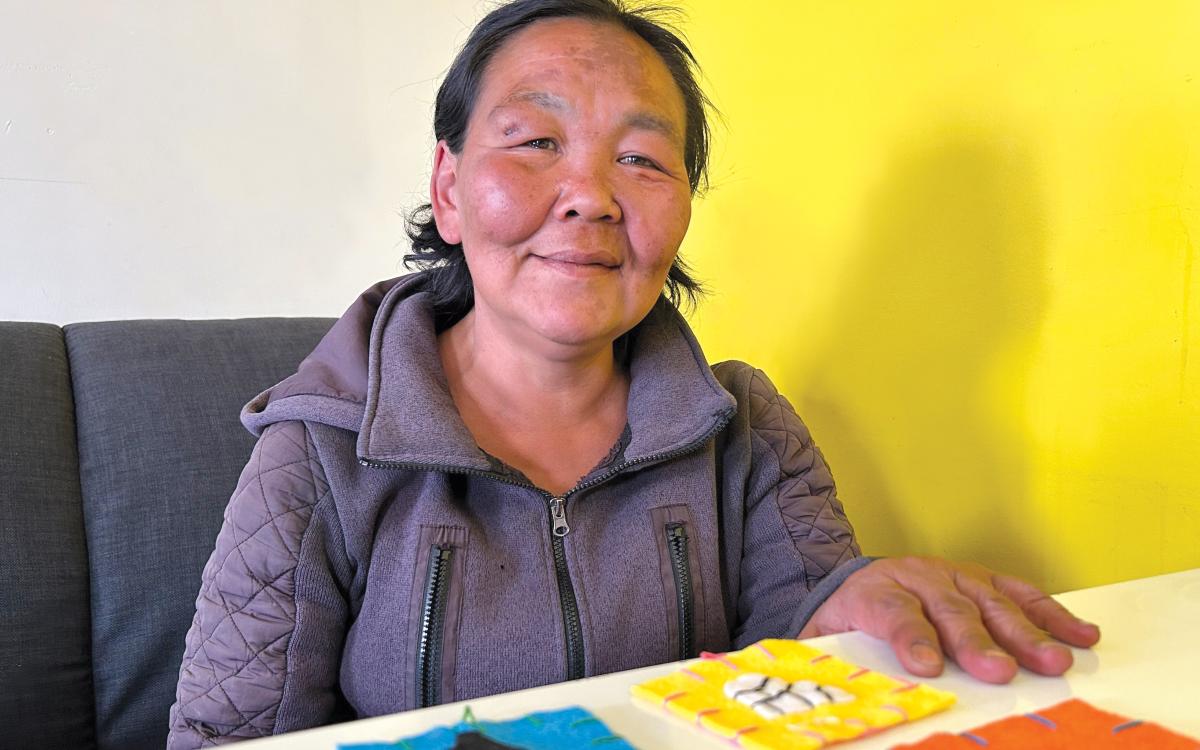
A WOMAN ORDERS a large latte and sits down at a table in Iqaluit’s Black Heart Café. Haiga Ashoona, who’s sitting nearby, offers her a small yellow wall hanging with a textile outline of a polar bear stitched to it—the most Nunavut kind of souvenir. “Just $40.” The woman shakes her head. “$30?” Still no.
Ashoona has spent much of her life walking around Iqaluit with her colourful embroidered wall hangings, asking: “Would you like to buy some art?” And like most artists, she usually gets a “sorry” or a “no, thank you” or one of those I’m-gonna-pretend-I-didn’t-see-you looks. “Sometimes, I would walk all day,” the soft-spoken 46-year-old says, “and no one would buy anything.”
Still, Ashoona manages to make roughly $300 a month, sewing small won’t-make-you-famous pieces. “I would do something else,” she admits, “if I didn’t have to make money.” She wants to try painting and one day make something she’d be proud to keep for herself—something big, detailed and personal.
The problem is how to get there. Inuit art—more specifically, the art that emerged in the 1950s as the Canadian government encouraged Inuit families to leave life on the land—has been a global ambassador for Inuit culture since the 1960s and an important diplomatic calling card for the nation.
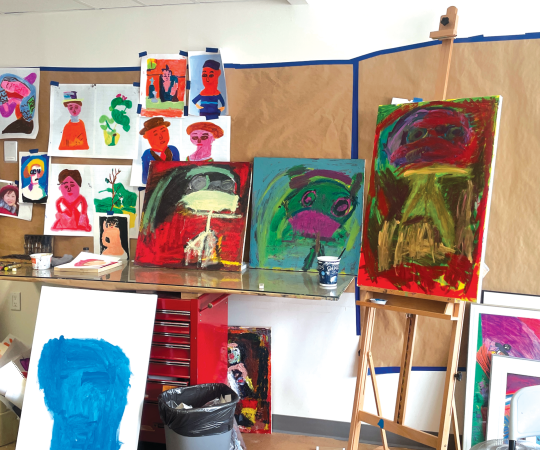
But the Inuit art market has become oversaturated with dancing polar bears, enchanted owls and cheerful walruses in the form of carvings, prints and wall hangings like the ones Ashoona was trying to sell in the café. Some artists break away from the old clichés, but, too often, creating art is a grind that makes it almost impossible to earn a living. And some critics argue that what gets produced devalues Nunavut’s heritage. There is a way out, but it will require education, money and legislation—and bolder art.
JUST OVER 80 YEARS AGO, the federal government began creating programs to encourage Inuit families to move from the land into permanent settlements. Arts such as carving and printmaking soon became a way to support local cash economies, most famously thanks to James Houston, who was one of the pioneer Inuit art popularizers. In his wake, a network of co-operatives—such as Kinngait’s West Baffin Cooperative—became the main art-selling avenue in the North. Carvers and other artists would get cash for their work and co-ops would distribute it to southern galleries.
Inuit art quickly made its way to national and international stages. In 1972, for example, half a dozen wooden boxes stamped with “Sculpture of the Inuit: Masterworks of the Canadian Arctic” arrived at The Pushkin State Museum of Fine Arts in Moscow. The crates contained dozens of pieces from a globe-trotting exhibition sponsored by the Canadian government to promote Inuit art. (Their arrival coincided with the Summit Series, the historic hockey showdown between Canada and the USSR.)
Squeezed between more ideologically charged displays—“30th Anniversary of the Socialist Revolution in Bulgaria” and a collection of children’s drawings called “We Love Lenin”—the Moscow exhibition also hosted artists Paul Toolooktook and Mark Tungilik, who had pieces on display. Tungilik shook hands with Soviet leader Leonid Brezhnev, helped build an inuksuk in one of the Pushkin’s halls and was part of an unofficial diplomatic effort. “He didn’t speak any English or Russian, obviously,” his grandson Jesse Tungilik says. “I’m not sure how much he really understood what his role was there.” Regardless, this was a time when Inuit were used to define Canada’s international identity. “Inuit art has been a huge resource for the government for soft diplomacy for a long time,” Tungilik says. “It humanizes Canada. It makes us look less like a colonial entity.”
But as the art became more popular, it quickly turned into a commodity—too quickly by Houston’s own estimation. In his foreword to the catalogue for “Masterworks of the Canadian Arctic,” which he helped organize, he wrote that Inuit art was becoming commercialized and the quality of some work had “unquestionably diminished.” Thinking more about what was easy to sell than good art, artists started to carve, draw and sew the same popular images. The trend accelerated over the years, turning art into labour rather than an expression of culture and identity. But being different—deeper and more intricate—takes time and resources that most artists don’t have.
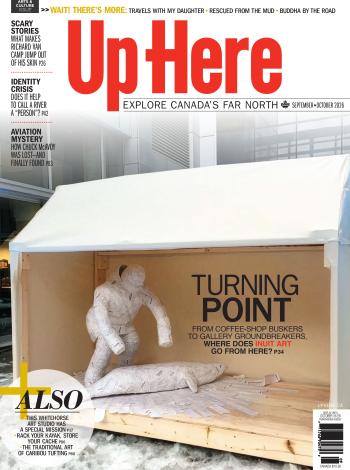
Like his grandfather, Tungilik is an artist. But instead of “traditional” art, he focuses on pieces designed to make people think, such as a sealskin space suit or a Nunavut flag made of bingo cards. His most prominent work recently made its way to the National Gallery of Canada in Ottawa, where it’s on display near one of his grandfather’s miniature hunter carvings. Called “Feeding My Family,” it depicts a metre-tall Inuk man catching a seal. Both figures are wrapped in receipts from Nunavut grocery stores showing the extreme cost of food. Tungilik collected those receipts for two years to make the sculpture, which is a statement about Nunavut’s food crisis.
Half of Nunavummiut suffer from food insecurity, including prominent artists whose works are displayed in galleries across the country. In 2025, Nunavut had the highest concentration of artists in Canada, according to the territorial government. The 7,811 artists—more than a third of Nunavut’s population—contribute roughly $50 million to Canada’s GDP. But individually, they don’t make much: In 2015, Nunavummiut earned on average $8,634 a year by selling art, hardly enough to make even a modest contribution to the cost of life in the Arctic.
But advocates and officials believe there are ways to address this economic problem. One is education, says Amy Prouty, a cultural industries advisor in Nunavut’s community services department. She’d like to see Inuit artists charge more. “People are very humble,” Prouty says. “They tend to sell their art for much less than it would be worth in a gallery in Toronto or something like that.” So, the government ran a pilot program on business skills for artists at Nunavut Arctic College in the fall of 2025. One course covered how to calculate the appropriate price for an artwork (considerations include the amount of time spent creating it, the cost of materials and the artist’s experience). Prouty hopes the program becomes a regular offering at the college and will give artists like Ashoona the skills to lead a sustainable life.
More government money is another potential solution. Nunavut already gives out hundreds of thousands of dollars each year to individual artists or hamlets to buy art supplies. But Prouty—whose job includes distributing that money—believes occasional grants are not enough. Nunavut should look into giving artists a salary for their work. The idea is not new. During the pandemic, the Republic of Ireland created the Basic Income for the Arts initiative. The government chose 2,000 eligible artists and gave them $525 a week for three years to produce art. The program cost more than $170 million, but that sum was completely recouped by the taxes the new art generated and a reduction in welfare payments. In 2026, the country made the program permanent. “It would really create an art ecosystem here,” Prouty says. “People would be able to create without having to worry about finding another job to pay the bills.”
Even with such a program, the sellers—not the makers—would still profit most from Inuit art. And after the initial sale, artists get nothing, even as their work goes up in value, sometimes dramatically. But federal legislation could ensure that art continues to benefit their creators even after the initial sale.
Kenojuak Ashevak’s “The Enchanted Owl” sold at a 2024 Toronto auction for $366,000, the highest price ever paid for the Kinngait artist’s most famous piece, which had made its way onto pillows, tote bags and stamps. Over the years, the sales and resales of Ashevak’s draft and final versions of a red-and-black owl with a long tail and sun-like mane add up to just shy of $1 million (not counting the profits from licensing fees). But Ashevak and her descendants got nothing from these sales. Well, almost nothing. Ashevak sold the original drawing in 1960 for $24—less than mugs with the reproduction of “The Enchanted Owl” cost at the Iqaluit airport today (those are a whopping $40).
For years, many groups, including the Inuit Tapiriit Kanatami, have advocated for artist resale rights, which already exist in more than 90 countries, including the European Union, the United Kingdom and Australia. The rights mean artists receive a royalty every time one of their works is resold. In Canada, parliamentarians have debated a similar initiative twice, once in 2013 and again in 2019, but both times it has died in the procedural weeds. A comeback is still possible—in the 2025 budget, the government announced its intention to amend the Copyright Act to include resale rights for artists.
But even though education, artist salaries and resale rights can all make a difference, Jesse Tungilik says the biggest—and possibly the hardest—change that needs to happen is a shift in Inuit artistic tradition. His “Feeding My Family” is part of “Qillaniq,” which the National Gallery of Canada describes as the world’s largest Indigenous circumpolar art exhibition. Artist Laakkuluk Williamson, a guest curator, calls it a masterclass in Inuit “badassery,” because it’s filled with badass pieces by badass artists who are each making a statement.
For years, such an approach was considered radical, a betrayal of peaceful and apolitical art, Tungilik says. But he sees more: New work that upsets old expectations can be a way for Inuit to reclaim a part of their culture that has been diminished by souvenirs made for tourists. “Art is about bringing attention to something, expressing dissatisfaction,” he says. “And the fact that more artists are doing this makes me optimistic. About our art and our future.”
That might not sound reassuring to artists such as Ashoona for whom years of trying to find the best buyer haven’t paid off, leaving little space to be optimistic. The challenge is to develop an environment where creators at all levels feel they can make work that feels authentic to them. Ashoona may not be a cultural groundbreaker, but she has an idea or two and, someday, she may make that piece she’d be proud to keep for herself.
WHO'S WHO
More on the Nunavut artists in this story
Mark Tungilik (1913–1986)
A master of miniature carving, Mark Tungilik worked with ivory, stone and caribou antler. His pieces have been part of more than three dozen permanent and temporary exhibitions across Canada and elsewhere in the world. Born in the Kitikmeot Region of modern-day Nunavut, he started carving as a teenager and never stopped, despite losing his sight later in life.
Kenojuak Ashevak (1927–2013)
The matriarch of modern Inuit art, Kinngait’s Kenojuak Ashevak was one of the most influential Nunavut artists in history. Her “The Enchanted Owl” ended up on Canadian stamps in 1970 and, later, it became one of the unofficial symbols of Nunavut. During her long career, she accumulated many major national awards and honours, including appointment to the Order of Canada, election to the Royal Canadian Academy of Arts and induction into Canada’s Walk of Fame in Toronto.
Haiga Ashoona (1979– )
Born into a prominent artistic family, Kinngait artist Haiga Ashoona learned to sew at an early age. For years, she has been selling her colourful textile wall hangings with a little “HA” sewn into them. Ashoona says she wants to change the kind of art she's making—she would like to experiment with painting and work on bigger and more detailed wall hangings in the future. Her pieces have been exhibited at Iqaluit’s Carvings Nunavut and the Nunatta Sunakkutaangit Museum.
Jesse Tungilik (1984– )
Iqaluit’s Jesse Tungilik is a vocal political activist—both in his art and in daily life. He sees artmaking as an act of protest against the many injustices Inuit face. He began his artistic journey with ceramics at age eight in Rankin Inlet, later tapping into jewelry-making, sculpture and textiles. His works have reached museums around the world, including in Monaco and Switzerland. Tungilik also promoted Inuit art within the Government of Nunavut and served as a director of the Nunavut Arts and Crafts Association.