IQALUIT’S AIRPORT is a boring place. There are none of the restaurants, bars or purveyors of foot massage you might find at YVR or YYZ. Instead, Iqaluit International Airport is a place that fun has forgotten. There is one takeout joint and one gift shop with Made-in-China T-shirts bearing “I love Iqaluit” slogans. Both close around 6 p.m., leaving those on evening flights with no food or last-minute souvenirs.
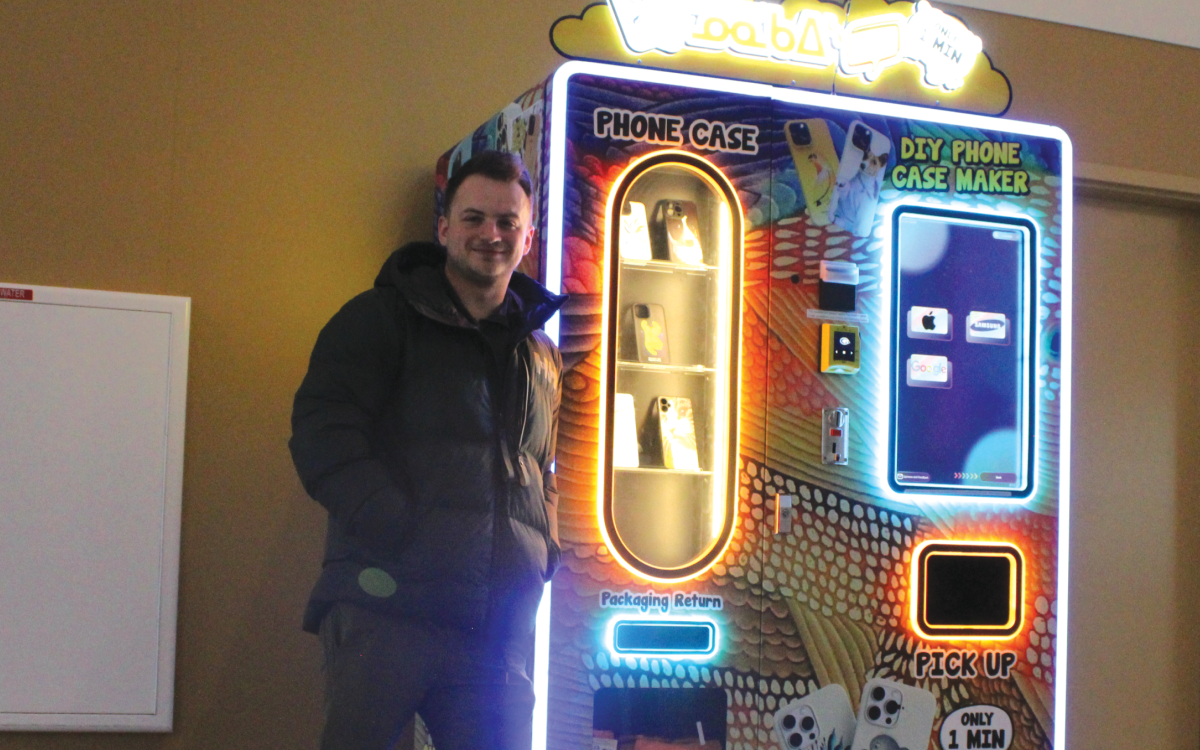
In mid-December, however, the airport levelled up with a 453-kilogram vending machine featuring flashy lights and a touch screen. “Not crapping on the airport here,” says Ivan Rainey, Iqaluit business owner and prominent techie. “We wanted there to be more fun things, especially for kids and families to do.” As he says this, he taps the screen of the vending machine and it starts buzzing. After two minutes of swooshing and clicking, it spits out an iPhone 14 case printed with “Summer Arrival” by Kinngait artist Qavavau Manumie—an image of a person flying on a bird above some branches and leaves.
The machine can print cases for 45 different kinds of phones with any photo the customer uploads to it. But Rainey’s favourites are a collection of more than a dozen Inuit prints that are pre-loaded into the machine’s system. Any time one of those prints sells, 15 per cent of its $20 price tag goes directly to the artist.
The machine is one of Rainey’s latest ventures. The nurse-turned-entrepreneur moved to Nunavut eight years ago to work at the Iqaluit hospital. After five years of saving, he bought a phone store on the first floor of the Astro Hill Complex, a local mixed business and residential development. It was a small place and things were not going well. “Oh man, we had like one leftover phone that nobody wanted to buy,” Rainey recalls. So, he rebranded as Baffin Phones, did a renovation, brought some plants and started doing small phone repairs. In just two years, it turned into the town’s main electronics hub, carrying several hundred phones at all times.
Around the same time, Rainey started selling phone cases with Inuit art from Kinngait. In the summer of 2025, he was scrolling Facebook and saw a spammy-looking ad for a phone case vending machine. When he clicked on one ad, six more popped up. Soon, he was talking to Chinese companies trying to find one he could trust. Eventually, he found a company that’s been in the business for years and would agree to ship a giant metal box thousands of kilometres to the Arctic. Shortly after, he placed the order. With shipping, it would cost him a little more than $20,000.
That was the easy part. The shipping took more than six months. Once he got the machine and the permission to put it in the lobby of the Iqaluit airport (it was an easy yes from the airport, Rainey recalls. They just wanted something), he had to learn how to program and maintain it. There aren’t many how-tos on repairing hydraulic arms in Chinese vending machines, so Rainey created an account for himself on the Chinese social network WeChat. Each time he had a question, he sent a note or a video to the company. They were quick to respond—in Chinese. It took him weeks of fiddling with the machine at the crowded airport and a lot of Google Translate to finally make it work.
Now, the machine attracts lineups of curious air travellers making themselves phone cases with a family portrait, a shot of a successful hunt or a cute cat photo. It makes 50 to 100 cases a week, and Rainey hopes he will be able to recover all the money he spent in a year—that is, if the machine doesn’t break. “Eventually, I’m sure it will break,” he says. For now, he’s trying to order as many spare parts as possible for the hydraulic arm, printer and the computer, but all of it takes months to arrive. But that’s fine, Rainey says. “If we can help people have some fun and preserve their memories from being here—it’s all worth it.”