ON A HAZY SUMMER EVENING, Forrest Doctor sits on the edge of a wooden half-pipe in his community of Ndilǫ, wearing black skinny jeans and a backwards baseball cap. “This is my dream half-pipe.” The 42-year-old slings his arm over the structure’s red-painted railing. A lifelong skateboarder, Doctor built it last winter with the help of fellow Yellowknives Dene First Nation members. “I wish I had spaces like this when I was younger,” he says.
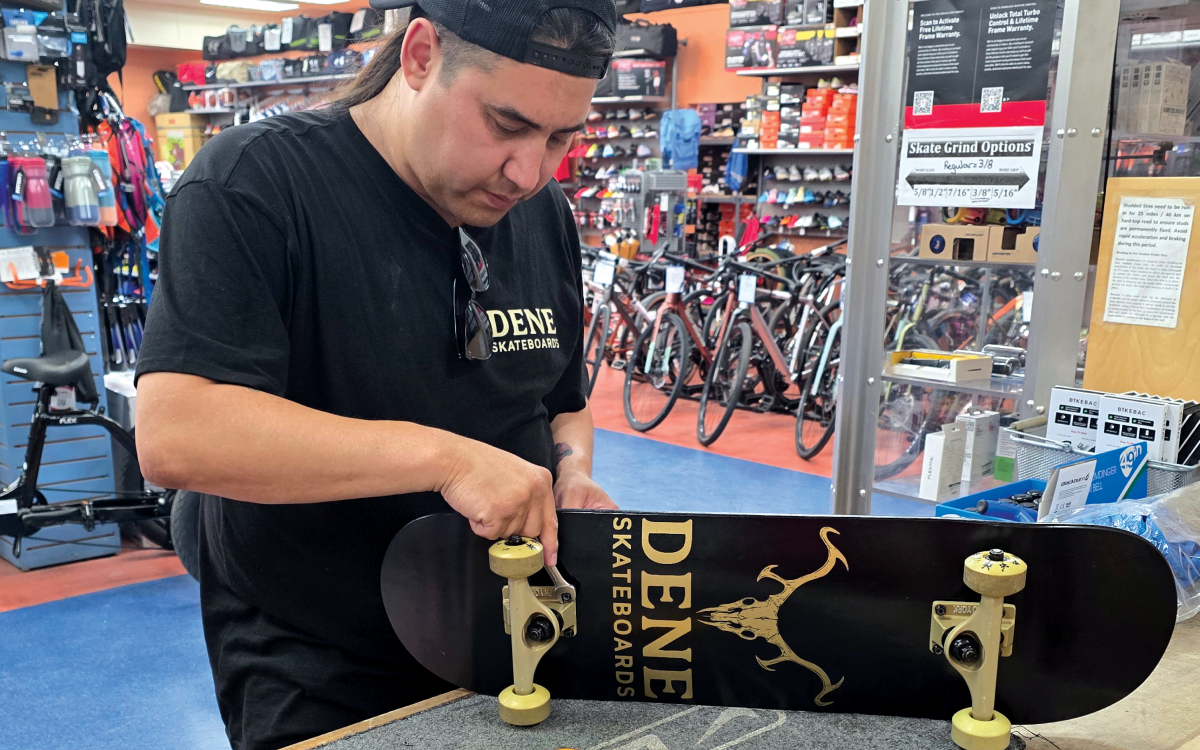
Doctor runs Skate North, a non-profit that raises funds to buy skateboards, helmets, knee pads and elbow pads for youth. He also builds obstacles, such as handrails, ramps and ledges, for public use and runs skate jams, informal gatherings where riders attempt their best tricks. Its success eventually led him to establish Dene Skateboards, a board and apparel company that aims to showcase Indigenous presence in the industry.
Skateboarding is an unlikely fit for the NWT, given the region’s long winters and general lack of pavement. But Yellowknife had a thriving skate community (roughly 50 riders) when Doctor was doing it in the 1990s and early 2000s. At 10, he was drawn to the thrill and freedom of the sport. As he got older, he was also attracted to the skate scene’s punk rock spirit. There were limited spots to ride, so everyone practised on curbs and shop railings in downtown Yellowknife. They turned Centre Square Mall’s parking lot into a skate park with homemade ramps. “There was a lot of DIY stuff,” Doctor says. “I loved it.” Sometimes, they went to Yellowknife’s grittier corners, encountering people under the influence of alcohol or drugs, which too often led to altercations.
That’s one of the reasons Doctor started Skate North in 2024. He wanted to create safe spaces for young riders and rekindle the skate scene that fizzled out in the 2010s. Skateboarding gave him a sense of identity and community. It also helped him navigate intergenerational trauma—his mother went to residential school. “I had a rough childhood,” he says. “I didn’t get to grow up with traditional values.” Skateboarding helped him cope and express his Indigenous identity. He wants to ensure today’s youth have the same healthy outlet.
“I do it for these kids,” he says as a group of children plays on obstacles next to the half-pipe.
Skate North runs on a mix of grants and donations. Last year, it received a $5,000 grant to build obstacles, and last winter, it received $20,000 to build the half-pipe. Doctor partnered on the half-pipe project with Dechı̨ta Nàowo, the Yellowknives Dene First Nation post-secondary education and training organization, which hosted a woodworking workshop. Community members received hands-on training while building the structure.
Doctor also used some of the funds to buy skateboards and helmets, which he’s been giving to youth for free. Recipients are sometimes selected through a draw, but, mostly, Doctor gives gear to parents and kids who ask. So far, he guesses he’s given away more than 50 boards.
Shelly Lafferty received three of them. The Fort Smith resident gave one to her 16-year-old daughter, Lilith Janvier. With the help of a seasoned skateboarder in Fort Smith, Janvier has been assembling the two other boards to give to youth in the community—proof, Lafferty says, that Doctor isn’t just giving away boards but creating opportunities and building connections. Already, Janvier has noticed it’s getting teens out of their houses.
That’s meaningful to Doctor. Early on, people didn’t take his work seriously. But since he built the half-pipe, Skate North has greater visibility. He consistently meets new people in the skate park in Ndilǫ. On Facebook, Skate North’s videos now get up to 4,000 views, a huge jump from the roughly 40 with which the organization started. Residents thank him for his work and want to get involved. As if to prove the point, a man driving past the half-pipe recognizes him and offers to build Dene Skateboards a website for free.
Doctor’s company was an unexpected outcome of Skate North’s popularity, mixed with unfortunate personal circumstances. Awareness of the organization was growing when Doctor, a heavy equipment operator, could no longer work due to injury.
“The thought of staying home and not doing anything just killed me,” he says. While waiting for knee surgery, he chased his dream of starting a skate company. His daughter, Meka Boline Doctor, designed the graphic for his first board — a gold caribou skull—and he had a small order manufactured
in Quebec.
Skateboard parts are deceivingly expensive. A fully assembled, high-quality skateboard with trucks, wheels and bearings can cost up to $500. Doctor’s boards alone retail for $105 to $120. He sells them online, at the Yellowknife farmer’s market and at Rumor Boardshop in Edmonton and Leduc. He also sometimes donates his boards to Skate North.
His second batch of boards features the original design and two new ones—an aerial photo of Latham Island, where Ndilǫ sits, and a graphic of a raven, skull and flowers, designed by Plains Cree artist Alex Peechow. And he’s started working with Print and Platen, a 100 per cent Indigenous-owned printing company based in Edmonton, Alberta.
This is just the beginning though. Doctor is currently assembling a team of Indigenous riders from across Canada to represent the company and showcase their skills through videos, photos and ads. His first team member is Tre Stonechild, a Cree skater from Saskatchewan.
It’s an ambitious plan for someone who’s new to running a business. The past few years have involved a lot of learning, solving problems as they arise and turning to other business owners for advice. The challenge hasn’t dissuaded Doctor, who still has the punk rock approach that drew him to skating in his youth.
“I have those DIY ethics,” he says. “That’s how you get things done.”