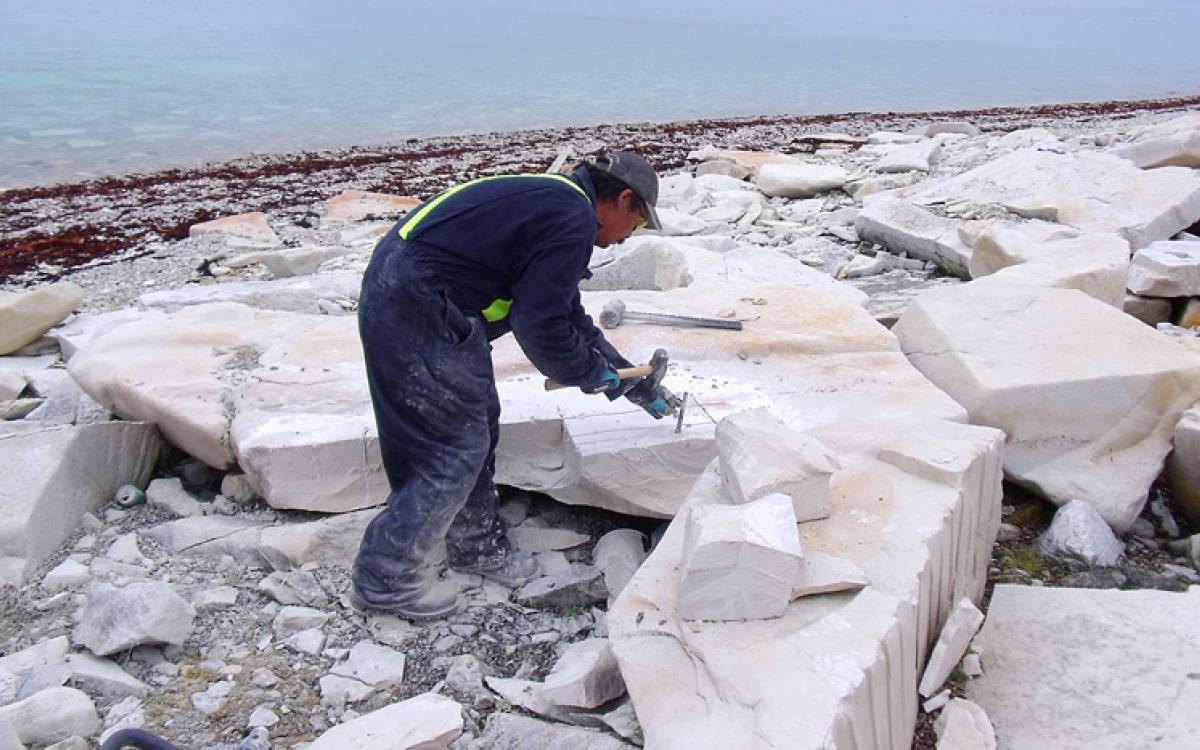
Jerry Ell is a soapstone carver from Iqaluit. Or artisan serpentinite carver, to be exact, as most carving stone in Nunavut is not actually soapstone (that’s just what most artists call any rock good enough for carving). Regardless, Ell not only selects good carving stone; he quarries it himself. So if you think a $1,000+ price tag on a carving is a little steep, read this and think again:
Step 1: Gathering a crew. The stone has to be quarried and carried by hand. And it’s heavy. Six strong backs are required to work a big site.
Step 2: Get there. For Ell, it takes anywhere from three to seven days, depending on sea ice and weather conditions, to reach a quarry site at Korok Inlet by boat, hundreds of kilometres west of Iqaluit.
Step 3: Set up camp. Most sites are far from any settlements, so the crew needs to be self-sufficient for a week or more. Ell buys some food from the store, but also harvests seal, fish and caribou along the way.
Step 4: Clear the rubble. Carving stone isn’t just lying on the ground ready to be picked up. The best stuff is usually buried underneath smaller waste rubble–which takes a couple of days to shovel off.
Step 5: Grade the stone. While Ell's on site, he tests the hardness of the stone, examines its colour, and chips away at it with an axe and a file. That gives him a better impression of which stones he wants to take back.
Step 6: Start quarrying. Now for the heavy lifting. Once all the rubble is cleared, sledgehammers and chisels (or a generator and jackhammer if you’re lucky) are used to break off pieces big enough for carving. (Explosives aren’t used because they would ruin the stone for carving.) Over a two- or three-week period, Ell says he can extract up to 35,000 pounds of stone. “The first few days you’re not producing much. But the next few days you can extract as much as you can pile up and store for winter pickup or to bring back with you by boat.”
Step 7: Load the boat. At Korok Inlet, the quarries can be several hundred feet away from the shore. “You’re moving all that weight, all those pieces, up and down that gully just to get it on board your own boat,” says Ell. You need to be in shape for this, he adds—“or in my case you eventually get a herniated disc out of it.”
Step 8: Head back to town. What’s another few hundreds of kilometres by sea? If the weather’s good, the trip takes just a few days.
Step 9: Get it to market. Once back in town, they either sell the stone, or use it themselves. All together, the stone costs about $1.50 per pound to quarry and transport back. Ell says they sell the raw stone for about $2.50-$3.00 per pound.
Generally the impression is still out there that we just pick ‘em up off the ground. Just walk along and pick them up here and there…there’s no understanding or appreciation how much effort it actually takes to get the carving stone into the artists’ hand in the community.
By-the-numbers: 2.0—Ideal hardness of carving stone on the Mohs scale of mineral hardness, with 1 being talc and 10 being diamond 103,000—kilograms of carving stone an Inuk is allowed to gather per year in Nunavut 100—number of qamutiqs, or sleds, you’d need to move that amount across the tundra 26—total known carving stone quarries and deposits in Nunavut 500-800—tonnes gathered each year by carvers in Nunavut. (Source: GN, Dept. of Economic Development and Transportation)
[view:image_galleries=block_1=1833]