TEDD TUCKER is comforted by the whir and drone of power tools coming from the auto glass shop below the Whitehorse office of his one-man graphic design business. The sound reminds him he’s part of a community of people who enjoy working with their hands. Tucker himself left a career in marketing because he wanted to develop and express ideas the way he had as a kid—by drawing. Seated at his desk, he’s surrounded by healthy plants, a wall of bright posters and a record player. There are some big screens and a tablet he uses for drawing, but Tucker considers himself a Luddite. A shelf of sketch books is full of pencilled studies and ideas for the logos and branding work he does. He also makes children’s books, greeting cards and art prints—and never uses AI. “There’s an inhumane element to it,” he says. AI can be shiny and visually interesting, but good art is a process, not a product.
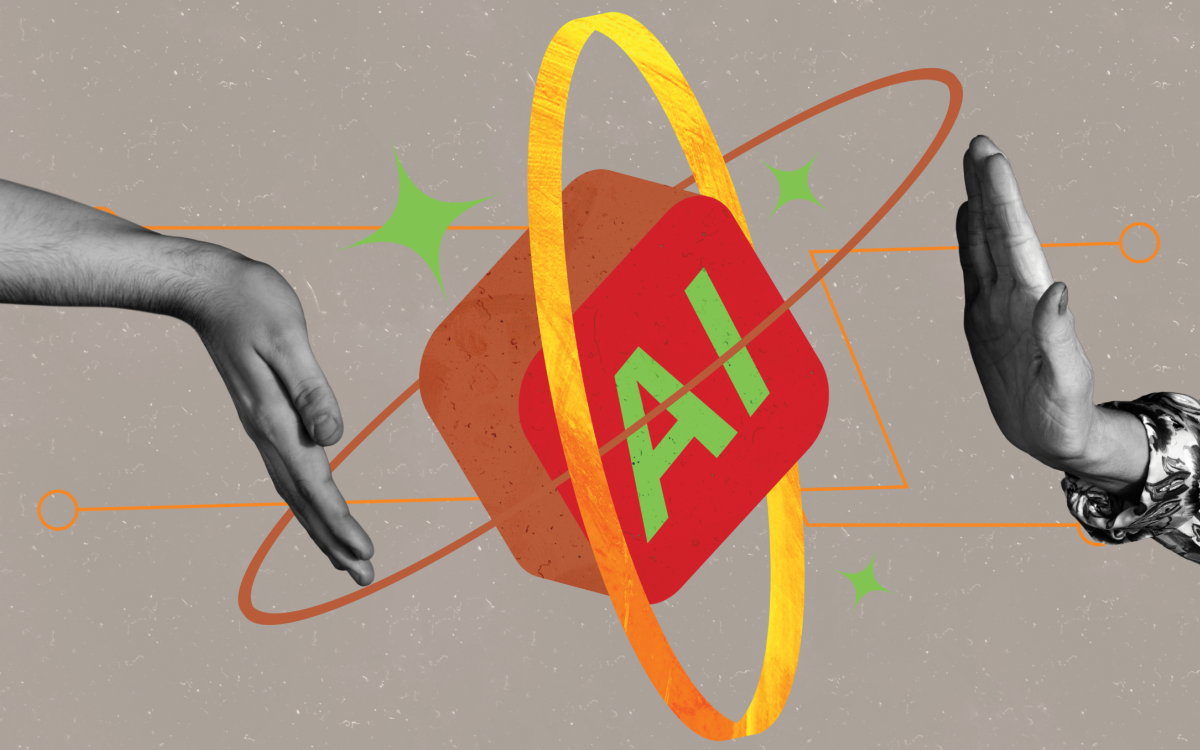
Tucker is one of many northern artists navigating the proliferation of AI-generated work in a field originally defined by craftsmanship and creativity. With municipal and territorial governments slow to establish guidelines around procurement and AI, some artists are wiping their work from the internet for fear of copyright infringement and theft. Not being online makes it even more difficult to gain recognition outside the territories though. Beyond copyright risks, some fear generative AI will cost designers and creators their jobs, while others are tempted by the cutting-edge possibilities offered by programs such as ChatGPT, Copilot and Adobe Firefly. Regardless, AI is here to stay, and northern creatives are being forced to find ways to coexist.
Casey Koyczan believes art and technology can grow together. The Dene artist has been fascinated by tech since he was a kid playing video games in a cabin outside Yellowknife. Now, as a 3D animator, tech breakthroughs offer vital tools and time-saving hacks (he uses LiDAR to scan trees and fungus for his installation work). Still, he’s staunchly anti-AI.
Koyczan uses technology, including
editing software and digital drawing tools, but it’s not autonomous. If it was, there would be no process, which is the part of the job where he learns and develops skills. AI eliminates that education by providing an answer before you can have a question. It responds to prompts in a text box, spitting out content built on an amalgamation of images and ideas dredged from the internet. The image will be original, in that it won’t exist elsewhere. But, says Koyczan, it won’t have a soul. So much of what goes on in an artist’s mind when they’re creating is embedded in the work. “I am implementing my thought process,” he says. “As an artist, you’re basically taking a part of your soul and putting it out there for the world to look at.”
Koyczan has made animations inspired by Indigenous art and life materials that are reminiscent of humans and spirits. People have assumed they were generated by AI, in part because Adobe recently came under fire after its stock platform was found to host AI-generated “Aboriginal art” and partly because sites like Etsy are awash in AI-generated Indigenous-style work. Created in seconds, these pieces have no kinship, country or cultural obligations. Many consider them to be not only cultural appropriation but theft. Koyczan and other digital creators have had to defend their work against false claims that it’s AI-generated, by posting proof including time-lapse footage of themselves working at their desks, building scenes or models. “It’s quite insulting to a 3D animator for someone to label your stuff as AI,” he says, “when we’ve spent hours, days—sometimes even months—working on a single piece.”
AI can taint reputations in other ways. Teagan Beemer is a Whitehorse artist who sells her prints and hand-drawn stickers at Yukon markets and local galleries. She does the odd commission, creating illustrative work. Last year, a client paid to license one of Beemer’s pieces to use on a product. She was happy with the arrangement, until she discovered her work had been altered by AI without her permission. The forest scene she’d drawn had been extended using AI. “It just looked bad,” she says. “The trees looked distorted and now people think I did that.” It also goes against Beemer’s ethics. When businesses create ads and promotional material with AI, she says, it steals jobs from graphic designers and artists, as well as their ideas.
That’s because AI is a hunter. “It’ll go right into your hard drive like a vampire, if you let it,” says Chris Caldwell, a Whitehorse artist best known for her humorous cartoon animals carrying out human activities. She recently scrubbed almost all of her art from the internet so AI couldn’t steal it.
Caldwell has made a living as an artist, with commissions for murals, beer labels, mugs, art cards, shirts and pet portraits. Her website helped promote her work, especially outside the Yukon. Now, after taking most of her work offline, Caldwell is only doing pet portraits. Clients write to her about their pet’s personalities and quirks. It’s like a dating site, she jokes. “‘Hi, I’m Bob the dog. I like to ride shotgun, etc.’ I incorporate all that into the drawing.” AI blends data to create an image, but it doesn’t reveal unique personalities. It couldn’t capture Bob the dog.
In fact, the images AI produces are often unnerving, verging on grotesque. Caldwell has seen mock-ups of people riding moose, with disquieting subtleties, such as reins coming out of the moose’s neck, horses with five legs or bears with missing paws. That’s part of why it’s so easy to spot AI art, though there are less obvious tells. Tucker has started noticing AI-generated cards, stickers and other work at local craft markets. The styles are erratic; there’s no consistency. To combat this, Whitehorse’s Fireweed Market altered its guidelines to disallow “artwork created fully or partially using AI or generative tools.” The board has also been working with digital artists to help identify AI-generated work, while the Yukon Crafts Society, which runs one of the largest craft fairs in the territory, is reviewing its policies and updating bylaws to safeguard authenticity. Meghann Morrison, YCS’s social media representative, calls it new territory. “We acknowledge that AI is here to stay,” she wrote in an email. “It can be a useful tool, and part of our role is thoughtfully navigating how these technologies intersect with art.”
Territorial governments are working to update policies surrounding AI as well. Internally, the Yukon government requires all AI-generated imagery or content to be explicitly cited. Microsoft Copilot is the only tool approved by the government’s chief information officer, but each department is free to review and approve its own tools in accordance with the government’s privacy and security standards. The NWT and Nunavut have no specific government policy focusing on AI and visual arts. Koyczan says not enough is being done to protect legitimate artists from the infringement of AI on their work. Beemer has seen the Yukon government use AI-generated imagery for some of its promotional material, including on a poster in June, to promote the Yukon River Quest. “They’re absolutely not doing enough,” she says. “There’s no reason to be using it when they have access to the resources to hire artists, designers and photographers for their promo materials.”
In the North, missteps enter an instant community feedback loop. While some Yukoners “liked” the government’s River Quest poster, many more criticized it. Last February, Air North was dragged for an online ad that used AI. Within a day, the company’s chief commercial officer, Benjamin Ryan, was on local CBC programs to respond. He called negative reactions to the ad “relatively minor” compared to the sales it generated. “We have to find a way to grow the market,” he told CBC. “And in doing so, we’re encouraging our team to be experimental.”
There are artists who are experimenting as well. In May of 2023, Inuk artist Agaaqtoq appeared in a YouTube video documenting the process of co-writing a song with ChatGPT. In it, he’s hunched over a laptop typing commands. “Please write us a song in Inuktitut with two verses and a hook,” he says in the video. “Make the rhyme pattern ABAB. The subject should be about a man who goes into space looking for other musicians who can play instruments other than his own instrument, which is drums. After each section, please include a short description in English.”
Within seconds, the program spits out lyrics and the Arviat musician begins reading them in the guttural rhythmic timbre of Inuktitut. “Does this make any sense?” asks Agaaqtoq’s collaborator Thor Simonsen, a Danish-Canadian singer who grew up in Iqaluit. “Is it real?”
Tempted by the novel simplicity of writing a song using AI, Simonsen and Agaaqtog made history, creating what is widely recognized as the first Inuktitut song created in collaboration with AI. Fusing modern technology with traditional Inuit culture, the artists remain open to its creative potential. “The astronauts travel to the sky…guitar players, guitar players…,” reads Agaaqtoq. “That’s cool.” But he’s reading the English translation. He doesn’t understand the Inuktitut that AI generated. Maybe it’s Kalaallisut, the main Greenlandic Inuktitut dialect, he says. After working out the melody and chords on guitar, Agaaqtoq and Simonsen decide to release the song, though there’s some debate about how to credit it—AI featuring Thor and Agaaqtoq? Before they can, however, they speak with Greenlandic speakers and find out the lyrics are actually a strange kind of Inuktitut gibberish.
It’s one example of why Koyczan dislikes AI. The tool could be used to help find a cure for cancer or develop light speed travel. But it’s also responsible for fake newscasts and a huge volume of the misinformation that makes it tough to tell fact from fiction. And it has a significant environmental impact, says Beemer, with data centres requiring massive amounts of water to cool and trillions of dollars to operate. If AI data centres are proposed in the North, Koyczan plans to stand on the frontline and protest. “It may be only a matter of time,” he says, “but I hope that never happens.”
Railing against it can feel as pointless as a horse-drawn carriage resisting the invention of cars. “You can’t fight it because of course a car is cheap; a car doesn’t require the same level of maintenance as a horse and a car doesn’t have physical limitations,” says Caldwell. That’s what the digital revolution has become—it’s about instant gratification. People want cheap and free. “Our skills will be usurped by robots eventually,” she says. “And those that benefit don’t care because they can get the art for free.”
Koyczan would like to see an age limit keep young minds away from AI. He says it does a lot to their brains and mental capacity. When he was five, he was eating dirt. Now, there are five-year-olds on iPads programming apps. “This may not be a popular view,” says Koyczan, “but I really feel the general public should not have access to AI. I don’t think we’re ready for the type of power that it has or the way that people choose to use it.”
This isn’t the first time a new technology has come for an industry. Machinery was part of the agricultural revolution, resulting in fewer jobs on farms. Mechanized textile spinning once put weavers out of work. Maybe AI feels more dire because, besides cutting into employment opportunities, it’s gutting that sense of soul Koyczan talks about. Art is borne of an artist’s experience and emotions. What does it mean if we outsource those?
In a dystopian future, where robot overlords run everything, Caldwell imagines humans relearning to draw by moving a stick through sand. Handmade artwork will somehow prevail, she says. “The evolution of art is alchemy—you can’t silence art.”