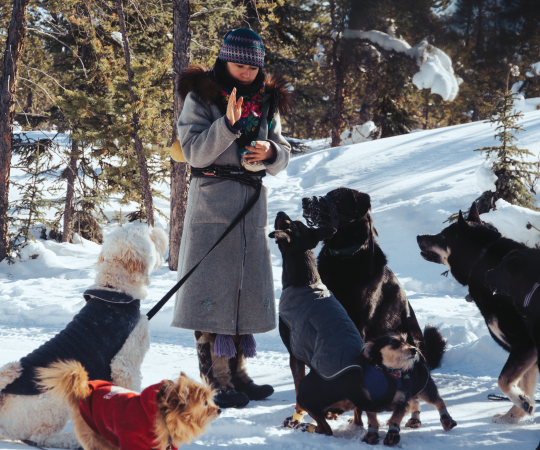

TERESA SAMSON pushes a button and a three-dimensional Elder appears on-screen, telling stories as she makes snowshoes. With another couple of clicks, coniferous trees and lichen-covered rocks appear, and three animals—a wolf, a grouse and a crow, voiced by Elders—teach you Northern Tutchone as you walk through the forest. Samson, who is heritage manager for the First Nation of Na-Cho Nyäk Dun, demonstrates these immersive experiences on what looks like a white commercial refrigerator crossed with a giant Barbie box in the First Nation’s office lobby. The machine’s touch screen pulls up holograms of Elders and games that teach Northern Tutchone words, a byproduct of Na-Cho Nyäk Dun’s efforts to document its specific dialect of Northern Tutchone, of which there are just six fluent speakers left.
The First Nation wanted to come up with an interactive way for citizens, especially young people, to learn the language. The result is this project, launched in 2025 and called Kwän Dék’án’ Do, which means “to keep the fire burning.” It will use artificial intelligence to come up with Northern Tutchone words for English terms that have never existed in the First Nation language—terms that will then be vetted by Elders to ensure they make sense. The fridge-like machine is the project’s delivery mechanism, with Na-Cho Nyäk Dun planning to launch a remote connection so citizens can play the games or listen to the stories on their phone or laptop. “It’s Duolingo on steroids,” Samson says with a laugh.
Na-Cho Nyäk Dun is at the leading edge of a new era of technology and language. In the last few years, Indigenous communities and governments in Canada have begun using AI to preserve and revitalize their languages. According to the Assembly of First Nations, all of the 60-plus Indigenous language dialects spoken in Canada are critically endangered, except Inuktitut, which is one of Nunavut’s official languages. Typically, Elders hold this knowledge, but as they age and die, the languages lose speakers. Across the North, First Nations and Inuit are turning to technology to reverse the trend. In some ways, employing AI in this quest makes a lot of sense. AI is good at “reading” hundreds or thousands of documents and identifying patterns. But there are also big risks, depending on the type of model used and whether Indigenous communities retain ownership of their language resources. The best practice when using AI for language preservation? Tread carefully.
Whether we love it or hate it, artificial intelligence is creeping into our lives more and more. AI-generated images are all over social media and the top answer for most Google searches is an AI-generated response, based on the company’s tool scraping the web and pulling information it finds into an answer. These AI responses aren’t fact-checked by a human, so incorrect information can appear in an AI-generated answer and be presented as truth. This is one of academic Michael G. Sherbert’s main concerns with generative AI, the type of tech that includes ChatGPT, Gemini and Claude. These tools can create new content (such as AI-generated images) based on massive sets of data (such as the entire internet). One of the problems with generative AI, says Sherbert, a member of the Algonquins of Pikwàkanagàn First Nation and a postdoctoral fellow at Queen’s University who studies Indigenous perspectives on artificial intelligence, is that it’s designed to give you an answer. If it doesn’t know something, it’s probably not going to tell you that. With generative AI, “hallucinations” are fairly common—when the tool sees non-existent patterns and provides inaccurate information.
Because generative AI scrapes the internet, Indigenous languages and cultural knowledge are at a disadvantage to “Western” or European languages and history. That’s because so many of the former aren’t digitized or thoroughly documented online; they’re more commonly shared orally. So, Sherbert says, generative AI is more likely to cite Western or colonial perspectives in its responses. Another hazard is its tendency to flatten Indigenous cultures and groups. For instance, if you ask ChatGPT for an Algonquin story, it might provide you with a similar Cree story but not specify that it pertains to a different nation. “It could use any kind of information that it thinks may be relevant and then give it as some kind of pan-Indigenous knowledge, so that you lose cultural specificity from nation to nation,” says Sherbert.
Many Indigenous languages are fragile, with few speakers. An error in translation conveyed via generative AI could have a significant impact on a language because its dataset is so small. Even further, many Indigenous languages are polysynthetic, with words that convey more complex meaning. For instance, one word in a First Nations language could translate to a whole sentence in English. Dinjii Zhuh K’yuu, the language of the Vuntut Gwitchin First Nation in the Yukon, is contextual, says Dana Tizya-Tramm. He’s a director of AI non-profit Nadlii and a former Vuntut Gwitchin chief. “We don’t even have, for instance, a ‘north,’ ‘east,’ ‘south,’ or ‘west’ in our language,” he says. “You have to understand which ways the rivers are flowing to, therefore, understand the directions.”
These complexities are why language preservation projects in the North are involving Elders in the verification process. Over the past few years, Microsoft has worked with the Nunavut government to add Inuktitut and Inuinnaqtun to its Translator app. Microsoft’s AI was fed reams of public documents to train it on the languages, then the government hired Inuktitut speakers to fact-check the work. The project was heralded as a huge win—it made these languages more accessible, allowing for better communication in health care and workplaces and within families. But, among Northerners working in the AI sector, there was an obvious downside: The government had handed over its data to Big Tech.
Data sovereignty refers to the concept that countries or Indigenous nations should maintain ownership of their data. In the case of languages, that can be done by keeping resources within a closed digital network, also sometimes called a structured knowledge system, that isn’t publicly available. By using this model, an Indigenous government or community can control what goes into its AI—for instance, only language resources that have been verified by speakers. And it means that these resources are protected and can’t be scraped off the internet by ChatGPT or other tools like it.
With a structured knowledge system, you could ask the AI the Algonquin word for beaver, and if it had that translation in its database, it would tell you: amik. The downside of this model is that it’s basic—the AI can search its library, but it can’t offer additional context or use amik in a sentence. “It’s like you have a robot going into a lock box with a bunch of files,” Sherbert says. “It can retrieve a file that it determines is relevant.”
Cole Robulack sees great benefit in this approach. The 22-year-old Vuntut Gwitchin citizen is the CEO and co-founder of Fireweed AI, a company that’s building a private AI tool for First Nations governments and development corporations. Fireweed’s tech is still at an early stage, but the goal is increased efficiency: Clients will have their own AI and database, and their information stays within their own network. The AI will be specific to the client, since it will have “learned” from the First Nation’s data, including policy documents, cultural information and final agreements. It’ll speak that First Nation’s language, says Robulack, both literally and metaphorically. And Fireweed’s clients will retain ownership of their data.
This is also the type of tech developed by Heritage Lab. The non-profit was founded in 2024, in response to a decline in Inuktitut in Nunavik—and to AI-generated books for sale on Amazon that purport to teach the language. Heritage Lab has developed an online dictionary that has recordings of real people speaking words aloud; a tool that converts syllabics to the Roman alphabet; a document scanner that recognizes English, French and Inuktitut; and an AI character called Ayaguta, to whom you can ask questions about Nunavik artists.
Heritage Lab is also developing a language app, using artwork made by real artists—not AI. A language committee verifies all the words used in the non-profit’s system. “It’s very exciting, but there’s a sense of urgency at the same time,” says president Lisa Mesher, an Inuk who grew up in Nunavik. She and her team have been in talks with First Nations across Canada about how Heritage Lab’s model could be applied to them—in one case, for a language that has just 10 speakers left. One barrier is that the organization has no consistent long-term funding.
Another challenge for these projects across the North is an overall wariness of AI in First Nations and Inuit communities. The concept of data sovereignty can be difficult to grasp since data isn’t tangible or visible. Not everyone yet understands the value of keeping resources in a private digital system, but those in the know liken big tech companies’ approach to colonialism—taking Indigenous communities’ data without permission. So, education is part of the work of Heritage Lab, Nadlii and other initiatives like them.
Environmental ramifications are another reason for hesitation. Generative AI, and the data centres that house its servers, requires large volumes of water to cool the equipment, as well as huge amounts of electricity to power computation. Since Heritage Lab’s dataset is small—Nunavik dialects of Inuktitut—the system runs on a computer the size of a toaster, which uses less electricity than an incandescent lightbulb. The data is stored at Mohawk Internet Technologies, a data centre in Kahnawake, Quebec. Tizya-Tramm is pursuing something similar with Nadlii: modular data centres powered by renewable energy on Indigenous land—with Indigenous nations’ approval. “Indigenous people need to be able to take control,” Sherbert says. “They need to have data sovereignty over their information.”
Robulack thinks of his great-grandfather, Patsy Henderson, who was part of the group whose discovery sparked the Klondike Gold Rush, and how that strike negatively affected First Nations through displacement and exclusion. “We watched as others benefited from what was found on our traditional lands,” he says. “I think AI is, in many ways, a modern-day gold rush.” But it’s one from which First Nations should benefit this time.
IN MAYO, Na-Cho Nyäk Dun continues to keep the fire burning. It’s partnered with Carleton University and the federal Office of the Commissioner of Indigenous Languages on Kwän Dék’án’ Do. Now, the First Nation is using AI modelling and photographs to create a virtual-reality experience in which you can accompany Samson’s great-grandma Mary to the community’s grocery store. She buys ingredients to make bannock and then, back at her house, she teaches you how to make it, all while speaking Northern Tutchone. Then, another Elder named Lucy stops by, and the two women go to a campfire and have a cup of tea, and Lucy tells you a story in Northern Tutchone. At first, Samson says, Elders were wary of the project. They didn’t want to be recorded, and they wanted to know who would own the material. Once they understood that the interviews were for younger generations and the First Nation would keep the recordings, they grew keen to talk on camera.
One late Elder was a big advocate for the initiative. Jimmy Johnny would come into Na-Cho Nyäk Dun’s office every day, encourage Samson to speak Northern Tutchone and tell staff that, if they didn’t speak their language, they didn’t know who they were. Last year, when Samson presented the machine at a conference in Ottawa after Johnny’s death, she brought up his hologram on the screen. She heard gasps from the Yukoners in the room—the appearance was so realistic, people thought he was really there.
Samson tears up as she talks about what the project means to her. “My grandma was a language teacher, my great-grandma was a language teacher,” she says. “It’s carrying on their legacy and what they thought was important.” It’s also, she adds, pushing back against generations of cultural genocide. “You’re showing that you have honour and you have place and space and identity and uniqueness.”
Correction, Sept. 9, 2026:
A previous version of this story referred to Lucy as Samson’s grandma. In fact, she is not Samson’s grandma.