Peter Wright is used to men with semi-automatic machine guns and bullet-proof vests busting into his Vancouver office. They’re there for the bags of gold, which the Dawson City placer miner regularly ships off to Italy. “It’s like a James Bond movie,” he says.
Wright deals in gold salvaged from old mine sites, a hot commodity that has brought him big clients, such as Apple, and luxury jewelry designers, including Tiffany & Co. and Mejuri. He didn’t believe it when he first heard Tiffany’s and Apple wanted his gold. “I thought it was all BS,” he says, “until two helicopters came flying up to Dawson a few years ago with this whole Apple crew from New York City.” They were there to see his claim at Sulphur Creek.
Flying into Dawson, Apple’s people saw grey snakes of waste rock coiling through the landscape, like giant worm castings. Remnants of the Klondike Gold Rush, these piles were left by the massive wooden dredges that slowly churned through the sediment sifting gold from gravel. The dredges found a wealth of gold and missed lots more. The banks they cut are still full of it, as are the tailings snakes. Plenty of placer miners are pulling gold from these dregs, but Wright is one of the only ones also getting paid to clean it up.
With growing awareness surrounding the environmental and ethical impacts of mining and a focus on where minerals are sourced, Wright is on the cutting edge of a movement that could reshape the face of both small- and large-scale mining in the North. In 2019, he teamed up with Regeneration, a young U.S. company that supports miners working abandoned sites to pull precious metals from waste while funding real remediation efforts. “A lightbulb went off when I flew over Dawson City and saw all those tailings,” says Regeneration president and CEO Stephen D’Esposito. “I realized that, instead of just focusing on do-good projects, we needed ones that were also environmentally viable.” That’s when he spawned Salmon Gold—an initiative that remines old sites while restoring habitat for salmon, grayling and other wildlife. When D’Esposito pitched the idea to Apple and Tiffany’s, both agreed to fund it.
Mining is in Wright’s blood. His dad had a placer mine near Atlin, B.C., and he grew up in the industry, though he took some time away from the Yukon, working to remediate old placer claims in B.C. and to ski. (Wright also owns Yukon Heliski, an outfit that operates in the White Pass summit on the border of the Yukon, B.C. and Alaska.) When he started mining in the Klondike, Wright was struck by the legacy of the Gold Rush’s environmental devastation, with an old dredge on his claim acting as a steady reminder. The forest was gone, with the creek just a trough of water finding its way through a moonscape of mud and crushed rock. “I want my daughter to grow up with creeks full of salmon and grayling,” says Wright, “not a landscape destroyed by mining.”
His mine is just one of three in the Yukon and Alaska supported by Regeneration. The organization connects its miners with local communities, governments, restoration experts, scientists, engineers, architects, manufacturers and brands so they can produce gold while also carrying out meaningful restoration and recreating healthy habitat for anadromous fish species (those that migrate from freshwater to the ocean). “All mines could be doing this,” says D’Esposito.
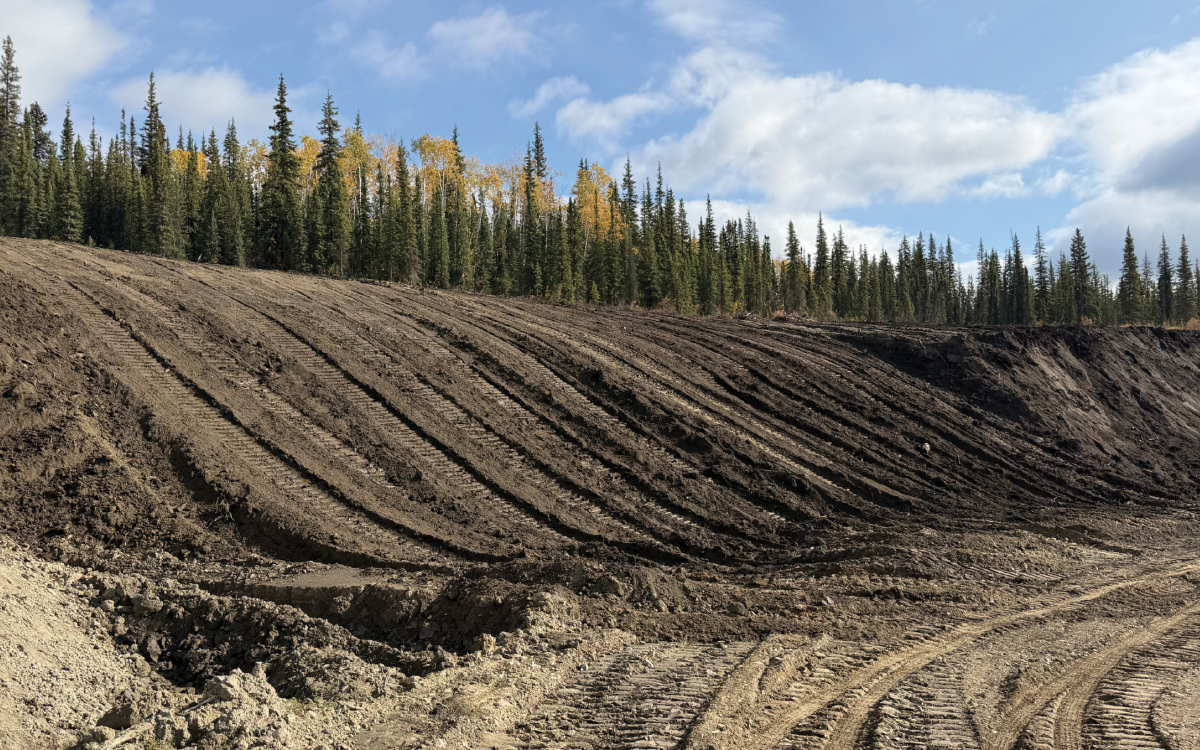
After he’s pulled gold from parts of his claim, tearing up the terrain in the process, Wright works with environmental architects out of Vancouver, who help design the streams and landscapes he’s remediating. He also separates the topsoil that gets disrupted during mining, piling it in a huge heap to later help resurface the area. The berries and grasslands that spring up the following year are full of native plant species, including some that grew during the last ice age. “We are getting plants that were here during Beringian times,” says Wright. “This black muck is frozen permafrost. It’s 60,000-year-old material made up of organic loam and ancient seeds.” As well as keeping the topsoil, trees that are cut during mining can later be used to line remediated stream beds while waste rock can help reinforce new lake bottoms.
New sites are constantly being brought to the attention of Regeneration. “The world is our oyster,” says D’Esposito, who’s turned the historical paradigm—where mines haul out ore, leaving remediation as an onerous afterthought—on its head. “We found these companies that know how to get precious metals out of tailings and flipped it, working with communities and First Nations to see what good restoration looks like.” It’s a “jiu-jitsu” move, he says. “We are a restoration company that is really good at getting metals out of waste and getting the right people together.”
It was D’Esposito who connected Wright with Mejuri. The Canadian fine jewelry brand was founded with a focus on sustainability. Its CEO Noura Sakkijha—a fourth-generation jeweller—was eight months pregnant with twins and still fundraising for her new company when she realized she not only wanted Mejuri to be around for her children, she also wanted the business to be something they would be proud of when they grew up.
Mejuri—which has become a global brand in the decade since it was founded in 2015, with more than 60 stores worldwide—ensures 90 per cent of its gold comes from recycled sources. This includes second-hand jewelry, melted-down electronic waste and mines like Wright’s. The other 10 per cent comes from mines it has vetted. The female-led company has a woman’s empowerment fund that supports education and business initiatives, such as an all-women-run gem-polishing operation in Zambia. This adds value to raw gems that are otherwise shipped off for polishing in countries such as China. The fund also contributes to scholarships in Canada, the U.S. and the U.K. for aspiring women jewellers.
Regeneration, however, remains Sakkijha’s favourite initiative. “It’s because we are fixing what mining sort of broke,” says Holly McHugh, Mejuri’s vice-president of Sustainability and Social Impact. “Can we put these places back together? Can we fix not only the harm done in these communities but the harm done to these habitats?”
Mejuri created a Salmon Gold line using only gold sourced from Wright’s Sulphur Creek claim and two other placer operations in Alaska that also joined Regeneration’s remediation initiative. “We had to create our own supply chain to do this,” says McHugh. “We had to get manufacturing partners for each step.”
Gold is highly regulated. It’s difficult to separate and trace small batches of the refined metal as it’s shipped around the world. “Our partners’ willingness to make those purchases that are outside the box, to develop those relationships that are outside the box, to hold the material in a different way, be willing to keep this material separate and only make this product from that material is really a special relationship,” says McHugh.
The whole process is unique. Wright flies his gold to Vancouver in a backpack, where it’s taken by machine-gun-toting Brinks guards to be shipped to a small town in Tuscany. There, it’s processed by Italpreziosi, a woman-founded-and-led precious metals refinery. Though it’s more work and less cost effective, Italpreziosi is willing to do small-batch refining so that all the Salmon Gold remains isolated and traceable, rather than being mixed in with bigger batches. It’s then sent to Thailand to be made into sleek, subtle rings, earrings and bracelets that Mejuri retails from $700 to $1,300.
Last year, Wright’s mine and Regeneration’s two Alaskan placer mines produced 10.5 kilograms of gold for Mejuri. “It’s just jewelry,” says McHugh. “It’s not critical. We’re not saving the world with jewelry, but this gives us an opportunity to repair these locations in North America while making something really beautiful. And when our purchase of this material goes back into funding the restoration of these places that have seen harm because of mining, that’s a powerful story.”
Out at Sulphur Creek, a big dozer is pushing prehistoric dirt around, smoothing it over the crushed rocks and gravel left behind by old placer operations like icing over a cake. Nearby, a grassland with raspberry bushes, heavy with berries, frames a meandering stream full of grayling and other fish. The stream flows out of Lily Lake, a body of water Wright named for his 10-year-old daughter. The little girl loves coming to his claim now to watch the beavers, look for lynx, eat berries and catch frogs.
Wright bought some of Mejuri’s Salmon Gold jewelry for Lily and his wife. “It’s beautiful, with salmon swimming around on a pair of earrings,” he says. “And to know it is our gold. It’s so different from just getting a ring made with a bunch of raw nuggets glued in.” McHugh has some of the Salmon Gold line, too. She buys it for gifts and wears it when she attends high-level functions. In September, she spent a week in New York City sitting on the UN Global Compact, which aligns companies with universal principles on humans rights, labour and the environment. “There is a huge push right now to ensure minerals are responsibly sourced,” she says, “across tech, automotive, jewelry—it’s all linked.” It’s like a massive Venn diagram. “For us, it was exciting to find an organization like Regeneration, doing something so central and connected to our supply chains as well as focusing on social impacts and the planet. Frankly, it’s unusual.”
It’s kind of like building a hockey team, says D’Esposito. He seeks out miners, environmental engineers, international brands, supply chain experts, scientists, government agencies and funders, then connects them. “All of a sudden, instead of being out there on your own, you have this global network where you can find expertise and resources.”
When Wright wanted to make spawning beds for salmon and grayling, D’Esposito already had biologists at his fingertips. Often, remediated streams and rivers are rebuilt too straight and, as a result, flow too fast. This is the result of companies quickly and cheaply complying with cleanup requirements, with little thought given to how their work may impact the wildlife that depend on waterways. Wright was advised to put in twists and turns, where the water slows in eddies, creating an ideal place for fish to lay eggs. He creates shallow ponds for frogs and tadpoles and leaves loosely fluffed bank material well out of the wet zone as nesting habitat for thousands of brown mice. The mice feed the foxes, wolves, bears and lynx that frequent his claim, while moose come to eat the new growth and rear their calves.
Wright employs some bulldozer and Cat operators from the Tr’ondëk Hwëch’in First Nation. “These men spend most of their time ripping up the earth for mining companies from Alberta and around the world with no long-term interest in the Yukon,” he says. One of these operators built Wright’s spawning channels years ago. “They love bringing nature back to these decimated mining sites,” says Wright. “They’re so proud of what they do.” Now, with wildlife returning, one of his dozer operators wants to hunt moose on the claim to feed local families, while Elders have started harvesting the burgeoning berries. “We have berry crops so thick that it breaks the branches off the bushes,” says Wright. “I’ve never seen anything like it and I’m born and raised in the Yukon.” He credits the mammoth bone fertilizer in the thick black topsoil that’s stripped off to get at the gold-bearing gravel, then laid down over a metre thick. “The flowers, the berries everything is on super-grow mode,” he says, “and this site is host to some of the best crops in the entire Klondike.”
McHugh hopes to make it up from Seattle to Dawson someday to see where the gold in her earrings originated. In the meantime, she’s working toward sourcing more sustainable, environmentally sound precious metals for Mejuri. “This is the type of work we want to do,” she says. “It may feel like a contradiction, but it is possible to do good mining. It’s about connecting our supply chains to the planet.”