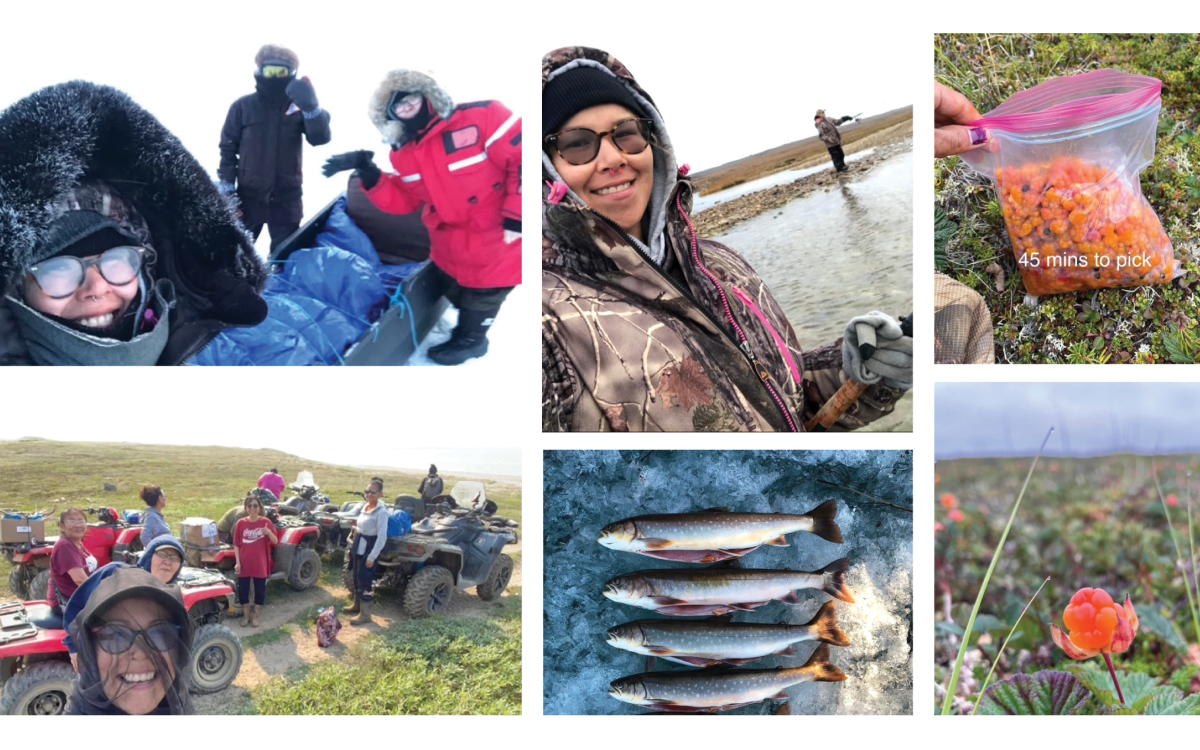
ONE OF THE BEST days was the day the group caught 63 trout at Billy Lake. They gathered at Kourtney Wolkie’s cousin’s house, to pack snacks and check the oil on their quads. There were around six people travelling across the land together that July day, led by Wolkie. Her group had made it to the mouth of a creek from which she often casts. The land was quiet. They parked and Wolkie looked at Billy Lake. All you could see was fins and fish mouths popping out of the water. That night, while the group picnicked, they talked about was how unbelievable it was to catch so many fish among them.
For the past four years, the 34-year-old Wolkie has taken women from her oceanside community of Paulatuk in the Northwest Territories out on the land. She uses Facebook to organize the trips, which include anywhere from three to 12 people, ranging in age from their 20s to their 50s, depending on work schedules and who has access to a quad.
Wolkie’s not a guide and she doesn’t get paid for these trips. Her day job is as a receptionist and officer with the Department of Motor Vehicles at the municipal office in town. She was raised on the land, though. Before ice breakup, her parents would take her to spring camp, travelling on the frozen ocean. Many in the community would do the same, staying for a few weeks. Wolkie remembers her dad teaching her to call geese, and running for them when he got one. “He would let me wring its neck,” she says. “It was terrifying because the wings were the size of my body at the age of eight years old.” Those gatherings don’t happen the same way anymore. Wolkie can’t pinpoint why, not in a way she can put into words. But she hopes, with her actions and trips like the day of the 63 trout, to bring them back.
AS THE CROW FLIES, it’s 17 kilometres from Paulatuk to Billy Lake. On the trail, it’s more like 40. Wolkie measures distance in time and only knows the journey takes an hour and 45 minutes, including the stop they usually make at the top of Thrasher Lake valley. There, they scan the land for caribou or bears before continuing on to the summit of “cellphone hill,” 200 metres above sea level. “For us, those are mountains,” Wolkie says, laughing. The area’s seen more rainfall than usual in the last few years, creating mudslides and exposing boulders. Sometimes, the quads dig in, so the group has to be careful about which trail they take. Once they summit, they text people back home to let family know where they are and where they’re going.
Wolkie started going out alone, or with her cousin, Georgina, years ago. She’d hear conversations in the community about women wanting to go out and gain experience. She decided to post her plans on Facebook, asking if anyone wanted to tag along. Immediately, she got replies. Men are welcome, but, in most cases, it’s women who are excited to go on the land.
THE LINE BETWEEN group member and guide is a blurry one for Wolkie. The women she takes out consider her their leader, always in the front. It’s tough for her to reconcile with the shyness she feels, but she plays the part. She checks trail conditions and watches for fog that might roll in. If it does, she’ll slow the group down and keep them close, maybe even start recording GPS co-ordinates on her phone. She makes sure someone’s carrying a rifle, or she brings her shotgun. She’s learned to always have a tire pump and plugs for flats. It’s exciting to feel her capability growing. From her husband, who used to be a weather observer at the airport, she’s learned about clouds. She’d test herself by looking up at the sky, making a guess and checking with him. Usually, she was right. Leading trips has helped her tap into independence and the knowledge she’s built up over her life.
The trips are about community as much as they’re about fishing or travelling, and they mean as much to Wolkie as they do to the women who go with her. Everyone’s in a different place in their life and being on the land together is a sort of reset. She’s known most of the women since childhood (Paulatuk’s population is 300), but they know each other differently after travelling together. Their connection is deeper, and they talk about everything from mental health issues to the well-being of the community and what they can do to make it better. For a lot of the women, the trips might be the only time they really get to go out on the land. Hunting, fishing and trapping are common in Paulatuk—where the cost of storebought food is 87 per cent higher than in Yellowknife, according to NWT’s most recent community price index—but it’s usually men in the lead. They’re the ones that end up with the harvesting jobs, going out, setting nets, getting fish, hunting caribou. That comes from the way things used to be, Wolkie says, but she’s moving in a new direction.
One day, Wolkie hopes to start a program for women and youth to learn on-the-land skills that will help build strong and capable travellers, who continue to appreciate the land. It’s one thing to talk to people about it, but it’s another thing entirely for them to go out and experience it. “The words that I’m saying,” she says, “don’t really do justice to what you would see out on our land.”