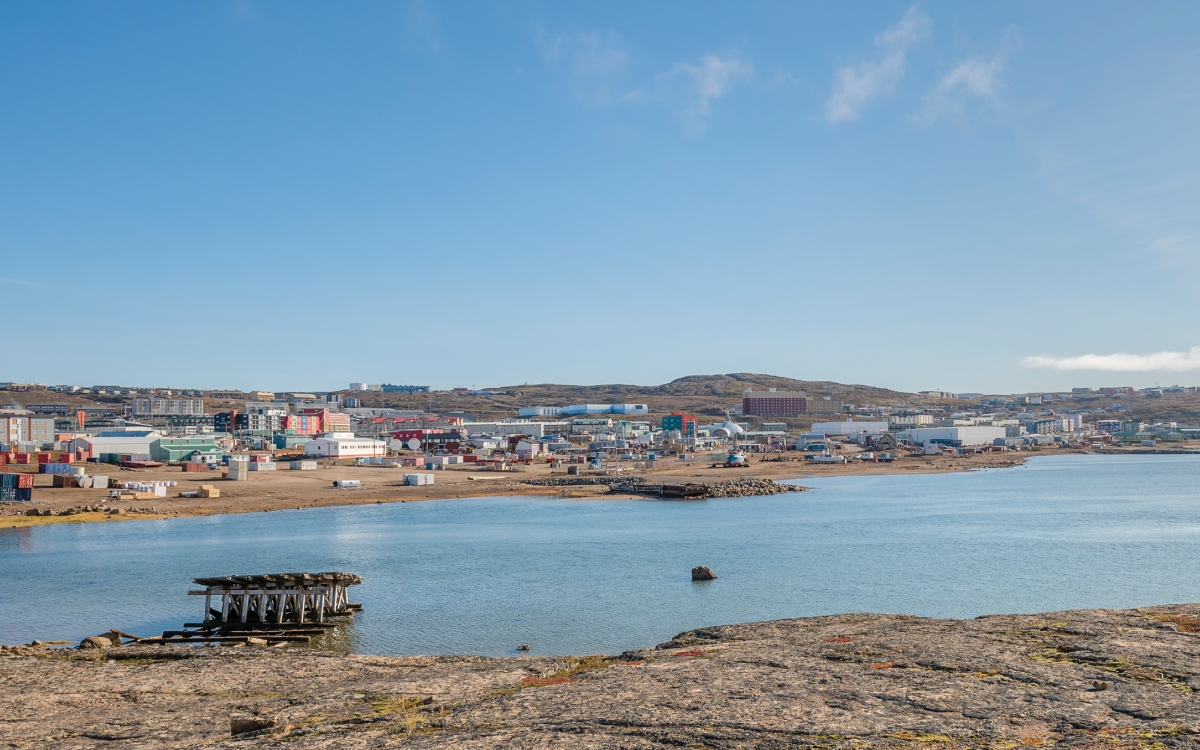
IN AUGUST 2024, Wang Di, the Chinese ambassador to Canada, sat down for his first media interview since being appointed to the role just two months prior. With three aides, all dressed in identical black suits, he sat at a wobbly metal table at Iqaluit’s Caribrew Café. Each time Wang was asked a question, he flipped through a stack of prewritten notes and gave paragraphs of diplomatic lingo with one main point––Nunavut would be lucky to have China as a friend. “You know, the hotel I’m staying at was built with Chinese materials,” Wang said. Indeed, the blue-and-white Aqsarniit Hotel was constructed in 2020 of materials from Shanghai. Everything from beds to microwaves was strapped into prefabricated modular rooms and loaded on to a yellow ship called Happy Dragon, which sailed for Iqaluit. “That hotel has created 60 jobs here in Iqaluit,” Wang said. “And saved $6,000,000 in terms of the construction cost.”
But helping build a hotel is far from China’s only Arctic ambition. In 2018, the East Asian country proclaimed itself a “near-Arctic state” and has since been trying to bring itself closer to Nordic affairs. The Chinese embassy has organized several coffee-and-snack-type events in Nunavut’s capital, meeting with the handful of representatives of the Canadian Chinese diaspora in the territory. The country’s research ships have roamed around the Arctic Sea, occasionally getting on the nerves of Canadian security officials, who have said those ships are actually collecting military intelligence. According to estimates from the U.S. House of Representatives, since 2003, China has invested more than $90 billion above the Arctic Circle, mostly in mineral exploration projects. One of those––a Chinese-owned zinc, copper and lead deposit in Nunavut––might now jeopardize the construction of the Grays Bay Road. The road is one of the biggest, oldest and most expensive projects in the territory’s history. Significantly, it could connect its Kitikmeot region to the road system in the rest of Canada. But it might also bring the fabled “Arctic foreign influence” right to Nunavut’s doorstep.
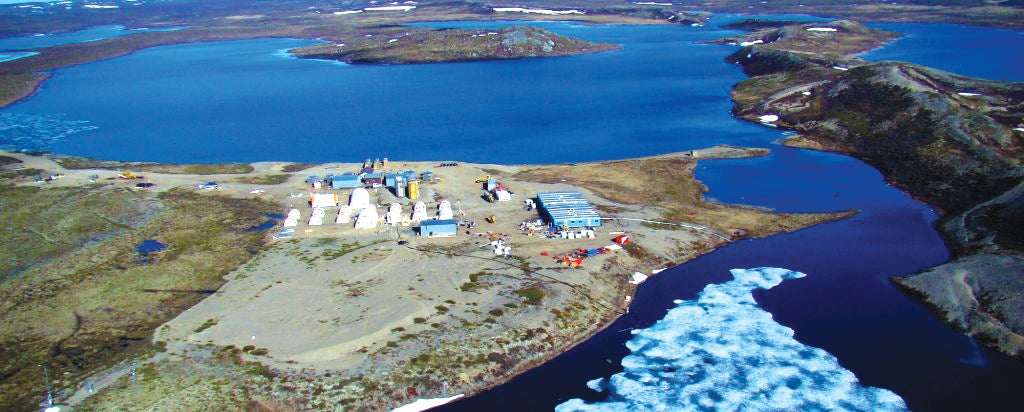
AMANDA DUMOND admits she gets “fired up” when she hears about the Grays Bay Road. “I can’t believe that my grandkids might never get the chance to see this beautiful land that way it’s been forever because of some mining companies wanting to make money.” Dumond manages the Kugluktuk Hunters and Trappers Organization. Sitting in her office, amid maps of caribou migratory routes that she argues will be affected by the road. The Grays Bay Road is a proposed 230-kilometre gravel road that would run from the former Jericho diamond mine to Grays Bay on Coronation Gulf, approximately 200 kilometres east of Kugluktuk, where a deepsea port would be built. It’s an approximately $1-billion project that’s set to cut through lands rich with mineral resources, which could make it easier for private companies to establish mines in the area. But the project has seen many delays over the years. “It’s like a cat with nine lives,” Dumond says. “It comes on the table, and then it dies, and then it comes back.” Until recently, she, along with a handful of other environmentalists, has been one of the few critics of the road, which has been touted a “nation builder” by the federal government (which is expected to cover most of the project’s costs). Lately though, Grays Bay is receiving a new wave of scrutiny.
In a 2022 report obtained by Canada’s National Observer, the RCMP said “numerous” northern mine and port projects are opportunities for foreign investors, which will likely use them to “conduct infiltration and espionage.” It specifically mentioned Grays Bay, as the road will lead to the Izok mine site, a large swath of resource-rich land on the border of Nunavut and NWT, owned by Chinese MMG Ltd. The company itself admits the government-backed road is instrumental to the creation of its mine. “Completion of Grays Bay Road and Port Project would help facilitate the accelerated development of this highly prospective geological region and, with it, the Izok Corridor Project,” says MMG Canada vice-president Catherine Knight on the company’s website.
According to MMG, the Izok area has one of the richest undeveloped zinc deposits in the world. The area has been bought and sold by half a dozen owners since it was discovered in the 1970s. With no roads or communities around Izok, none of those companies had the capacity to develop it into a mine. In 2009, it fell into the hands of MMG, a global resources company headquartered in Australia and mostly held by state-owned China Minmetals. The company deemed this potential mine so lucrative that, in 2012, it proposed a road project, almost identical to the current plans for the Grays Bay Road. At the time, MMG said the road would allow for production of approximately two million tonnes of ore annually for 12 years. But MMG dropped those plans due to the high cost of building in the Arctic. Shortly after, in 2016, the Nunavut government and the Kitikmeot Inuit Association announced they would team up to build this road, though the territory pulled out in 2018. Now, after a decade, with the feds’ interest, the project is finally getting going.
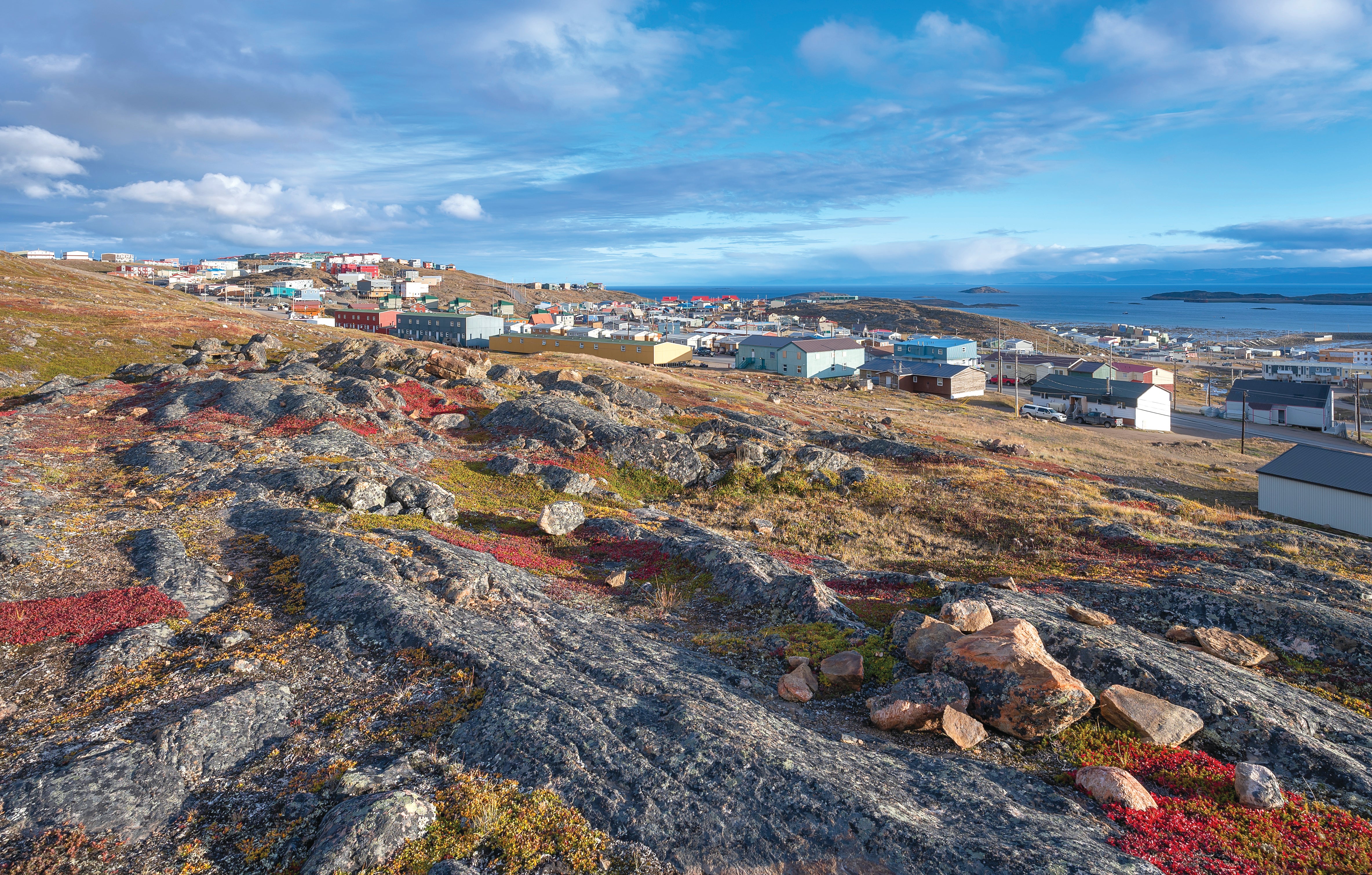
“NATION BUILDING” has become an essential part of Canadian life––at least the political speeches part of it. That includes northern politicians. In the four years of Nunavut’s sixth assembly (from 2021 to 2025), the term, along with various Nunavut specific “nation builders,” was mentioned more than 200 times. Geopolitical tensions are a big reason for it. “There has been a renewed interest in the North with the unprovoked war Russia did with Ukraine,” Nunavut’s then-premier P.J. Akeeagok told the assembly in October 2024. He went on to say the war has given the Nunavut government an opportunity to push for projects such as the Grays Bay Road and Port. That’s when the road’s selling point expanded beyond pure mining development to include Arctic sovereignty and security. In 2024, Brendan Bell, CEO of West Kitikmeot Resources Corp. (the Inuit-owned company spearheading the project), said the road has a greater chance of success with this newfound national and international interest in the Arctic.
Donald Trump’s second inauguration in 2025 helped the cause. That’s when Mark Carney ascended to the prime minister’s office and Canadians, including Nunavummiut, started boycotting all things American. Some Iqaluit residents even promised to stop using one of the most sacred institutions for this fly-in community––Amazon (Iqaluit is the only Nunavut town that gets free deliveries). It was a short-lived stand, as the next Christmas––as per tradition––Iqaluit’s Amazon delivery hub was so full of holiday purchases that it had to stop accepting new orders.
That was also the time when the federal government announced it was considering listing Grays Bay under the Build Canada Act, which could speed-run federal approvals for the road’s construction. Carney himself name-dropped the road as a project that would “bring the country together.” At the same time that Canadian politics were full of slogans such as “buy Canadian” and “elbows up,” military officials were also displaying anti-China sentiment. Then-Canadian Armed Forces Maj.-Gen. Michael Wright named China as the most significant threat to Canada’s interests in the Arctic. And despite being touted as a sovereignty project, at its core, Grays Bay is still about mining. It’s
estimated to grow Nunavut’s gross domestic product by a total of $5.1 billion and Canada’s by $7.6 billion over 15 years. Most of that would come from mining projects such as MMG’s Izok, which West Kitikmeot Resources Corp. considers the most “advanced” exploration project in the region. So now, the proposed building of the Canadian nation is set to significantly benefit another nation—one that Ottawa has long considerd a threat.
NUNAVUT HAS ALWAYS been slightly friendlier to China than the rest of the country. In 2016, Qikiqtarjuaq, a hamlet on the east coast of Baffin Island, tried tapping into Chinese investors to build a port for which the community has been lobbying the federal government since the 1950s. In 2020, the Chinese state-owned Shandong Gold Mining almost bought the Hope Bay mine in western Nunavut. Neither of those things happened. Qikiqtarjuaq port––like Grays Bay––became another nation-building project. Construction of the port was supposed to start in summer 2026 but was delayed when the promised federal money didn’t come quickly enough. And the sale of Hope Bay was blocked by the federal government for national security reasons. During Wang’s visit to the Café, the last time he was in the territory, he wasn’t shy about criticizing what he called Canada’s protectionism. “We see that a lot of suppressing and constraint of the normal economic co-operation and trade corporation, including investment, was done with the excuse of economic security.”
The Chinese government is notorious for using economic assets as a political tool or “coercive leverage,” says Arctic historian Adam Lajeunesse and the co-author of a book China’s Arctic Ambitions. That happened in Norway after Chinese dissident Liu Xiaobo got a Nobel prize in 2010––Beijing blocked salmon sales from the country. China also imposed tariffs on Australia’s government after it called for an independent inquiry into the origins of COVID-19 in 2020. China also restricted billions in Canadian agricultural exports after Huawei CFO Meng Wanzhou was arrested in Vancouver in 2018 on a U.S. extradition request.
So, now, Lajeunesse says, Grays Bay is putting the Canadian government in a tricky position. “On the one hand, they have identified this as a nation-building project,” Lajeunesse says. “And at the same time, I would be amazed if the government allowed taxpayer dollars to fund infrastructure to support a Chinese state-owned enterprise.” One possible scenario is that Ottawa wouldn’t allow the project to go ahead unless Izok switches owners. Another option would require ambitious political gameplay. Lajeunesse says the federal government might allow the project to go ahead as a signal to the U.S., which has been waging a trade war against Canada. “If you’re going to start this fight with Canada,” he says, “you have to be prepared for Canada to find new friends and new partners that you abhor.” That would be a huge leap for the feds. But ever since Trump started the tariff war and started openly musing about Canada becoming a 51st state, Lajeunesse thinks this is now “within the realm of the possible.”
DURING HIS AUGUST visit to Iqaluit, Wang also met with Stephen Sullivan, president of the Baffin Regional Chamber of Commerce, and Nunavut’s then-premier P.J. Akeeagok. At a later Assembly, the premier was questioned about the meeting and said they had discussed critical minerals in the territory but had made no decisions. Speaking about this in the Caribrew Café, Wang said the visit was merely an attempt to start a “province-to-province and city-to-city exchange”––to skip the whole geopolitics business and make the Arctic a space for what he called a “global village.” He also implied that, considering the history of colonialism, the government in Ottawa might be almost as foreign to Inuit communities as one in Beijing.
That’s when the “official” interview ended and Wang received a friendly parting question: “So, are you planning to try some seal or Arctic char while you’re here?” It turned out to be the one question for which Wang didn’t have an answer in his notes. He had a brief huddle in Chinese with his aides and came up with, quite possibly, the most unnecessary dodge: “They briefed me on a lot of special, unique food and drinks here, and I am clearly aware that here there is a unique culture and traditions.” He ended by saying that China would never try to unduly influence those traditions and life in the North.