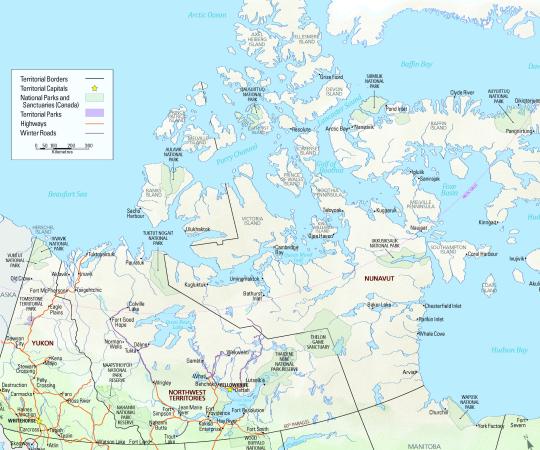
On August 3, 2003, a helicopter pilot and four members of a diamond exploration crew found themselves flying over the Central Arctic barrens toward their camp north of Takijuq Lake. It was a clear summer day, and the helicopter was flying low, just a couple of hundred feet in the air, when the pilot and his passengers spotted something camouflaged among the rocks below. They landed, and the group got out to investigate the scene—the burnt and crumpled airframe of a long-ago bush plane that had apparently crashed and rolled to a stop near the shore of a small lake.
The only evidence they found was a pair of hip bones and a Bowie knife on the pilot’s seat and, underneath the bones, a wallet holding a membership in Ducks Unlimited and a VIP card for the Flamingo hotel in Las Vegas. Both were made out in the name of Chuck McAvoy.
And in that moment, one of the North’s greatest aviation mysteries was solved.
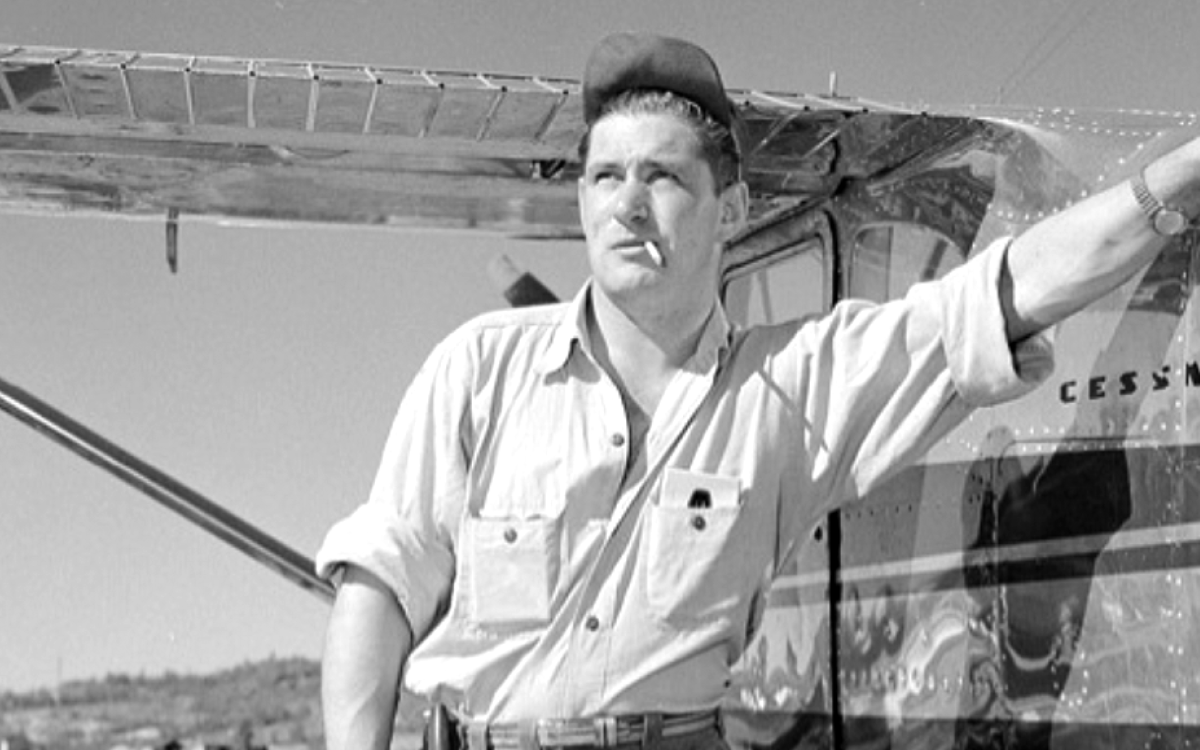
Chuck McAvoy, who vanished with two passengers in June 1964 at the age of 32, was a legendary bush pilot, equally famous for his skill at the controls as for a daring flying style that his peers sometimes described as reckless. According to local lore, he once flew underneath a new bridge on the highway to Yellowknife to mark its opening. It’s unlikely there’s anyone left to vouch for that story, but no one questions McAvoy’s reputation as an aviator, especially when it came to search and rescue. Much of the country first learned his name in May 1960, when, following a gut instinct, he saved the two starving survivors from a five-man prospecting party that had been stranded in Nahanni’s Headless Valley for more than two months after an expected pickup did not arrive.
Closer to home, Chuck and his brother Jim cut dashing figures on the Yellowknife scene. They’d learned to fly in a pair of planes owned by their family’s business, Wildcat Drilling, and later founded their own company, McAvoy Air Service. Aviation, however, was only part of their charisma. They captured the imaginations of local boys with a lifestyle of boats, motorcycles and big cars. One of those kids, Joe McBryan, so idolized Chuck that he went on to found Buffalo Airways Ltd., famous today for its fleet of DC-3 and DC-4 airplanes. McBryan also continued the search for McAvoy’s remains as a personal mission right up until the discovery of the wreck.
If McAvoy had any concerns about the risks bush pilots faced in the North, he didn’t let on. “If I ever go missing, they won’t find me,” he is known to have said. The boast was almost a prophecy.
On June 5, McAvoy took off from Yellowknife aboard his canvas-covered 1938 Fairchild 82, carrying two young men, Doug Torp and Albert Kunes, graduate students in geology from the University of Missouri, and their gear. Torp and Kunes had hired McAvoy for a 1,100-kilometre charter that would touch down at a handful of mineral discoveries over seven days. After leaving the geologists at the last site, McAvoy was scheduled to return to Yellowknife by himself on June 12.
On June 9, McAvoy’s wife, Gwen, received a radio transmission from her husband. It was a routine message, and she was unconcerned that the radio was silent over the next few days. Chuck was far from home and probably out of range. She started to worry only when McAvoy didn’t return on schedule. The search for the missing Fairchild began that night, not only involving local pilots but also an RCAF Dakota dispatched from Winnipeg with an 18-man team that included a para-rescue group.
The search widened after three days. On the fourth, a private pilot covering a remote corner of the search area briefly raised hopes, reporting he’d picked up a mysterious radio signal. Efforts to trace the signal back to a source, however, were unsuccessful. The official search was called off on June 26 and then, after political pressure from prominent Northerners, resumed on July 2. This time, two RCAF aircraft and a pair of planes from the United States joined the northern pilots, flying in tighter patterns and at lower altitudes than during the initial effort. Even then, the location of McAvoy, Torp and Kunes continued to elude searchers.
Officials finally called off the formal effort on July 13, and it didn’t take long for speculation around McAvoy’s disappearance to churn. Most had it that he and his passengers had died in a crash, with one version of the story saying the plane, rumoured to be carrying a load of dynamite, was blown to bits when it hit the ground. Another story wondered if McAvoy and the geologists vanished with a load of precious minerals to finance a new life of luxury. Or that McAvoy disappeared as part of an insurance fraud scheme. That theory collapsed when Gwen McAvoy
sued her insurance company, which was refusing to pay the $25,000 policy in full, saying no one could prove Chuck
McAvoy was dead.
Newspapers covering that lawsuit never reported on its eventual settlement, if there was one. Gwen McAvoy died not long afterward, and beyond family and friends, the story of her husband faded into lore, a vivid and mysterious tale but one that also grew less personal year by year.
After the remains of McAvoy’s wreck were finally discovered in 2003, investigators determined the plane crashed hard in heavy summer snow, causing fuel and other flammable liquids to catch fire. They also concluded that McAvoy, Torp and Kunes were killed on impact and, mercifully, spared the flames. A few weeks later, members of the families of the three men gathered at the site for a memorial service, where an inuksuk was erected in their memory.
Joe McBryan later flew to the location and collected the remains of the Fairchild 82’s airframe with vague hopes he might be able to have it repaired and rebuilt one day. As he approached Yellowknife with the wreck’s remains, he buzzed the old McAvoy dock as a tribute to the aviator who’d inspired much of his life and career. “I just had to,” McBryan said afterward. “I had his plane on board, and it was 40 years, two months and two weeks late.”