
JACK JOHNSON IS ON A BREAKAWAY. He cuts straight up the centre of his backyard rink while providing his own breathless play-by-play. “Medicine Hat Tigers has it,” the eight-year-old calls, driving toward the net, the low winter sun in his eyes. As he dekes an imaginary goalie—right, left, right, left—he yells the name of the player whose number, 72, is on his back of his sweater. “Gavin McKenna!”
The shot sails in. Jack’s not religious, but he crosses himself and drops to one knee, saluting the snowbanks. Unaware his dad, Dan Johnson, is behind one of them filming, the boy is lost in the daydream of being McKenna—the 17-year-old Whitehorse kid who’s the consensus number 1 pick ahead of the 2026 National Hockey League draft. Jack’s not the only one with big plans. In the same way eight-year-olds fantasize about the NHL or the Professional Women’s Hockey League (PWHL), thinking, why not me? Whitehorse is looking at hockey hotbeds in Canada and wondering, why not us?
Each year, NHL teams draft just over 200 teenagers from Canada, the U.S. and Europe, and this small northern city is on the verge of producing, in six years, two top-10 picks (Dylan Cozens was seventh in 2019).While Whitehorse has this momentim, three local hockey dads—Dan Johnson; Gavin’s father, Willy McKenna; and Peter Johnston—have formed a First Nations-owned corporation to build a year-round sports complex called the Total North Performance Centre. The goal is to give Yukon kids a place to train without having to leave home for greater competition.
Beneath that, though, is the same accelerant that’s fuelled a thousand sports movies—the ego and ambition of an underestimated person, team or place. Right now, Penticton, B.C., is the western Canadian city for hockey camps and training. Johnson’s kids have trained there, and he acknowledges the Okanagan Hockey Group has a great program with great coaches. “But in terms of a place to go? We’re a lot more attractive than Penticton,” he says, emphasis on a lot. “If we had another rink, I have no doubt we could become Penticton of the North.”
It’s the classic underdog narrative. The catch is the scripts for these movies don’t usually include a subplot about who’s paying the Zamboni driver’s salary. Given that Total North needs around $100 million for its own Mystery, Alaska moment, the idea seems like a long shot. But the excitement over Gavin McKenna has helped turn the territorial capital into a hockey town with something to prove.
 Photo by Cathie Archbould
WITH THE OPPOSING Prince Albert Raiders on a power play, McKenna picks up the puck just behind his own team’s blue line and starts a two-on-two rush. He cuts to the centre of the ice and pulls the puck behind himself. As the Raiders’ defender follows the fake, McKenna spins the other way with the puck and scores on a glove-side shot. “What a move!” the announcer yells. “Mastery from Gavin McKenna!”
The ability to make plays like that one, from the 2025 Western Hockey League playoffs, are why the Tr’ondëk Hwëch’in citizen earned exceptional player status
in 2022, allowing the WHL’s Medicine Hat Tigers to draft him when he was just 14. His first season, he was rookie of the year. Last season, he smashed a record older than he is by netting points in 54 consecutive games. He also played in the World Junior Championship as a 16-year-old, only the eighth Canadian to do so—putting him in company with Wayne Gretzky, Sidney Crosby and Connor McDavid. He’ll join Team Canada again this year, but he won’t be back with Medicine Hat Tigers. Now that Canadian juniors can play for Division 1 U.S. college teams, McKenna will make US$700,000 as a Penn State Nittany Lion instead.
He’s not even in the NHL yet, and the lore around him draws other players to Whitehorse. One of them is 13-year-old William Gruben. He was such a dominant star in Inuvik, a community with ice in its arena only six months a year, that his coach created a rule just for him—once you’ve scored three goals, pass the puck. People across the Beaufort Delta started telling the kid’s father, “You’ve got to get him out.” So, in 2024, Chris Gruben moved his family to Whitehorse. Because of McKenna. For William, it’s a dream to live in the town the future star came from. For his dad, it means more exposure to scouts, greater competition and better coaching. He’ll take any edge he can get.
There may be something to Gruben’s approach. In The Talent Code, journalist Daniel Coyle examines sports and cultural hotspots trying to crack the nut of brilliance and lands on three qualities. The first two, practice and coaching, are rooted in neuroscience and measurable strategy. The third, ignition, is where the woo-woo comes in. It’s the simple magic of rubbing up against greatness. South Korean golfers dominated the LPGA after Se-ri Pak won the 1998 championships; Russian women took over tennis within a decade of Anna Kournikova; and, in Johnson’s opinion, Nathan MacKinnon came out of Cole Harbour after watching Sidney Crosby do it. “It’s the Gavin McKennas, the Dylan Cozens. Boom,” he says. “There’s a spark.”
Yukon girls’ hockey has seen the same thing. In six years, the league has grown to 156 players from 25. Originally the lady Mustangs, the players wanted their own name (the Yukon Wild), their own logo, their own cheers and their own McKennas. In July, four PWHL players—including Jenn Gardiner, who plays for Vancouver—helped coach a hockey camp at the Canada Games Centre and played in a Friday night game before rammed stands full of little girls in PWHL sweaters and princess dresses. “It was honestly surprising,” Gardiner says of the hockey obsession. “At the same time, one little girl was like, ‘Do you play in the NHL?’ And I just kind of laughed because I was like, ‘She doesn’t even know what the PWHL is yet.’”
Not long ago, the same could be said of Whitehorse. The city was a big, blank space in the minds of scouts and coaches. “I didn’t even know people lived there until 10 years ago,” says Chad Olson. Head coach of the Bremerton Sockeyes, a junior team in Washington, Olson talks machine-gun fast, like someone with zero filter and a surplus of Red Bull. Maybe it was eight years ago, he says. Whenever people started talking about Cozens in the junior league. It’s part of what brought him to Whitehorse in late July when Hockey Yukon held its first scout camp.
Olson saw more talent than he expected and signed one player, Jamie King. He liked that the kid encouraged teammates no matter how the game was going. In fact, overall, attitude stood out more than the skill, even if there were a couple of kids who were straight-up assholes. When Olson started coaching and was out to prove something, he chased skill. Trouble was, when you build a bench full of cocky guys who want Ferraris, teamwork falls apart. Now, he builds culture. That includes weekly pre-game potlucks where players cook for each other, even if Olson must teach “his idiots” how to scramble eggs (which he has).
Whitehorse isn’t going to pump out NHL players, but Olson would put money on William Gruben and has circled his name to check back in five years. “He’s gonna be the next Gavin McKenna coming out of there,” he says. The problem local players face is the closest competition is a nine-hour trip away in Juneau. “The biggest downfall with Whitehorse hockey,” Olson says, “is they just have no one to play.”
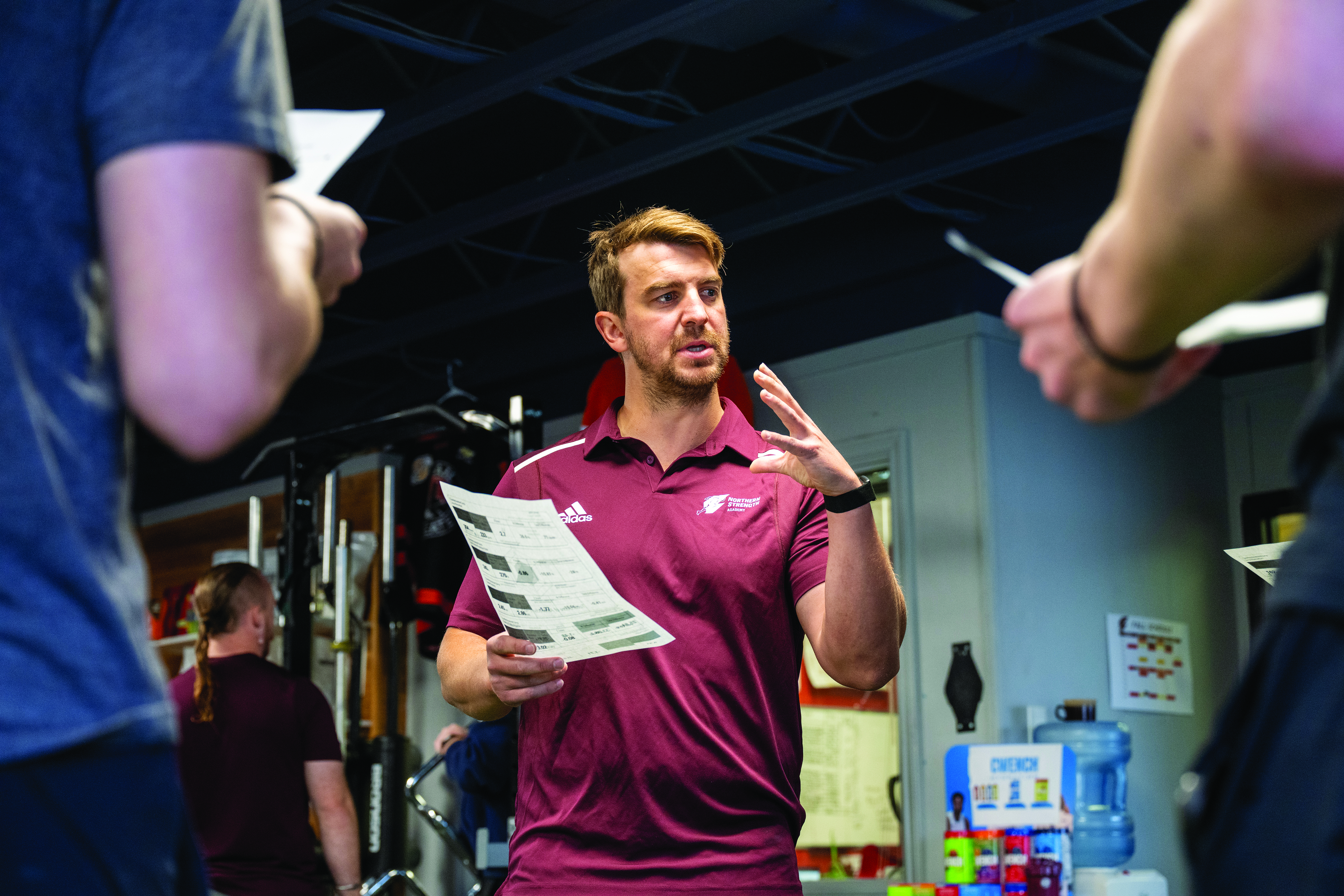
Photo by Cathie Archbould
WHAT ARE YOU doing Friday night? In the Whitehorse of the 1990s, there was one answer to that question. You were going to Takhini Arena, an old barn with faux log walls and 1,500 seats that overlooks the city from the top of Two Mile Hill. The smell of sweat and rubber flooring mixed with concession stand fryer oil and the mineral tang of freshly flooded ice. It was the heyday of the Whitehorse Huskies, a senior AAA men’s team that won Canada’s Allan Cup in 1993, and of the Yukon Claimjumpers, a short-lived junior team.
When Dan Johnson played for the Claimjumpers, he’d come out of the tunnel to the sound of AC/DC’s “Hells Bells” and take a minute to soak in the feeling. His peers sat across the ice, his parents had season’s tickets behind the bench and a gaggle of old guys sat in the far corner, judging warm-up shots. The same way his son cosplays Gavin McKenna now, Johnson stepped on the ice imagining he was the Huskies’ starting goalie. “I didn’t know how insignificant that was compared to the NHL,” he says. “To me, that was the show.”
But the Huskies and the Claimjumpers folded, taking with them a certain sort of Friday night. Now, that buzz is back, especially when McKenna’s in town. Twice, he’s played December charity games to standing-room-only crowds at Takhini. The fever is contagious. If you walk into the Dirty Northern Public House during the Stanley Cup playoffs and ask for just one of the bar’s televisions to show basketball, you get a dead-eyed stare—we watch hockey here.
We can’t always find a place to play it, though. For a city covered in ice two-thirds of the year, it’s a knee in the jock that there’s never enough to practice on. With women’s and old-timers’ leagues (both with waiting lists) and 821 minor hockey players, ice time is hard to come by, especially for two months straddling spring and summer when it’s not even in at Takhini or the Canada Games Centre. No wonder talented kids, including Cozens, move south to attend hockey academies at only 14 or 15, billeting with strangers or living in dorms. Johnson’s 15-year-old daughter is making that decision right now.
Sitting in a boardroom at the telecommunications company he owns in Whitehorse’s Marwell industrial area, Johnson remembers how brutal it was going to a hockey academy when he was 15. Each week, he made one 20-minute phone call to his family from a jailhouse-style phone in his dorm hallway. He missed most of his younger sister’s formative years. His parents scraped together money to visit him once a year, separately. But even after being “in the system” as a player and coach for 20 years, he loves the game. He’s amped about watching, playing, coaching. He advocated for the girls’ team to have its own name (“Who Wild?” he mimics the team cheer. “Everyone yells back, ‘We Wild!’”). Even when he’s talking about his business, he treats it like a hockey bench: How do you get your fourth line, your new staffers, to perform like first-line players?
He points out the window of his Copper Road office. Behind a row of corrugated steel-sided buildings is vacant land he owns. He was thinking about putting in small rinks for skill sessions before he formed True North with Willy McKenna and Peter Johnston. The three men, who play old-timers hockey together, didn’t realize they were all thinking about a sports complex until Johnson’s wife, who’d been talking to Johnston, got them to start discussing it together, over many beers and coffees.
A former chief of the Council of Yukon First Nations, Johnston is keen on giving Indigenous youth the same funding and support elite players receive. McKenna wants quality training close to home, so kids don’t have to travel Outside 18 times a year, the way he and Gavin did. Johnson loves hockey and likes building things. He has interest from potential tenants. Maddie Nicholson, Hockey Yukon’s executive director, wants her organization’s office there. Ben McPherson, who trains both Cozens and
McKenna, wants to move his gym, Northern Strength Academy, into the building. In August, McPherson had just returned from Ontario, training Cozens in Muskoka, where the Ottawa Senator spent his off-season with other NHLers. Part of Johnson’s plan is for pros to summer in the North instead.
If enthusiasm were currency, he could build a rink in every Yukon community, but he’ll need a stronger pitch to convince the City of Whitehorse. Ice is not its most pressing issue. Water is. Much of Whitehorse runs on 1950s infrastructure. It wasn’t sufficient 10 years ago, when the town had around 20,000 people. By 2023, the population had climbed to 36,000, and the Yukon Bureau of Statistics predicts a jump to 46,000 a decade from now. In July, as workers ripped apart the Hillcrest neighbourhood for road and service reconstruction, interest groups lobbied city council for rinks, pickleball courts and pools. Spending on water and sewers is invisible, an un-fun, but necessary, expense like replacing the shingles on your roof instead of installing a hot tub. Add the unexpected need for a new multi-million-dollar water treatment plant, as well as damage control on the escarpment that started slumping over Whitehorse roadways in 2023, and hockey drops further down the city’s list.
A performance centre would also still need to meet zoning requirements and align with the Official Community Plan. Mayor Kirk Cameron doesn’t want to shoot the project down and sounds relieved to hear the private sector is making plans. That might actually result in some action. “But I’m not going to guarantee that,” he says, “and it won’t be coming on the backside of funding from the City of Whitehorse.”
Beyond the $100 million for the building, keeping the lights on and staffing the place could run another $2.5 million a year. Or, at least, that’s the cost at the Southeast Event Centre in Steinbach, Manitoba, an hour outside Winnipeg. Southeast is to Whitehorse what Gavin McKenna is to Jack Johnson. Aspirational. Jack’s dad sees it as the model for True North. The slick, glass-fronted building, which replaced an aging recreation centre, has sports facilities, including two rinks, an arts and event space and a restaurant. When it opened in 2024, it had been 14 years in the making. Southeast was overly optimistic with costs, timelines, everything. The 2019 estimate of $42.5 million jumped to $75 million. “Plan for the worst,” advises Grant Lazaruk, president of the board that runs Southeast, which operates as a non-profit because, as he puts it, “these facilities are unprofitable.”
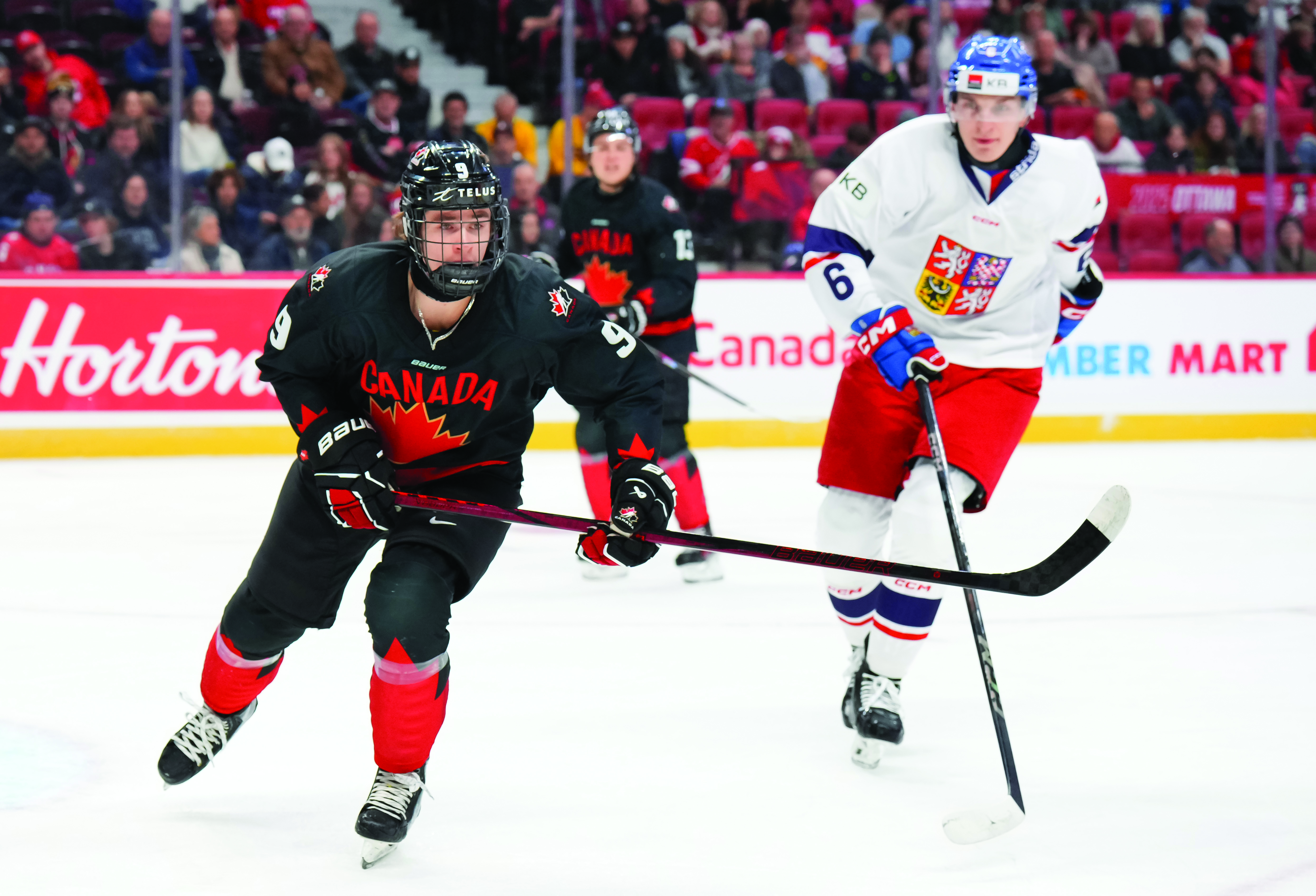 Photo courtesy of André Ringuette/Hockey Canada Images
KAELAN BASNETT is a good skater with a decent shot who knows the first thing coaches notice is that he’s 6’ 3”. But the 18-year-old forward, who grew up in Whitehorse and signed to play for the Port Alberni Bombers in 2025-26, is pragmatic about his career. He didn’t attend a southern hockey academy and has known since he was 15 that the NHL is out of reach—but that a free education at a U.S. college is within it. Basnett, who’s struggled with stress around games and tryouts, has found it helpful to work with sports psychologists and wants to study psychology. He’s the type of player who would benefit from the True North centre, according to Johnson. As a coach, he’s seen parents spend thousands sending their kids south to train and watched them land where they would have if they’d worked with local coaches and professionals like McPherson.
Johnson is convinced the money for a centre will be there. When he coached the Huskies during their brief resurgence in the 2010s, the team ended the year with cash in the bank from beer and ticket sales—even after flying four teams’ worth of competition to town and paying for their hotels. In September, when Medicine Hat, minus McKenna, played the Kelowna Rockets at Takhini, the city provided a shuttle to help manage traffic. Imagine if Whitehorse had its own junior team or if parents could get their kids into local camps where, fingers crossed, NHL players—including McKenna—helped out?
If McKenna’s trajectory continues, Olson jokes, he could pay for the centre after a couple of years in the NHL. Barring that, True North will have to do it. But it hasn’t come up with a design, done a feasibility study, received funding commitments or sought zoning changes. Johnson relishes the challenge. “I like building things that sometimes people say, ‘Probably not gonna happen,’” he says. “I kind of like people saying, ‘Oh, yeah, good luck.’” That sounds like the premise to every sports movie ever made. Cue the training montage.