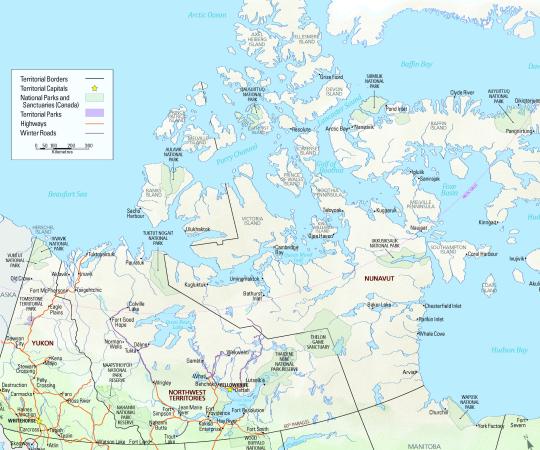
When you kite-ski across Great Slave Lake, you’re at the mercy of the weather. For several days last spring, Eric McNair-Landry monitored the conditions. Finally, he confirmed: We’d go tomorrow. The wind would be low and at our backs, the firm snow would cause little resistance and we’d have 17 hours of daylight. We’d travel on skis across the North Arm of the lake as kites the size of buses pulled us along. We packed our gear into two sleds: spare kites, camping gear and enough food, water and clothing for a day and a half, in case we had to spend a night on the ice.
I discovered kite-skiing through videos French adventurer Matthieu Tordeur posted on social media. I was amazed by the concept of travelling fast and fully wind-powered over long distances. The skills required attracted me, too: mastery of the kite, control of the skis and understanding the winds. I’ve always been interested in northern adventure. When I moved to Yellowknife, I volunteered at a sled-dog kennel to learn about mushing. I went running at -40°C and learned to cross-country ski. I tied a canoe barrel full of camping gear around my waist and swam for hours in local lakes. Now in my late 20s, I consider it time to dive into the sports I’ve always wanted to try. (It’s not “northern,” but I also recently started gymnastics.) The learning curve has humbled me. It’s frustrating at times to try these activities so late, to grapple with fear and to see children and other adults moving much faster—and more confidently—than I am. But it’s better to start late than not at all.
So, when I saw someone kite-skiing on Great Slave Lake, I asked if he’d teach me. Although he’d coached newbies in the past, he was retired. Nearly a year later, I travelled to Iqaluit for a polar-training course with Sarah McNair-Landry. In a brief lesson at -45°C, I got a feel for the wind and how the kite pulled me. Then she put me in touch with her brother, Eric, who lived in Yellowknife. I spent the next year learning everything I could from him. An experienced Arctic adventurer who has kite-skied across Greenland, Antarctica and the Northwest Passage, McNair-Landry holds the world record for the longest distance kite-skied in 24 hours: 595 kilometres.
Although I was already a capable downhill skier, kite-skiing is next level—you’re harnessed to the wind. I learned to use smaller kites in strong winds and bigger ones in less wind. I got the hang of managing my kite’s direction and elevation, and controlling my direction and speed, by pulling a handlebar. I practiced how to do an emergency stop by yanking my brake line, which folds the kite’s wings, lowering it to the ground.
I fell down a lot. When I dropped my kite and couldn’t get it back into the air, I’d have to walk to shore. Once, the Dettah to Yellowknife ice road broke underneath me, and I was suddenly kite-swimming. That left me soaked, with a few cuts on my stomach. Still attached to the kite, I got pulled out of the water by the wind. Another time, too confident in my ability to manage strong winds, I got dragged for 150 metres, my sled trailing behind me. I managed to stop by throwing my entire body over the brake line. But when everything clicked and I was flying across the ice, it was worth the frustrations. It felt thrilling.
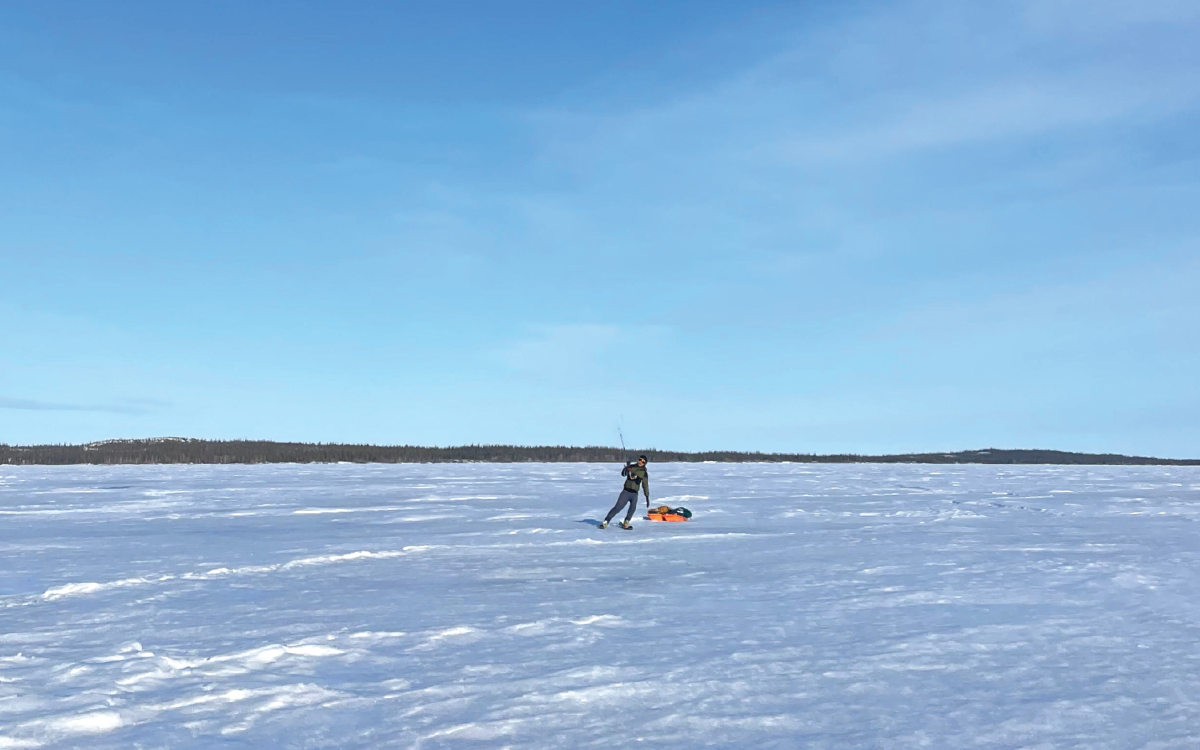
So, that’s how I ended up on the edge of Great Slave Lake with McNair-Landry, prepared for a long day. We brought four kites, ranging between 10 and 18 metres, and started with mid-sized ones. Low winds, slow start. I followed McNair-Landry, who navigated away from shore. As we neared the corner of the North Arm, he dropped the sleds and began zigzagging, jumping and doing tricks, his way of accommodating my snail speed. I slogged behind. Outside of the ideal wind speed of 15 to 25 kilometres per hour, kite-skiing requires great technique to control speed and direction—which I didn’t yet have. Twenty kilometres in, the winds dropped completely. Our kites fell to the ground. We rested, snacked, subbed in bigger kites and started again when the breeze picked up. The winds were teaching me patience.
An ice ridge began to define itself against the skyline, about two metres at its highest. I hoped we wouldn’t have to cross, but that was wishful thinking. McNair-Landry traversed it with ease. Scared, I lowered my kite to the ground and took my skis off to examine the ridge more closely. It was a jumble of small ice blocks, with water on either side. Finding a spot that wasn’t too high or wide, I lifted my kite into the air and cautiously approached. Whoosh! What a rush.
Later, McNair-Landry suggested I use a kite with a longer line to catch more wind and move faster. To compensate for the extra pull, I took the two sleds. We made good progress, and he could have more fun, jumping off the sharp sides of a three-metre ridge. But as the temperatures rose, the snow softened. A late-to-melt bump caused me to go down face first. Then, as I crossed another ice ridge, the sleds got stuck in a hole hidden by the blocks of ice. The kite scooped me up and I floated two metres in the air, eyeing the sharp chunks below. McNair-Landry was too far ahead to hear my calls. The kite caught some wind and propelled me forward. Luckily, I ended up with only a bruise and friction rash.
We arrived at the opposite shore at 9:30 p.m., before sunset. The 11-hour, 180-kilometre journey was my first long-distance kite-skiing trip and my first time crossing ice ridges. I was proud of the effort. Some days, it feels like I’ll never be as good at kite-skiing—or cross-country skiing or gymnastics—as I want to be. However, I can appreciate my progress. Picking up a new activity as an adult isn’t easy, and I’ll have to resign myself to smaller dreams than world records, but I know I’m learning and improving. That’s worth it.