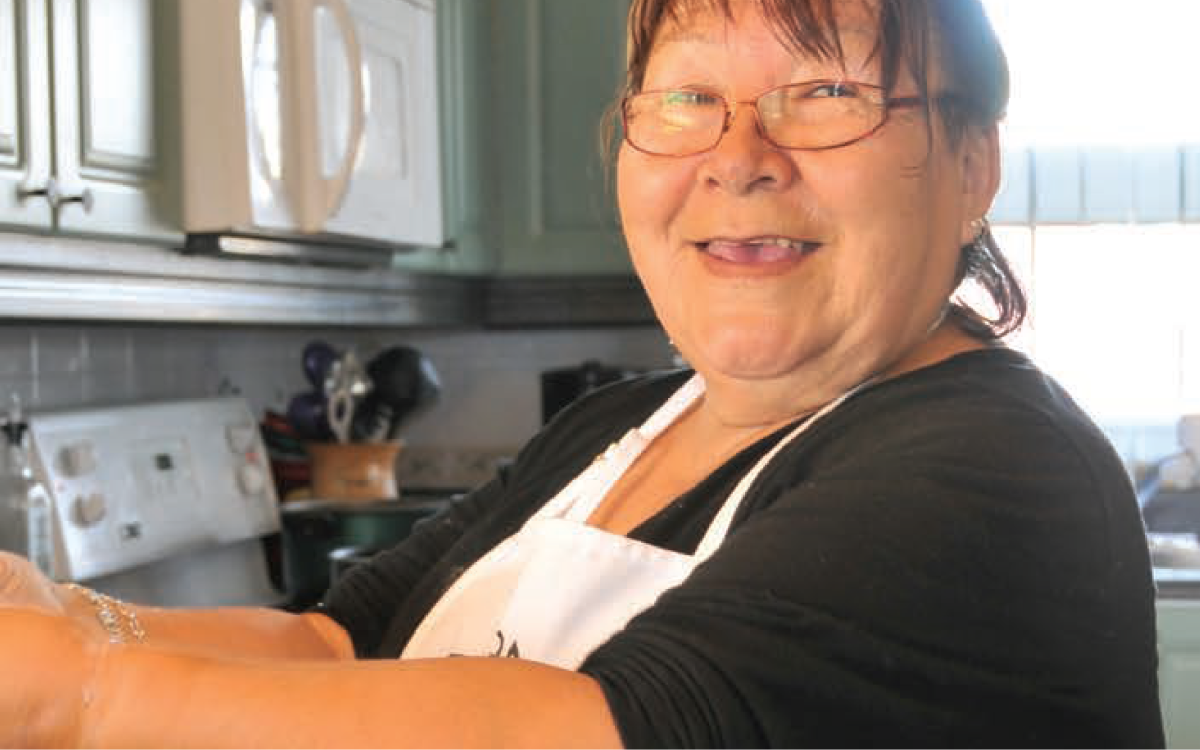
The TV ad fades to black, replaced on screen by a simple kitchen with green wooden cupboards and a refrigerator plastered with fridge magnets. Cooking-show hostess Rebecca Veevee sharpens her favourite ulu to a jingle of jolly pop music. Enter Jordin Tootoo. As the Inuit hockey hero prepares his favourite dish – sautéed caribou – the petite, grandmotherly Veevee flutters about, chopping veggies and chatting in Inuktitut. She checks on his sizzling pan. Taima, she says. Enough. Then she gazes up at the hulking Tootoo. “Mama Mia! So tall!” she exclaims, unleashing peals of laughter. As the 30-minute episode wraps up, Veevee presents a finished meal of caribou steaks and shrimp stir-fry. “Delicious!” she says, beaming. “And easy.”
Veevee’s on a one-woman mission to change how Inuit eat. “People in the Arctic live like they’re in another world, junk food all the time,” she says. “So many have diabetes and high blood pressure. Very awful!” Her popular lunchtime cooking show, Niqitsiat, or “healthy cooking,” is heading into its fourth season, broadcast nationally in Inuktitut on Canada’s aboriginal network, APTN. Each day on the show, Veevee creates nutritious Northern dishes that can be cooked fast and cheap. Past meals have included caribou pizza, goose soup, char casserole, seal pie and her signature dish, beluga muktuk stir-fry.
Veevee’s studio kitchen doubles as her real kitchen, inside her sunny Iqaluit home. On the June day that I visit her, months after the Tootoo segment, she’s still savouring his guest appearance. She points to her apron, which bears the word Niqitsiat, printed in her show’s ulu logo. “Jordin signed it here,” she says, showing off his felt-penned autograph. Right now she’s baking up mounds of bannock. When two kettles are slow to simmer, she sings at them – “Oh, come on, baby!” – and dances across the kitchen. She drops the first bannock into the bubbling oil. “Deep fried,” she sighs. “Not so healthy, but it’s a tradition, and that’s important too.”
Keeping Inuit culinary traditions alive isn’t easy, she notes. With fewer hunters around these days, especially in Iqaluit, getting char, caribou and seal is tricky. In her home town of Pangnirtung, Veevee says, “I had to pay $10 for one ptarmigan. Nothing is free anymore.” And even if country food is available, she says, shaking her head, it all receives the same treatment: “Boil, boil, boil. I have so many ideas – fix it, mix it different ways.” Although Veevee rarely consults cookbooks and, ironically, avoids cooking shows, she clearly has the touch, experimenting with flavours and tossing together bright colours for appeal. She preaches that healthy food is cheaper than fast food. “In Pang, a pop is $5,” she says. “But you can buy a lot of veggies for the same money. You just have to know what to do with them.”
Up to her elbows in flour, Veevee reminisces about growing up at an outpost camp near Pang. Raised by an aunt, no one had time to teach her to cook. Then, after moving to Iqaluit in 1972, she took a job at the hospital kitchen. “They taught us how to make everything – white man’s food,” she says. She immediately loved cooking. “I was grateful because I was poor and had two kids to feed.”
Part of the appeal of Veevee’s show is that she’s a clown. At any given moment she might sing the theme song from Spiderman or hold rings of bannock up to her eyes to make doughy spectacles. But her silliness masks an inner sadness. She takes a deep breath: “When I’m cooking, I’m happy, but when I was drinking, I was crying.” She relates snippets of her difficult past, which included being forced by her family to marry a man who abused her. She turned to alcohol, but also to humour. “People used to ask why I was always acting happy and it was because I was hiding everything inside,” she says. In recent years she’s been trying to talk more about her troubled history. “I’m still hiding,” she says solemnly, “but not so much.”
It was in Iqaluit, nearly 40 years ago, that her fortunes began to turn around. In the early 1970s, when filmmakers came to town to shoot the Arctic-survival drama White Dawn, Veevee’s charisma won her a prominent role. Not long after, she got remarried, to Jacques Belleau. With their two children they moved to his hometown of Québec City, where they lived for 18 years. (“I wanted to make sure my kids had a good education,” she says. “Not like me.”) Eventually they moved back to Iqaluit, where Veevee’s filmand-television career was reborn. She landed a part in the 1993 movie Map of the Human Heart, and in 2004 APTN asked her to travel across Nunavut to explore the funny aspects of Northern life for a comedy series called Inuit Mittatin – “That’s Funny!” One of her guests was comedian Rick Mercer. “We were competing at telling jokes and he just went on and on like he does. I told him ‘Rick, shut up, it’s my turn,’ and I beat him!” she crows triumphantly.
During that filming, an APTN rep suggested Veevee devote one episode of Inuit Mittatin to cooking. Although the series was cancelled the next season, Veevee’s performance in the kitchen got her an offer for a cooking show in 2007. She hasn’t looked back. In more than two dozen episodes of Niqitsiat, she’s cooked up tables-full of modern- meets-traditional Northern fare. She’s been joined on-air by local celebrities like former MLA Ed Picco and CBC North radio host Joanna Awa. In 2008, she cooked belugamuktuk soup that wowed visiting Irish comedian Billy Connolly. And always, she’s kept her audience – and herself – in stitches.
It’s all in the cause of helping Northerners cook and eat better, she says. She places her flour-dusted hands in the middle of her chest. “What I feel in my heart I call flowers. Helping other people makes your flowers grow. I have to help them. Life is too short.” By now a mound of bannock is teetering on a plate. She plucks one from the stack, takes a bite, and begins discussing plans for next season.
What will be on the menu? “Seal, because people say they don’t know how to eat it anymore. Marinated in ketchup and barbecued.” Then she grins broadly. “And seal-head. It’s something I learned from my grandmother. People have forgotten how good it is.” And then she laughs and laughs.