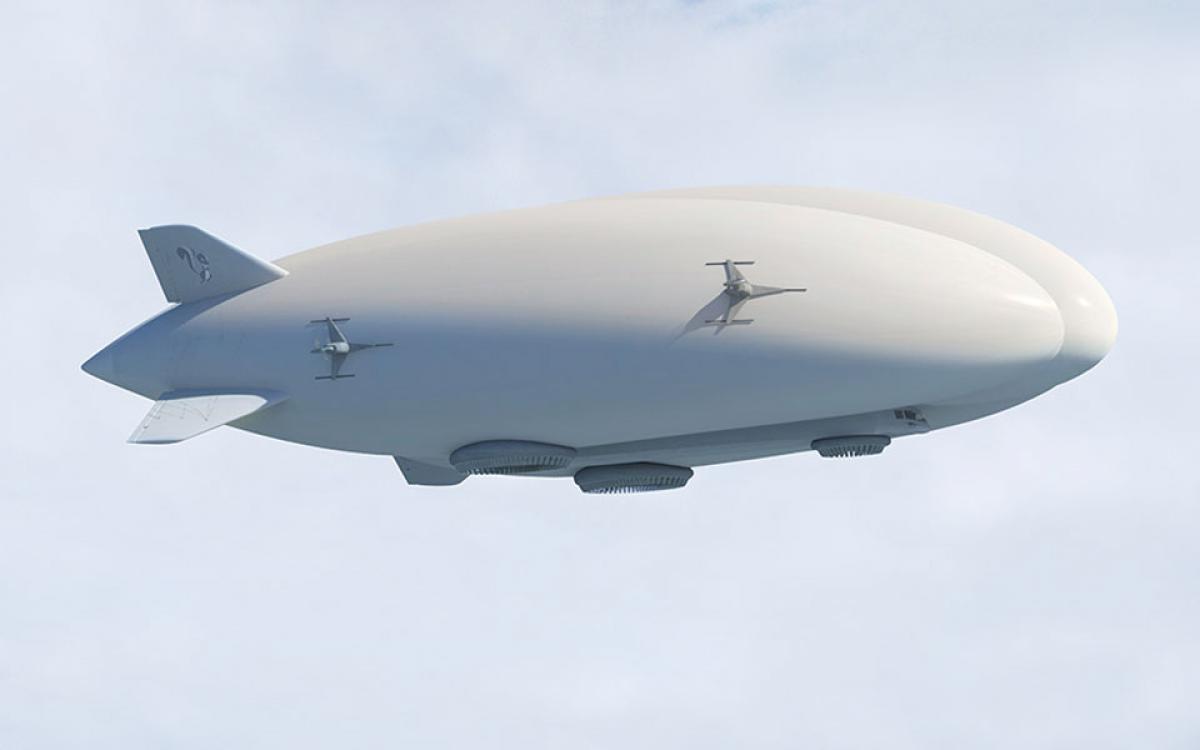
They’ve been floated as the answer to just about everything—from Arctic food insecurity to housing issues—and as a means of lowering living, business and construction costs across the North. Over the years, hype has been building around cargo airships despite the fact not one modern blimp has moved goods into the territories. Earlier this year, retailers of Lockheed Martin’s LMH-1 airship met with NWT cabinet to pitch them on the freight-carrying potential of its hybrid blimps.
Today’s airships, which now use helium as a lifting gas instead of flammable hydrogen, have been employed in recent decades as floating advertisements or for aerial surveillance. At first blush, cargo airships would seem an ideal fit in the North: They can travel year-round with large, unwieldy loads and don’t require airstrips or much else in the way of local infrastructure for landing and offloading. But based on the market realities in Northern communities, for whom does the airship actually make sense?
Lockheed is just one of many companies developing cargo airships around the world. And by no means is there a standard being adhered to—designs, dimensions and technologies differ with each developer. (Worldwide Aeros Corp. in California, for instance, is working on a 280-metre long, 65-metre high blimp, with a cargo payload of more than 450,000 kilograms.) Lockheed’s LMH-1 is being designed to move nearly 20,000 kilograms in freight. That’s less than a super-tanker truckload, but 5,000 kilograms more than the classic Boeing 737 can carry, more than four times what the ubiquitous ATR-42s and Dash 8s are capable of hauling, even more than the mighty Hercules can handle. And because it would fly all year, it could give construction companies and governments more flexibility when ordering supplies that are generally shipped up during the sealift or barge season. This would cut down on their holding costs.
One area where the airship could play an immediate role is at nascent mining or oil and gas sites with little infrastructure. Though, fully loaded, the LMH-1 isn’t technically lighter-than-air, once its 20 tonnes of freight is offloaded, its reverse-propulsion cylinders securing it to the ground can’t keep it from floating away. What’s required is a ballast. For now, the plan is to use a water truck or tank to pump water into a hold to offset the weight of the freight being unloaded. What happens when the temperature drops to -40 C? Brian Bauer, chief operating officer of Hybrid Enterprises (Lockheed’s exclusive international reseller of the LMH-1), theorizes anti-freeze could be mixed into the ballast water to keep it from freezing up.
Compared with airplanes, airships move slowly. The LMH-1 tops out around 120 kilometres per hour. And it doesn’t necessarily float above the clouds either. The LMH-1’s ceiling is about 10,000 feet—not a limitation on the airship, but on the humans flying it. Bauer says that provides a freight-moving advantage: Because the flight is depressurized, the LMH-1 would be able to haul awkward items like wind turbine blades, which could theoretically hang out of the cargo bay so long as they were secured.
Roughly 80 percent of the airship’s lift would come via its helium gas store and 20 percent from its aerodynamic shape and the thrust of its four propeller engines. This means there would be a big fuel savings compared with planes and helicopters.
But airships wouldn’t be immune to Arctic conditions. The LMH-1 won’t be safely loaded or unloaded in winds of 50 kilometre per hour. But if it encountered a storm en route, it could slow right down to one or two knots—just a few kilometres per hour—and ride out the weather. For hours. For days. “You could wait there for weeks,” says Bauer.
So now the big question: how does the LMH-1 stack up against established transportation modes? “If it’s competing against a truck that has a road—a paved road or a well-established gravel road—the truck more often than not is going to be less expensive than the airship,” Bauer concedes. But with “reasonable utilization,” the LMH-1 would come out cheaper than the Boeing 737 or Hercules, he says—without providing specific dollar amounts.
Bauer has pitched the airship to diamond miners in the NWT, arguing a fleet could eliminate the annual need (and the $16- to $20-million cost) of building and maintaining hundreds of kilometres of ice road that enable the movement of thousands of truckloads of fuel and goods to the mines.
“We have envisioned it being first applied to the extraction industry,” says Bauer. Those companies have “the consistent need for that type of volume and the resources to make a decision based on a lower cost.” As for blimps solving food insecurity in rural and remote communities? Well, food delivery might be more of a secondary market. “If you’re moving upwards of up to 200,000 tonnes of equipment and consumables to some of these [industrial] sites, that’s a pretty good steady clip of work for the airship. But a small community: 20 tonnes might be half a year’s supply,” says Bauer. He says airships could service a large mine site five days a week and then do a milk run to
several communities once a week.
But here’s the thing—the commercial model of the LMH-1 isn’t actually complete and it hasn’t even been flight-tested yet. A prototype of the LMH-1—the P-791—passed its proof-of-concept flight test ten years ago. These airships haven’t been certified to fly in Canada either. Bauer is hoping the LMH-1 will be good to go by 2019, which means not only getting the actual airship off the ground and proving its airworthiness, but also getting it through regulatory approval. Worldwide Aeros hopes to have its mammoth blimps airborne by 2023.
The Airlander 10—a 10,000 kg-capacity hybrid blimp being floated by Hybrid Air Vehicles, promoted by Iron Maiden frontman, pilot and major shareholder Bruce Dickinson—is the cargo airship closest to actual takeoff. It completed one successful 30-minute test flight last April, but a 100-minute flight in August ended when the airship’s nose hit the ground hard, damaging the cockpit.
It’s a tantalizing concept—convoys of hulking blimps silently and stoically floating over a tundra expanse, loaded with fuel and food. Today, it remains just that—a dream. But with the clout of Lockheed Martin behind it, the long-held promise of cargo airships slowly chugs closer to reality. And though NWT diamond miners and Northern grocers were cagey when providing comment for this story, airships might just be hovering in the backs of their minds.