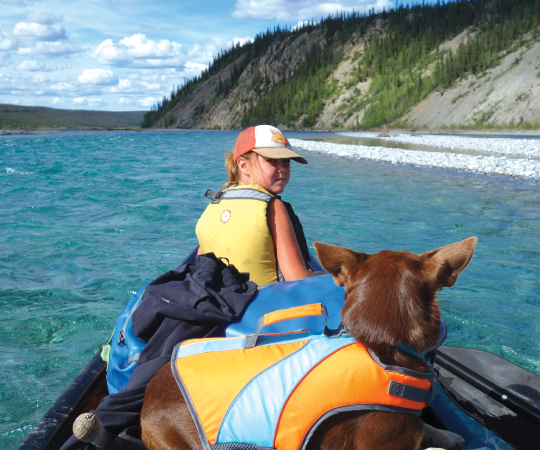
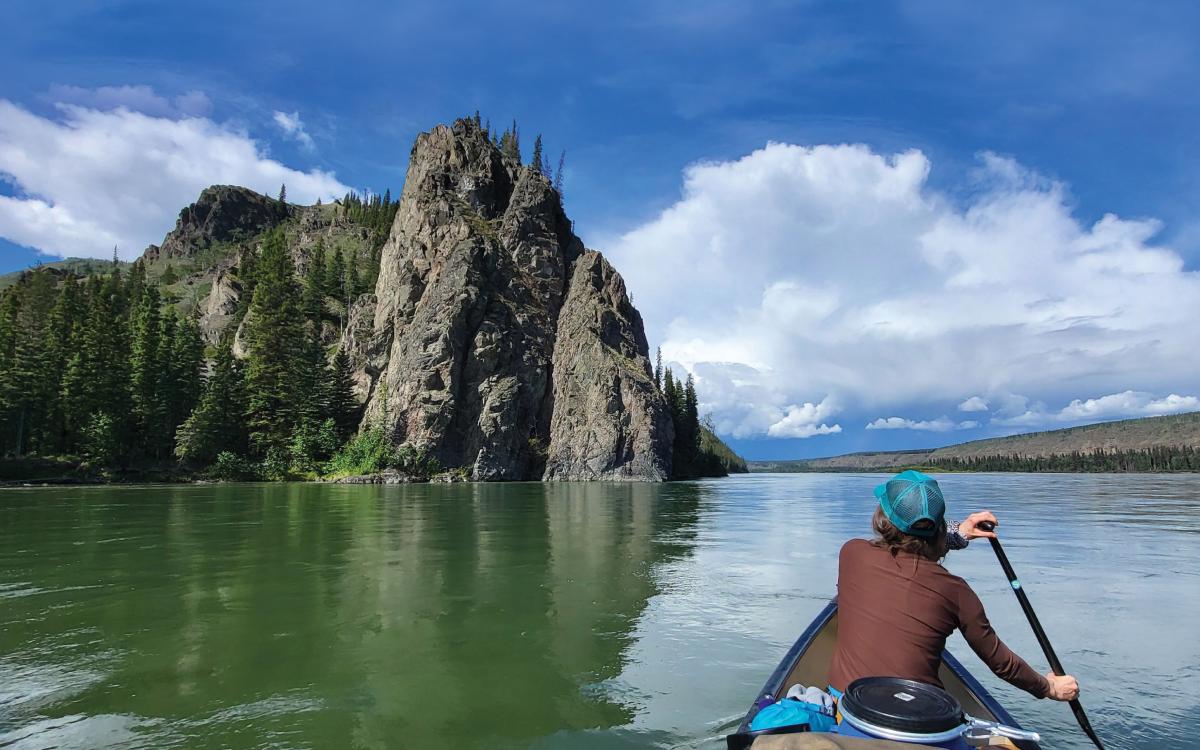
For five generations, Carissa Waugh’s family has had a fish camp on the Yukon River just north of Whitehorse. It’s near a spot on the braided, arterial waterway that widens and glints like a gold coin in the sun when seen from a plane. On maps, the area is shaped like an anatomical heart. In this slower section of the river, salmon can rest on their long migration from the Bering Sea to spawning grounds anywhere from 150 to 3,000 kilometres upstream. The camp has been here even when her great-grandma died and her grandparents were taken from their tiny waterfront cabin to residential school; in the years before her relatives reclaimed the site when Waugh was little; and today, when a seven-year moratorium on Chinook salmon fishing means the camp has changed.
One thing hasn’t. “It’s always been who we are,” says Waugh of the area, where sheer bluffs rise from the river, striated like slices of tiramisu with layers of duff, soil and sand. Swallows dip in panicked murmuration as ravens dig their eggs out of cliffside burrows. Tipsy spruce bow from eroding banks toward the water like illustrations in a Dr. Seuss book. Waugh remembers her grandma gathering the grandkids to clean and prep the fish net, her dad and papa building the smoke shack. “Now, because we can’t set the net, all those traditions are missing from camp,” she says. “There’s not as much family gathering.”
Waugh is hopeful that giving the river personhood status could help bring those traditions back by protecting the waterway better than existing regulations and conservation efforts have. Over the last two decades, legal personhood has been granted to a handful of lakes, rivers and forests around the world. Although there’s no universally applicable definition for the designation, when Quebec’s Magpie River gained personhood status in 2021, it received nine rights, including the right to respect for its natural cycles and the right to maintain its integrity. But in other places, the status hasn’t survived legal challenges; nature’s right to personhood has stood up only when it hasn’t inconvenienced actual people. Maybe we need a better strategy.
In Southern Tutchone, the river is Chu Níikwän, or “shining waters.” Originating in northwestern B.C., it’s fed by a cluster of lakes before officially becoming the Yukon River, south of Whitehorse, at Marsh Lake. Each spring, this area offers the first expanse of open, ice-free water for migrating geese, ducks and 10 per cent of North America’s trumpeter swans. A protected species in the Yukon, the swans rest here to feed for up to a week. By mid-April, the sky over Whitehorse can look as though it’s draped with strings of pearls as the birds fly further north in looping V formations. Below them, the river supports a 3,185-kilometre food chain that includes black and grizzly bears, moose, caribou, beavers, muskrats, 38 species of fish and, of course, people.
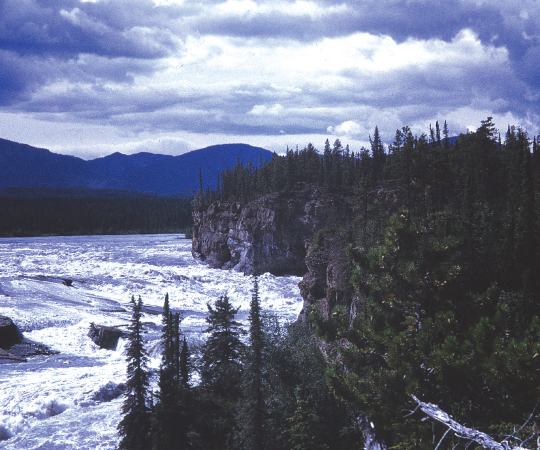
Near Whitehorse, it narrows through Miles Canyon, named by settlers for an American general. There’s no evidence he even saw the turquoise water here, or the persistent pink fireweed that grows from shallow scrapes of dirt in the cracks between black basalt columns. Waugh’s First Nation calls it Kwanlin, the Southern Tutchone term for “water running through canyon.” The Kwanlin Dün take their name from this spot, where Indigenous people fished and traded for centuries. Back in the bush are remnants of the gold rush-era settlement that came later: rusted cans and abandoned bits of tramway.
WAUGH IS ONE of many people considering what personhood could mean for the river. In March 2025, the Council of Yukon First Nations voted to look into legal personhood for the waterway. The following year, the opposition NDP tabled a motion asking the Yukon government to draft new legislation in support of the designation, though NDP leader Kate White is clear this isn’t being driven by the party. “The nations will make decisions based on the advice and the expert support that they’re getting,” she says. “And we will echo that.”
To Swim and Speak with Salmon, a Whitehorse conservation organization, also supports personhood, though it’s still questioning the best approach. It could be something nations declare on their own, it could be rooted in law or be strictly educational—a way of teaching youth that nature has spirit and agency and can act on us. This is already part of many Indigenous worldviews, which is why these conservation efforts are often led by Indigenous people. The Innu Council of Ekuanitshit pushed for the Magpie’s personhood.
The headwaters of the Magpie River lie at the border between Quebec and Labrador. Yenny Vega Cárdenas, who has a PhD in water resources law, helped secure its personhood for the Innu. She’s featured in Robert Macfarlane’s book Is a River Alive?, which tries to answer the question by visiting various places with personhood. Cárdenas is proud of the success, though she’s clear the reason it was so easy to defend is that it might not need defending. A 300-kilometre watercourse in the Côte-Nord region, the Magpie is remote, with little industry nearby.
The Yukon is more complex, not only because of surrounding mining activity, industry and highways, but because it passes through a province, a territory, a state and the traditional homes of 73 First Nations and Indigenous tribes. Historically, they haven’t even been unanimous on how to conserve salmon, whose numbers have steadily declined since the 1990s (Chinook numbers from 2015 to 2025 are just 41 per cent of what they were from 1981 to 2014).
But Cárdenas believes that’s no reason not to try for personhood. Beyond environmental protection, she considers it a form of reconciliation. Rights of Nature efforts like this are often led by Indigenous people. In New Zealand, for example, the Māori worked on getting the Whanganui River personhood in 2017.
A few years ago, Waugh was in New Zealand as part of her job with Reconnection Vision, a Yukon First Nations organization that’s focused on youth-led activism. She met Cárdenas there and swam in the Whanganui River. That experience is part of what led her to participate in a Whitehorse conference on personhood last spring. The Council of Yukon First Nations brought in lawyers to talk about the legal issues. The Trʼondëk Hwëchʼin shared the perspectives of its citizens in Dawson. To Swim and Speak with Salmon spoke about the advocacy training it does with youth. After hearing from all of them and considering the complications around international borders, Waugh realizes the Yukon won’t become a person any time soon. “But I really do hope that it does happen,” she says. “In my lifetime, at least.”
The river chokes on its way into Whitehorse. Past the canyon, past the manmade reservoir of Schwatka Lake (named for an American lieutenant) is a hydroelectric dam that throttles the rapids from which modern Whitehorse takes its name. The air is filled with mist where whitewater tosses and bucks like wild-maned stallions. Running at river right is the fish ladder, an eight-by-eight-metre square wooden tunnel that acts as a kind of VIP line for fish migrating upstream. If they can find the opening, the ladder guides them safely through the dam. Recent environmental reports, however, estimate that as many as one-third of juvenile salmon heading downstream are killed by the dam’s turbines each year. It’s one of the factors contributing to a decline in the number of Chinook salmon that hatch in Canada and return to their spawning grounds. Climate change is another. A heatwave that swept the Bering Sea from 2016 to 2020 caused an even greater decline.
Past city limits, the river becomes Lake Laberge, 50 kilometres long and up to five kilometres wide. On a sunny day, it looks tropical and inviting. In a storm, it goes gunmetal grey and hostile. As it runs beyond Carmacks and Pelly Crossing, there are still bald spots on the banks from recent wildfires.
Eventually, you hit the White River confluence, where one of the Yukon’s seven major tributaries charges in from the left. Silty with glacial sediment, it mixes into the clear water of the Yukon like chocolate milk. If you follow the White’s family tree, it’s fed by the Kluane River, which is fed by Kluane Lake, which was fed by Ä’äy Chù, which was fed by the Kaskawulsh Glacier until 2016. That’s when the glacier receded so much that its runoff reversed directions. Ä’äy Chù, which means “glacier water” in Southern Tutchone, is now a dry, cracked valley rather than a river.
DRESSED IN SAND-COLOURED pants and a forest green T-shirt with a river graphic on it, Neil Hartling makes tea in his Whitehorse kitchen and sits at a table built on a massive tree stump. The roots are like tentacles on the floor near his feet. Sunlight streams through windows surrounded by climbing pothos vines. A nearby glass-topped coffee table looks like an oversized biologist’s collection, filled with rocks and shells. A copy of Is a River Alive? sits in front of him.
Hartling believes it is. For more than three decades, he ran Nahanni River Adventures, guiding Canadians on remote northern rivers and Jack London-loving Europeans on the Yukon. In his 20s, rivers were a means to adventure. But the more time he spent on them, the more involved he became in their politics. He was part of the push to create B.C’s Tatshenshini-Alsek Provincial Park; expand the boundaries of Nahanni National Park Reserve; and seek protections for the Peel Watershed, a 68,000-square-kilometre region of pristine Yukon land.
Hartling once had a certain naiveté about environmental regulations, assuming that, if the rules were there, they were being followed. But after a landslide at Victoria Gold Corp.’s Eagle Mine spilled cyanide-contaminated water near Mayo, a review of the disaster found the company had ignored some of the restrictions of its licence. Afterwards, inspectors found leaks in the pool containing the contaminated water. Victoria Gold went into receivership and the Yukon government agreed to lend the receiver up to $220 millions to pay for remediation.
No wonder Hartling is now skeptical about regulations. He also worries that granting the Yukon River personhood could create a hierarchy that prioritizes certain ecosystems over others. What happens when the rights of a river conflict with the rights of a boreal forest or tundra or desert? There are so many overlapping, sometimes contradictory needs in nature.
Still, he wonders if personhood could protect the river in a way rigid environmental guidelines can’t. Contaminating waterways is objectively wrong and it still happens. “Maybe this personhood question could change that from just being wrong to being criminal,” Hartling says. As Cárdenas points out, a corporation such as Victoria Gold doesn’t exist in reality, but it does in law. In Canada, corporations are protected against unreasonable search and seizure under the Canadian Charter of Rights and Freedoms. Why should companies enjoy the same rights as people when a river—which you can touch and drink from and rely on to survive—has none?
So far, advocates of environmental personhood offer no such explanation of what it means for a river “to flourish” and nebulous phrasing only weakens a court case. That’s why Noah Sachs is opposed to personhood. “It’s not that I don’t care about environmental protection,” says Sachs, a University of Richmond law professor who has testified about environmental regulations before the U.S. House of Representatives. “I care about it very much.” But he's concerned about language, intention and clarity. Unlike detailed regulations, terms such as personhood, which are flashy banners for activists, are too flaky to hold up in court. In 2019, the City of Toledo, Ohio, passed the Lake Erie Bill of Rights (LEBOR), granting the lake the right to “exist, flourish and naturally evolve.” Almost immediately, an agricultural company sued the city, worried that farmers could be liable for fertilizer runoff in the water. The State of Ohio joined the suit as a co-plaintiff. The judge called the bill aspirational but impractical. “Under even the most forgiving standard,” he wrote in his decision, “the environmental rights identified in LEBOR are void for vagueness.”
The Ganges and Yamuna rivers in India also lost their rights to personhood only three months after achieving them. The country’s supreme court ruled that if the Ganges could sue people for polluting the river, people could sue the Ganges for flooding their land. If personhood is meant to be legal and punishable, Sachs believes the language must be specific. Court cases live and die on definitions and precedents. And the legal precedents that have been set for river personhood could ultimately undermine the rights of nature.
Beyond the White, you reach the confluence of the Yukon and Stewart rivers. Later in the summer, when levels are lower, the water here is calm and expansive. The labyrinth of islands and braided channels, caused by more sediment than the water can carry, makes it easier than you’d think to get turned around in a boat. White and black spruce mix with birch, poplar and willows. Moose stand in the shallows and black bears swim between islands or forage for groundberries. The Stewart is fed by the McQuesten, which is fed by Haggart Creek, a salmon-spawning stream contaminated by a spill at the Eagle Mine in 2024. Roughly a month after the accident, 70 fish were found dead in the creek.
Nearing Dawson, the first thing you see is the Moosehide Slide, a pale cream-coloured scar in the green hills over the townsite. In the Hän language, Ëdhä dädhëchą (weathered moosehide hanging) signalled to the Trʼondëk Hwëchʼin people that they’d arrived at their traditional fishing grounds each summer. Later, it was the sign to prospectors that they’d made it to the Klondike. The gold rush pushed the Trʼondëk Hwëchʼin downstream, to Moosehide Village. Past that, it’s a short paddle to Eagle, Alaska, and the Yukon Flats, where headwinds can stop you dead in the broad, boggy wetland.
WESTERNERS OFTEN NAME places for people, while Indigenous communities name a place for itself. That’s one thing Dr. Ryan “Rye” Karonhiowanen Barberstock learned from his grandmother. Barberstock is Rotinonhsión:ni, Wolf Clan, from Mohawks of the Bay of Quinte. He also works as an adjunct Indigenous professor at Queen’s University, including in its School of Urban and Regional Planning. Growing up, he understood that whether a valley or river or mountain offers sustenance, spirituality or clay for pottery, its given name honours the identity of the land itself. While he agrees that human intervention is necessary to protect resources, he wonders if personhood is the best term for something like a river because our role is not to speak for nature, which already has its own ways of maintaining balance.
One alternative could be symbolic rather than legal personhood. But another is this—appreciating the river as a river. There’s a reason any city lucky enough to be on water builds itself around that feature. Cárdenas thinks water has a way of making ourselves and our problems seem smaller. We’re drawn to it to look or listen or swim.
If we listen, Barberstock believes, we could learn something. “Consider this as a host-and-guest relationship,” he says. The host is the land itself. That means humans, whether they’re present as short-term or long-term guests, have a choice. “We can live sustainably, in accordance with the responsibilities established by the host nations, or we can degrade and devalue the very systems that sustain all life, including our own … There is only so much Mother Nature, as host, will endure when her guests treat her poorly.”
When Waugh attended the spring conference in Whitehorse, she heard a lot of discussion around the term personhood and worries that it might scare some people off. One of the main arguments in the Rights of Nature movement is that the current worldview is anthropocentric—that humans see themselves as separate from and superior to nature. A parody of this perspective was the U.S. president threatening tariffs on Canada if wildfire smoke didn’t dissipate this summer. Floods, droughts and earthquakes should be further reminders of where we stand with nature. It’s egotistical to confer personhood as though we can respect the river only if we can see ourselves in it. Maybe instead, as Sachs says, we need to hold ourselves accountable to the regulations Hartling used to believe did their job. Rather than pasting personhood on something as spectacular as the Yukon River, a better way of getting our heads out of our own asses could be to respect the river for its riverhood.