South of 60, young men’s thoughts may turn to love as April surges over the horizon with its promise of May flowers, green grass and balmy evenings under the stars.
Not up here.
Spring in the North doesn’t really get going till May, and it mostly means three things: muck, a shuddering halt to off-road travel, and skyrocketing food prices in highway-served communities of the Mackenzie Valley and the western Arctic. Ice bridges break up and ferries sit, ready but useless, waiting for piled-up floes to move.
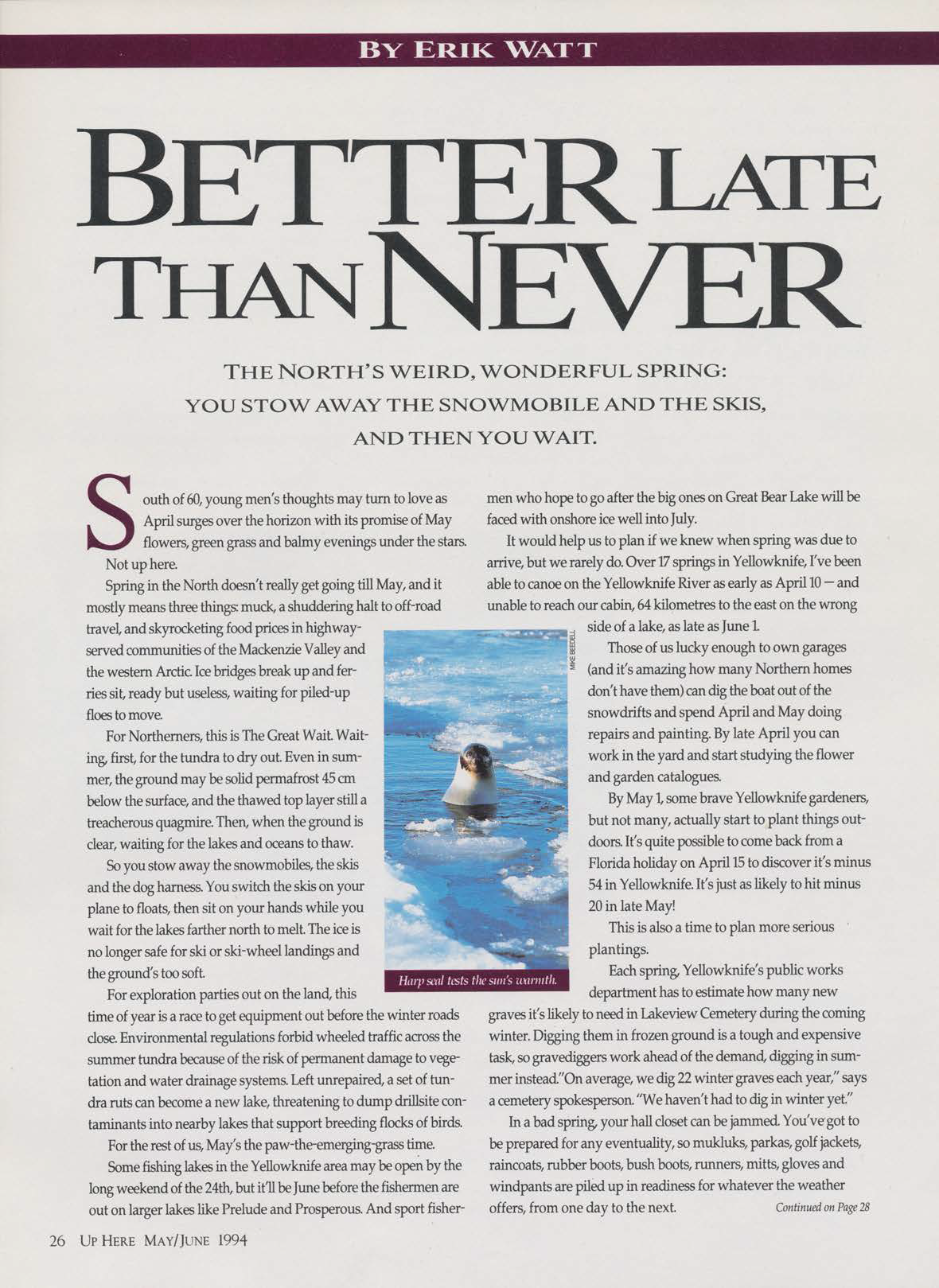
For Northerners, this is The Great Wait. Waiting, first, for the tundra to dry out. Even in summer, the ground may be solid permafrost 45 cm below the surface, and the thawed top layer still a treacherous quagmire. Then, when the ground is clear, waiting for the lakes and oceans to thaw.
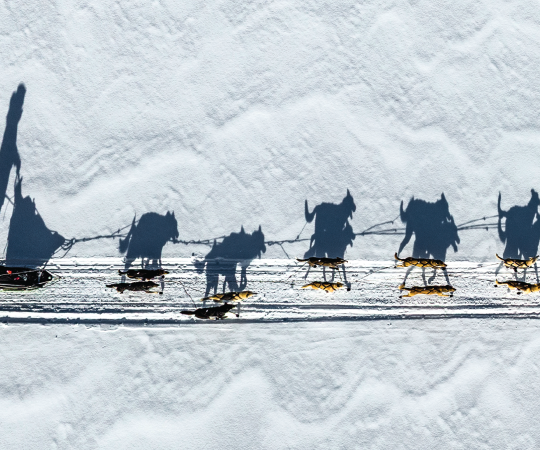
So you stow away the snowmobiles, the skis and the dog harness. You switch the skis on your plane to floats, then sit on your hands while you wait for the lakes farther north to melt. The ice is no longer safe for ski or ski-wheel landings and the ground’s too soft.
For exploration parties out on the land, this time of year is a race to get equipment out before the winter roads close. Environmental regulations forbid wheeled traffic across the summer tundra because of the risk of permanent damage to vegetation and water drainage systems. Left unrepaired, a set of tundra ruts can become a new lake, threatening to dump drillsite contaminants into nearby lakes that support breeding flocks of birds.
For the rest of us, May’s the paw-the-emerging-grass time.
Some fishing lakes in the Yellowknife area may be open by the long weekend of the 24th, but it’ll be June before the fishermen are out on larger lakes like Prelude and Prosperous. And sport fishermen who hope to go after the big ones on Great Bear Lake will be faced with onshore ice well into July.
It would help us to plan if we knew when spring was due to arrive, but we rarely do. Over 17 springs in Yellowknife, I’ve been able to canoe on the Yellowknife River as early as April 10 — and unable to reach our cabin, 64 kilometres to the east on the wrong side of a lake, as late as June 1.
Those of us lucky enough to own garages (and it’s amazing how many Northern homes don’t have them) can dig the boat out of the snowdrifts and spend April and May doing repairs and painting. By late April you can work in the yard and start studying the flower and garden catalogues.
By May 1, some brave Yellowknife gardeners, but not many, actually start to plant things outdoors. It’s quite possible to come back from a Florida holiday on April 15 to discover it’s minus 54 in Yellowknife. It’s just as likely to hit minus 20 in late May!
This is also a time to plan more serious plantings.
Each spring, Yellowknife’s public works department has to estimate how many new graves it’s likely to need in Lakeview Cemetery during the coming winter. Digging them in frozen ground is a tough and expensive task, so gravediggers work ahead of the demand, digging in summer instead. “On average, we dig 22 winter graves each year,” says a cemetery spokesperson. “We haven’t had to dig in winter yet.”
In a bad spring, your hall closet can be jammed. You’ve got to be prepared for any eventuality, so mukluks, parkas, golf jackets, raincoats, rubber boots, bush boots, runners, mitts, gloves and windpants are piled up in readiness for whatever the weather offers, from one day to the next.
Spring is a relative thing, too.
In Northern mainland communities like Aklavik, where the sun’s high in early April, people consider it to be spring when the thermometer still reads minus 10 or 15. At Resolute, 1,500 km north of Yellowknife, it may be 40 below on April 29, but the sun’s up until August 13. Winter, as far as Rez is concerned, is over.
Yet at the Polaris lead/zinc mine, just 150 km northwest of Resolute, spring doesn’t become official until August 1. That’s when Cominco Ltd. shuts down its surface vehicles which, parked or in use, have been running steadily for 10 months.
Polaris learned the hard way that it’s cheaper and easier to let idle equipment stay running outdoors all winter, rather than stopping it and then trying to get it started again. Metal and plastic still shatter like glass in Polaris’ “spring” temperatures.
The best mainland spring of all is one of those springs when the thaw starts in early April and continues apace into early May until the night the thermometer unexpectedly drops to minus 30 for a day or two. That hurts. But, wow, what it does to hatching mosquitos!
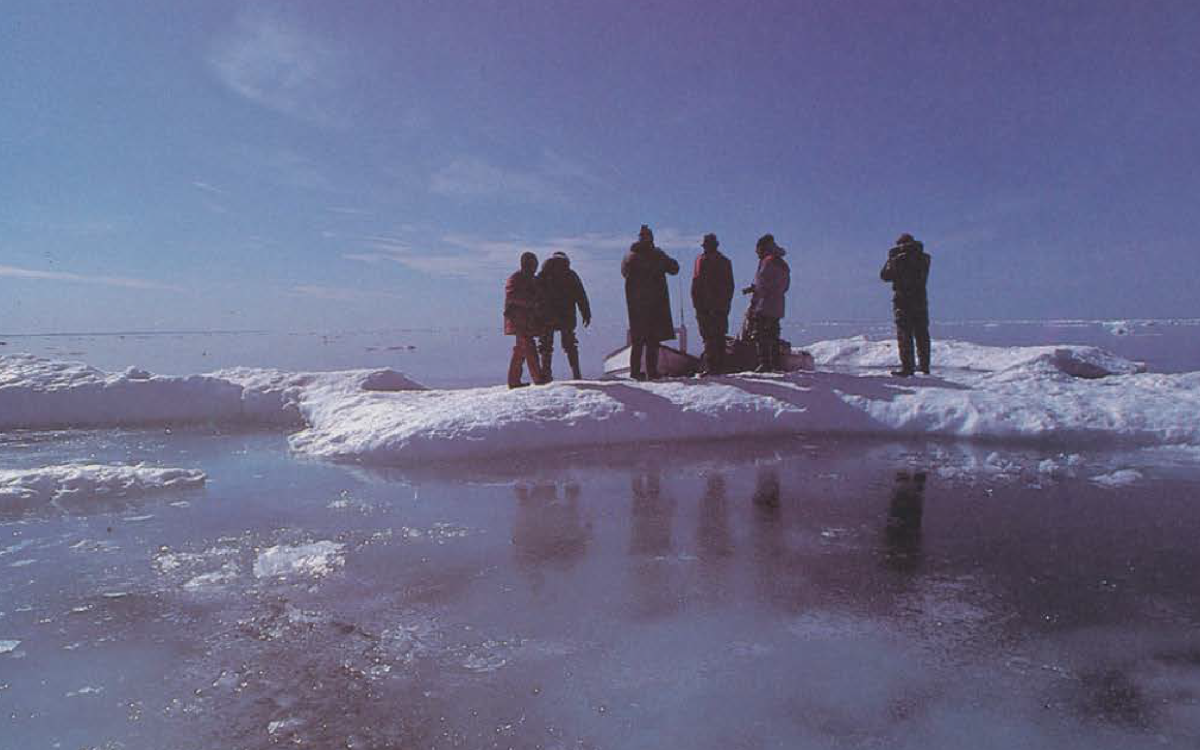
Up in the Arctic Islands, mosquitos are no problem. But the ocean doesn’t open to shipping until August — and has been known to stay solid all year round near some communities, though the permanent polar ice mostly hugs the northern shores of the outlying islands.
Even with our mosquitos, blackflies and bulldogs, we mainlanders are better off now than people who, 25 years ago, had no really effective repellents with which to greet the Northern spring.
Spring in those days was a time to flee the bush for the settlements or the coast, where breezes kept the bugs down. Now, thanks to bug juice, spring is a time to stampede into the bush once it’s dry enough to move about.
We do a fair amount of visiting in early spring, in the knowledge that when the good weather arrives you’re unlikely to see your friends again before fall, unless they visit you (or vice versa) at the cabin, or you run across each other in the bush.
Spring also creates an identity crisis.
In our socially free-and-easy world, we mostly get to know each other by our first names, the colour and design of our parkas, and our vehicles. When, thankfully, parkas go to the cleaners (after six months of constant wear, that becomes a spring priority), you suddenly find yourself staring blankly at people who have acquired ears, legs, bald spots or flowing tresses, and lost 40 pounds (bulky windpants are popular, too, in winter), until you hear them speak. (“Migosh, Ed! It is you!”)
If you knew Ed by his brown pickup, it’s quite disorienting to discover it’s really white, once it’s...
been washed. Indoor car washes are few and far between in the NWT. Street gutters — where they exist — are muddy, soapy seas for most of May as the garden hoses sluice the residue of last fall's puddles from the family vehicle.
The unkindest cut of all, come spring, is the fact that while southern Canada is still groping its way to work in the dark, we're basking in early morning sunlight — and still freezing to death. We get about four hours of daylight — from 11 a.m. to 3 p.m. — in Yellowknife in the dead of winter. But after December 21, we gain seven minutes of sunlight per day until June 21, when we hit 20 hours of sunlight. After that, we start losing seven minutes of sun per day, but it's never really dark until August.
Great Slave Lake, the world's 11th largest, is one of the few constants in the western part of the Territories; it hardly ever breaks up before June 10, even though the snow may be gone along both northern and southern shores by mid-May.
That makes every spring a potential disaster for Hay River, at the mouth of the river of the same name on Great Slave's south shore. The Hay, which rises in Alberta, breaks up long before the Big Lake, and ice can form a huge jam at its mouth, inundating docks and buildings in the older part of the town.
Northern Transportation Co. Ltd., which bases most of its fleet of Mackenzie River tugs and barges at Hay River, watches the approach of spring with particular trepidation. And even if all goes well — if no huge ice jam forms at the mouth of the Hay, or blasting can break it up — NTCL's first tug and its tow of barges won't head north until at least June 10. More often, June 15, says traffic coordinator Derek Briggs.
That first run usually is directly to Norman Wells, some 600 km north by river. Bulk freight and perishables for other communities along the river and Tuktoyaktuk, on the Beaufort Sea, follows; the rest of the Mackenzie is usually open by June 15. The first tug will pull into Tuk 10 days after leaving Hay River.
Break-up and freeze-up on the Mackenzie River at Fort Providence used to mean communities east of the river had to depend on perishables helicoptered across the Mackenzie or flown direct to Yellowknife from Hay River, for up to six weeks at a stretch. On bulk perishable items like milk, bread and fresh meat and veggies, that can mean a doubling of the price.
New ice bridge-building techniques and more powerful, ice-breaking ferries have largely eliminated highway traffic disruption at freeze-up. The Territorial highways division usually opens its Providence ice bridge (several kilometres upstream from the ferry crossing, where the river is wider and the current less swift) before the ferry has to stop running.
As yet, though, no one has devised a reliable way of swiftly clearing the rotten ice that chokes the ferry crossings in spring.
The 16-vehicle ferry Lafferty will likely open the season on the Mackenzie Highway's Liard River crossing near Fort Simpson around May 10, followed a couple of days later by the Merv Hardy at Fort Providence.
Spring is sprung; the world we knew emerges, paved in doggie doo, the legacy of bitter nights beneath the writhing Northern Lights when it was just too cold to shovel. Now sunshine's bared our grungy hovel. Spring in the North? A total bummer! Hurry up! We need YOU, Summer!
Antoine McKicker
This year, the smaller ferry Johnny Berens (8 vehicles) moves 60 km downriver from Fort Simpson to connect Wrigley to the Mackenzie Highway. The last necessary structure on the Mackenzie-Wrigley section, a 204 metre steel bridge across the Willowlake River, will be open this year by May.
Two Dempster Highway ferries, the Abraham Francis, which crosses the Peel River south of Fort McPherson and the Louis Cardinal, crossing the Mackenzie at McPherson to serve Inuvik, will be operating by June, says Russ Wiggs, senior advisor on marine programs to the NWT government.
This spring will see the resumption of work on Territorial parks and visitor services on the Mackenzie and Dempster Highways. Hot showers are available now at the Fred Henne Campground in Yellowknife, Blackstone Territorial Park on the Liard Highway and the Trout River Territorial park on the Mackenzie Highway. They should be operating later this year, as well, at Nitianlii Park on the Dempster and Lady Evelyn Falls, just off the Mackenzie Highway east of the Providence junction.
Highway workers have been busy, too, putting the final touches on construction plans and hauling gravel for stockpiles from Great Slave while the winter roads last.
Final details of a road-widening and asphalthing program on the Yellowknife Highway (20 km of reconstruction and 20 km of asphalt surfacing) are being worked out now, too, though work won't start before summer. With a new bridge over Mosquito Creek, southwest of Rae, due to open this fall, there'll only be 230 km of gravel left between Yellowknife and Edmonton.
In the south, people wait for the robins to reappear. We'll see some, too, in Yellowknife. But I'll know spring is here when the neighbours down the street haul their cabin cruiser out of storage, park it at the curb and move into the cockpit, to paint and polish and maybe enjoy a glass or two while they wait for the ice to go in Yellowknife Bay.