As the nights get longer and winter snows return to the North, many people go out to seek the northern lights. But aurora seekers are not alone. Owls are also out there patrolling forest openings, marshes and roadsides on silent wings, ready to swoop down to take their prey. For these master hunters, the darkness is not a problem because they have several superpowers.
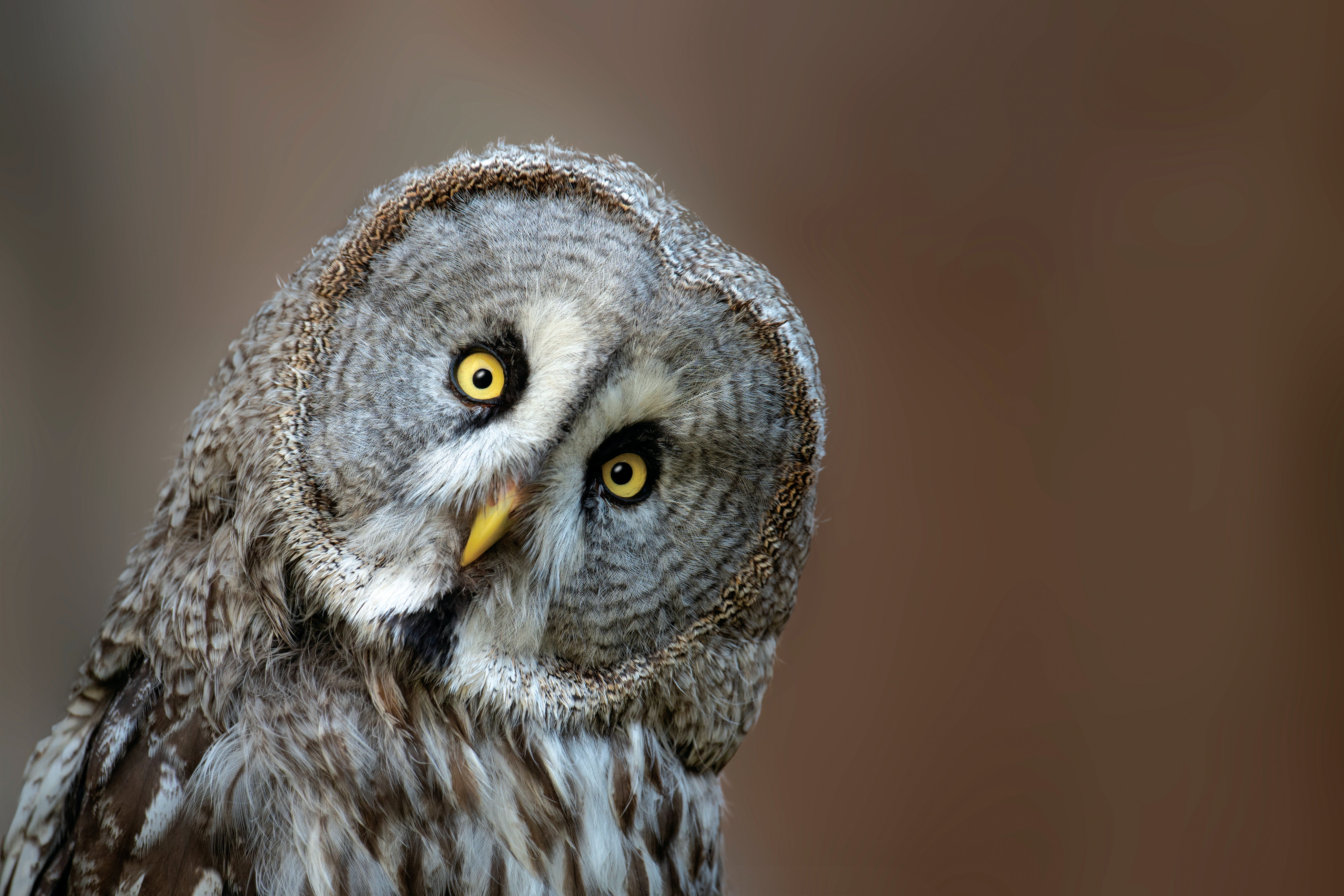
First, the ears in most owl species have wide openings and large tympanic membranes and sit at different heights on the sides of their skulls. This asymmetrical arrangement allows the birds to triangulate the faint sounds of potential prey. In addition, radiating stiff feathers form circular facial disks that channel sound waves to the ears.
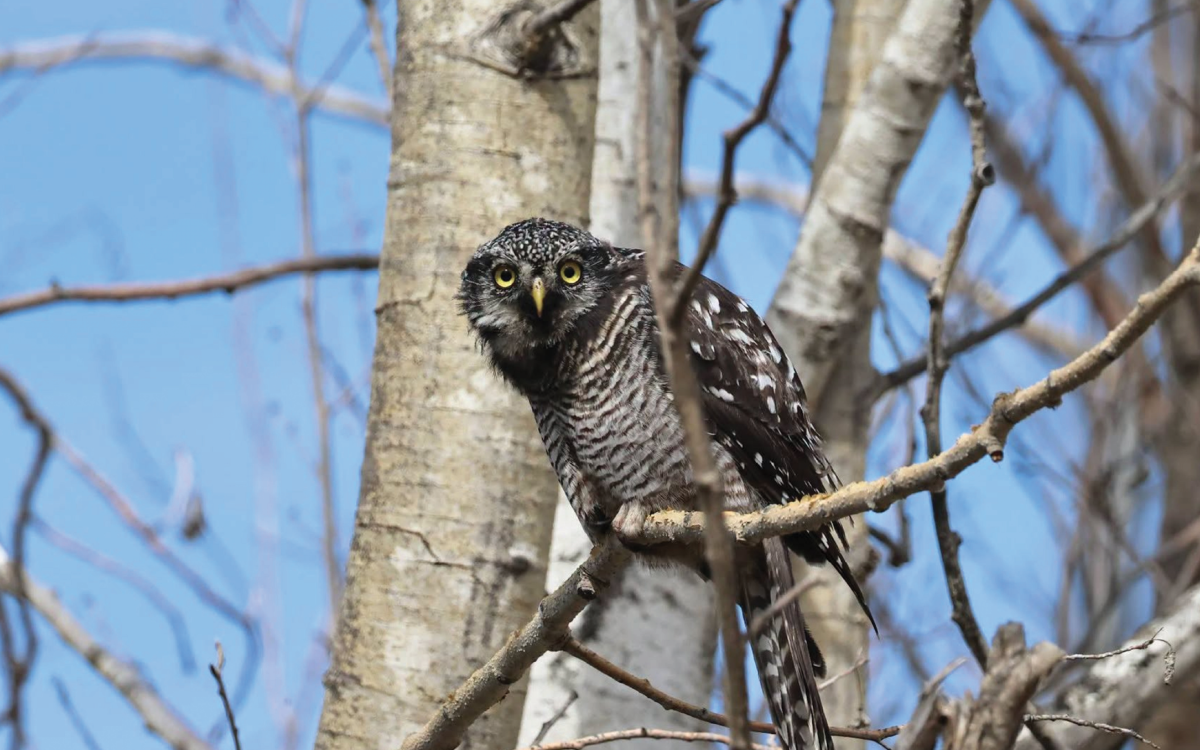
Second, the large eyes on the front of their heads give them binocular vision. Owls cannot move their eyes—you’ll never see one give you an eyeroll—because they’re locked in place by bony plates called sclerotic rings, so they must move their heads to zero in on prey. With 14 neck bones, they can turn their heads more than 270 degrees.
Third, they fly silently. Most owls have specific flight feather modifications that decrease flight sounds. It has to do with the movement of air over the wing. Tiny, stiff modified feathers on the leading edge of the wing work in unison with fringed ends of the feathers on the trailing edge, and the velvety surface of the wing feathers all cause disruptions to airflow, reducing sound. Their broad wings allow slower flight and better surveillance for prey.
Fourth, their talons are sharp and formidable. Most northern owls have feathered legs and feet with four toes, two pointing forward and two backward, one of which is variable and can go either way. For perching securely, they use the two-forward, two-backward technique, but to immobilize prey, they use three toes forward and one back. Talons are also useful for defence and an owl will not hesitate to throw itself on its back, talons up, causing most predators to pause and reflect.
Obligate carnivores, owls depend on small mammals and birds in winter. During the snowless seasons, their diet expands to include insects, amphibians and (rarely) fish. They usually take prey to a high branch to feed in peace and avoid ground predators. Although most owls gulp their food whole, they can’t digest fur, feathers, bones, teeth, claws, beaks and hard insect parts. In their stomachs, these indigestible items are sorted out and packed into pellets, then vomited up during roosting. When feeding their young, owls tear the prey into smaller bites, but the young also regurgitate pellets. The pellets provide researchers with a good index of what the owl is eating. In the High Arctic, isolated stones on ridges are often surrounded by thick vegetation, fertilized by generations of snowy owls depositing pellets and feces.
For the most part, these birds are solitary, joining a partner only to mate, incubate eggs and raise their young. However, some short-eared owls congregate on roosts during migration and in winter, often leading to multiple sightings in an area. Owls don’t “build” nests, though some will add twigs to the top of a broken snag to support the eggs and brooding owl. They mostly use old raven nests, deteriorating magpie nests or in old rough-legged hawk nests on ledges. Tiny species such as the boreal owl and northern saw-whet owl nest in holes in trees and will use nest boxes. Short-eared and snowy owls nest on the ground, vulnerable to predators such as foxes, wolves, wolverines and other mustelids, jaegers, gulls and even, surprisingly, to caribou, deer and other so-called “herbivores.”
Some species use feather and wing sounds to communicate—short-eared owls can cause clapping sounds with their wings when courting, defending a nest or driving off a rival. I heard this once and didn’t have a clue what it was. I was watching a northern harrier (also called a marsh hawk), hunting low over brushy tundra up along the Arctic coast. He suddenly dropped out of sight, and I heard a racket of percussive sounds and saw a tumbling mass of birds.
The harrier had found a short-eared owl nest on the ground and was attacking the young. The parent owls were whirling around, clapping wings and emitting creaking insect-like defence sounds to try to drive off the hawk. They were unsuccessful; I saw one owl fly off, and then the other. The hawk remained in the willows for a while, then flew away, lower than usual. Maybe carrying one of the owlets? I could not tell. I went down later and found only a few owl feathers and a flattened cup that could have been the nest. I saw the adult owls the next day, hunting over the Burnside delta, but I didn’t see them near the nest area again that year.
In the North, you can expect to find boreal owls, northern saw-whet owls, short-eared owls, long-eared owls, northern hawk owls, barred owls, great horned owls, great grey owls and snowy owls. The short-eared owl, which has the broadest global distribution, relies strongly on small rodent prey, mostly voles, and is somewhat nomadic. It tends to hunt in twilight or even daylight, so it is one of the northern owls most easily observed in flight, which is moth-like and low over the vegetation. But, in Canada, the short-eared owl is now categorized as “Threatened” on the national species-at-risk list. This is likely due to exposure to pesticides through its prey and its vulnerability to nest destruction during farming activities and habitat destruction on its migration routes and wintering areas.
Conversely, the dark-eyed barred owl is rapidly extending its range in North America, northward and westward to the Pacific coast and into the North. We can expect to hear more of their “who cooks for you, who cooks for you, who cooks for you-all?” songs in future.
Listen for these expert hunters the next time you are aurora hunting or wandering the boreal forest at twilight. Northern owls court and nest from about February through May, so they are most vocal at that time, less so when raising young. And if you get the feeling that you’re being watched, look for yellow eyes above a branch or all you may see is a shadow in silent flight.