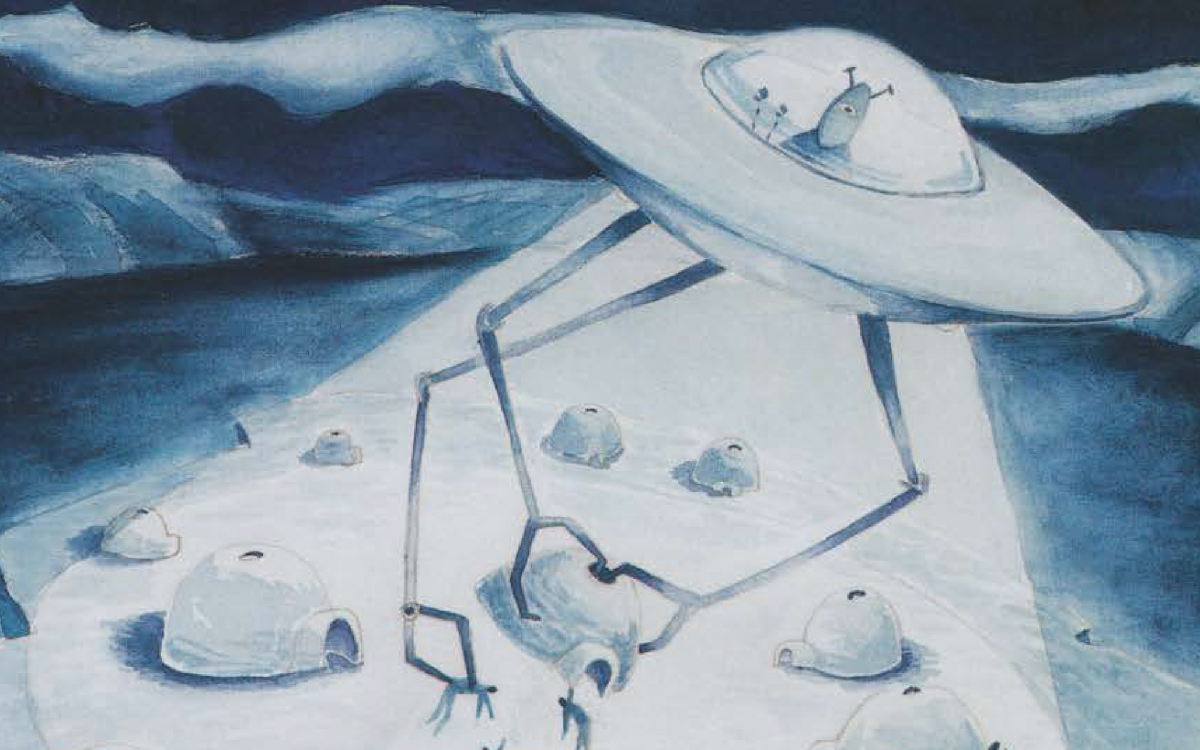
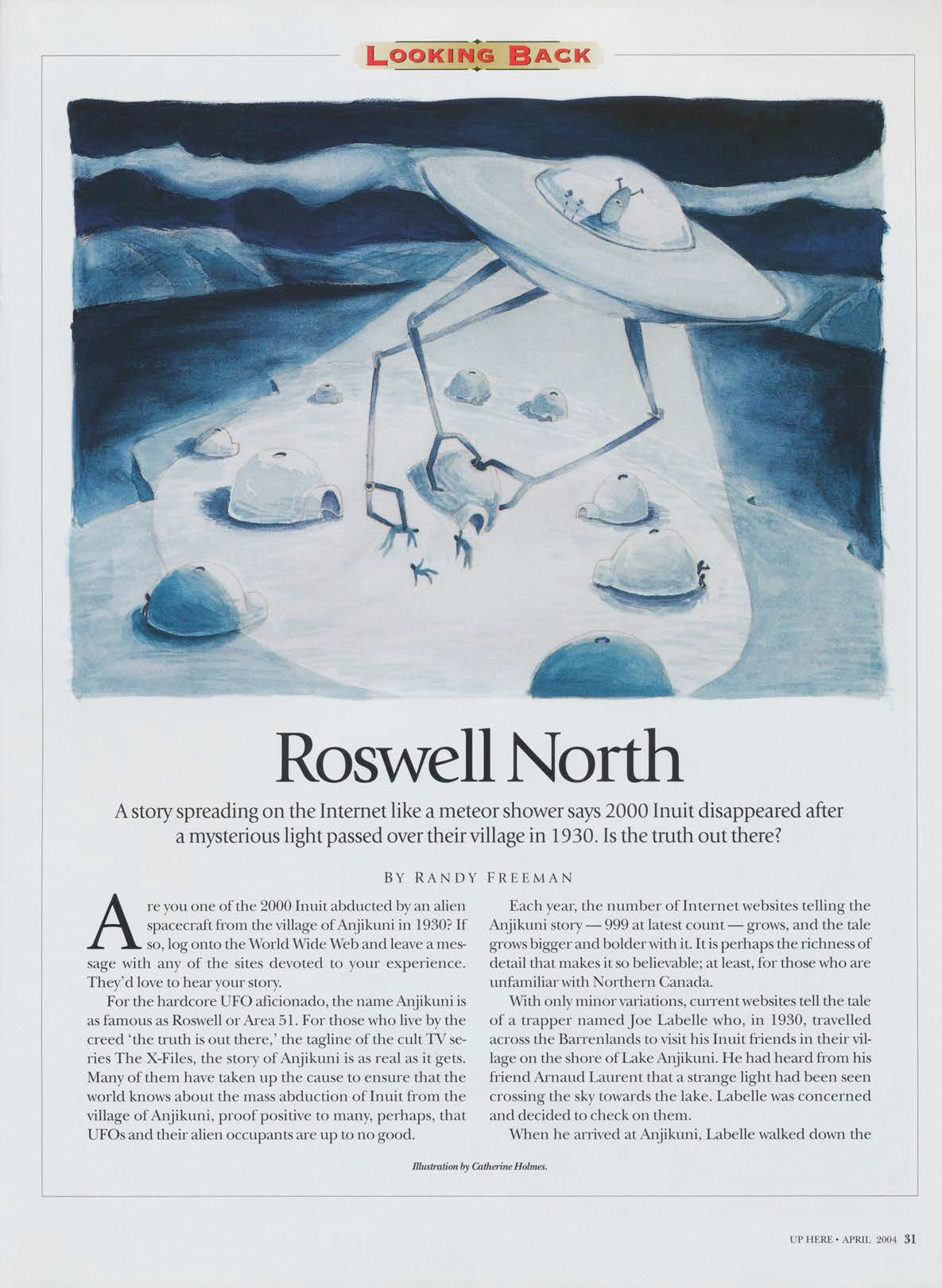
Are you one of the 2000 Inuit abducted by an alien spacecraft from the village of Anjikuni in 1930? If so, log onto the World Wide Web and leave a message with any of the sites devoted to your experience. They’d love to hear your story.
For the hardcore UFO aficionado, the name Anjikuni is as famous as Roswell or Area 51. For those who live by the creed ‘the truth is out there,’ the tagline of the cult TV series The X-Files, the story of Anjikuni is as real as it gets. Many of them have taken up the cause to ensure that the world knows about the mass abduction of Inuit from the village of Anjikuni, proof positive to many, perhaps, that UFOs and their alien occupants are up to no good.
Each year, the number of Internet websites telling the Anjikuni story — 999 at latest count — grows, and the tale grows bigger and bolder with it. It is perhaps the richness of detail that makes it so believable; at least, for those who are unfamiliar with Northern Canada.
With only minor variations, current websites tell the tale of a trapper named Joe Labelle who, in 1930, travelled across the Barrenlands to visit his Inuit friends in their village on the shore of Lake Anjikuni. He had heard from his friend Arnaud Laurent that a strange light had been seen crossing the sky towards the lake. Labelle was concerned and decided to check on them.
When he arrived at Anjikuni, Labelle walked down the...
...empty streets and became alarmed when he didn’t see smoke coming from the chimneys. He went into each home to discover uneaten meals and abandoned personal possessions. He noted the rifles were in their usual place, leaning against the wall near the front door of each house. This was the clincher for Joe Labelle that something sinister had happened; he knew his Inuit friends would never leave without their prized rifles.
Two thousand men, women and children — gone. But perhaps the most disturbing thing, as described by some of these websites, was that all the graves in the ‘town graveyard’ had been dug up from the frozen ground. Aliens had obviously gone to a lot of trouble to not only abduct the living but also the dead.
While some websites don’t bother to address whether or not anyone noticed that hundreds of people had disappeared without a trace, others claim the Royal Canadian Mounted Police searched all of Canada and made inquiries throughout the world for the missing villagers. They didn’t find any.
That’s how the story goes, for the most part, on the World Wide Web. Now take a closer look. Detailed maps of Canada’s North lend some credibility to the beginning of the tale. There is indeed a lake on the Kazan River, midway between Great Slave Lake and Hudson Bay, that carries the name Aniguni, although it is spelled with a ‘g’ instead of a ‘j.’ Spelling variation aside, it is a real place.
However, this real place would not have streets and houses. Inuit were still semi-nomadic in the early 20th century, following the cycles of animal and fish. Besides, Anjikuni was supposedly north of the treeline — what would they have been burning in their fireplaces?
Then there are the alleged couple thousand souls who vanished. Apart from the fact that Inuit wouldn’t travel in such large groups, in 1930 the entire population of the Northwest Territories, which included present-day Nunavut, was less than 10,000. Isolated as it was, someone would have noticed that a fifth of the territory’s population had gone missing. And how many people can you cram into a UFO, anyway?
You can trace the story of the missing “Eskimo” of Anjikuni back to earlier Internet incarnations. In 1999, a mere 22 sites told the tale. The details were mostly the same, including the suspected abduction by a UFO, but in these stories only 1200 people went missing.
Take another step back in time, to the days before the Internet, and the story takes on a completely different tone. According to Woody Gelman and Barbara Jackson in their 1976 book Disaster Illustrated: 200 Years of American Misfortune, just 30 men, women and children vanished. Their story is a simple one of an unexplained disappearance. They tell of Joe Labelle finding his friends gone, their huts empty, their kayaks and rifles abandoned and a single grave, in the form of a stone cairn, dismantled and empty. The authors don’t mention UFOs.
Many of these details can also be found in Frank Edwards’ 1959 book Stranger Than Science. He is the one who claimed that in 1930 the RCMP conducted “months of patient and far-flung investigation” and that the mystery, at least at the time of his book’s release, was still unsolved.
Edwards was also one of America’s most popular radio broadcasters in the 1950s, with an estimated 13 million listeners tuning in to his evening Mutual Radio Network broadcasts. He introduced listeners to the mystery in Canada’s Far North.
Though Edwards didn’t mention flying saucers and aliens in his telling of the story, in the 1950s he was instrumental in stirring public interest in UFOs through his broadcasts and books. It’s perhaps because of Edwards’ notoriety that a connection was made between Anjikuni and UFOs, at least in the fertile imaginations of modern-day UFO website authors.
Yet the story of Anjikuni is not a product of the fertile imagination of Frank Edwards. He based his version on an article, distributed over the Newspaper Enterprise Association network that appeared in hundreds of Canadian and American newspapers during the first week of December 1930.
It all started with the Halifax Herald’s November 30, 1930 edition. In an article titled “Tribe Lost in Barrens of North: Village of Dead Found by Wandering Trapper,” Joe Labelle’ Emmett E. Kelleher, a reporter living in Flin Flon, Manitoba, described how a trapper from Flin Flon had stumbled across six empty skin tents pitched along the shore of Lake Anjikuni in the Northwest Territories.
In these tents he found cooking utensils, skin parkas, pairs of boots and a single rusty rifle hidden under a caribou skin. Outside he found the remains of several dogs and several more that he described as “walking skeletons.” His most surprising discovery was an Inuit grave, a cairn built of stones, that had been dismantled with no sign of the former occupant.
Labelle claimed “the whole thing looked as if it had been left just that way by people who expected to come back. But they hadn’t come back.” He told the reporter he had no idea what happened to the two dozen or so people who once occupied the camp but suggested that it may be the work of “the Eskimo’s evil spirit” Tornark.” In a time before UFOs became popular scapegoats for unexplained disappearances, why not blame ‘evil spirits’?
It is true the RCMP were involved in the case, but the focus of their investigation was on Kelleher and Labelle. There was no need to investigate the disappearance of a large group of Inuit because, as they concluded in 1931, it never happened.
In January 1931, Sergeant J. Nelson of the RCMP detachment in The Pas, Manitoba, chief investigator of the case, wrote in his report: “Joe Labelle, the trapper who is alleged to have related the story to Emmett E. Kelleher, the correspondent, is considered to be a newcomer to this country... and doubts are expressed as to whether he has ever been in the [Northwest] territories.”
Nelson goes on to state that: “Mr. Kelleher is in the habit of writing colourful stories of the North, and very little credence can be given to his articles.” The officer concludes his report by stating that “the case for the vanished village rests upon the story of an inexperienced trapper told to an imaginative and not too conscientious newsman.”
This police investigation should have brought an end to the story, but it didn’t. And the tale could have been laid to rest when it was again thoroughly debunked, first in an article written by Dwight Whalen for the November 1976 edition of Fate magazine and again in John Colombo’s 1988 book entitled Mysterious Canada. Again, the story continued to flourish.
With one or more people having made a connection between Anjikuni and UFOs and the case with which sites can proliferate on the World Wide Web, there’s probably no way to stop its spread. Someday, someone in Hollywood may take notice and the story might make it to the silver screen. Close on the heals of a blockbuster film, could kiosks on the shores of Lake Anjikuni, selling alien bumper stickers and alien head salt and pepper shakers, be far behind?