SNOW COVERS THE LAND, horizon to horizon, faint traces of ridges breaking the white blanket. On a crest, a muskox paws the ground to expose the thin vegetation. In the lee of the hill, the snow moves and a small reddish head appears, bright button eyes staring warily. An Arctic ground squirrel, just out of hibernation, stands ramrod straight, then dashes to the ridge, where he picks through trampled ox tracks, gleaning bits of vegetation. Then he bounds to another ridge where he stands again, scanning the area. Spring has arrived and ground squirrels are out and looking for mates.
With one of the longest hibernation periods of any mammal, Arctic ground squirrels spend more time in torpor than in active life. Hibernation is a seasonal state of reduced activity, including a drop in metabolism, lower body temperature, decreased heart rate, significantly slowed breathing and the cessation of regular feeding. For Arctic ground squirrels, it has traditionally lasted from August or September until late April or early May. But that may be changing; and because they are a keystone species, one of the true bases of the food chain over much of the mainland Arctic, the changes will have far-ranging effects.
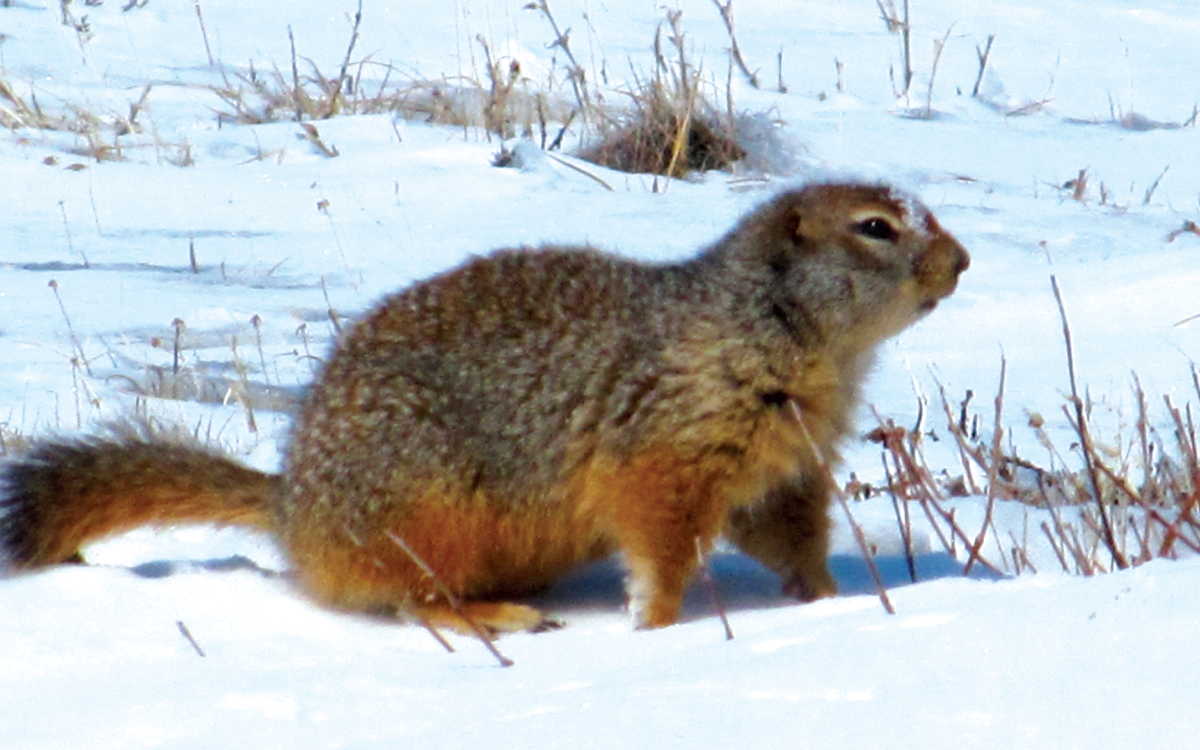
Called siksik in Inuktitut, hikhik or highik in Inuinnaqtun or didi in Tlicho, after their alarm calls, the Arctic ground squirrel (Urocitellus parryii) is related to tree squirrels, chipmunks, flying squirrels, marmots, groundhogs and prairie dogs. Covered with dense, short fur, these rodents have a white-patterned grey back and are reddish orange on their sides, belly and head. Their ears are short, and they have large eyes on the sides of their head that allow a 360-degree view. Long claws aid in digging and large cheek pouches allow them to transport food and bedding. Their long incisors grow throughout their lives, and they must gnaw to keep them sharp and aligned.
Omnivores, siksiks eat leaves, stems, roots, flowers, seeds and, sometimes, bark. They avidly seek out mushrooms and will eat some insects or even stranded fish. Carrion, injured small mammals, bird eggs or nestlings are all acceptable to a hungry ground squirrel. Males are often cannibalistic on young siksiks, especially those that are not their own offspring. Shed caribou antlers are also on the menu, supplementing their calcium. And they’re expert in getting into waste bins or buildings to steal human food.
Adult ground squirrels weigh between 300 grams (females) and 800 grams (males). Predators include foxes, weasels, wolverines, wolves, bears, eagles, hawks, gyrfalcons, snowy owls, jaegers and some peregrines and gulls. Traditionally, Indigenous groups used ground squirrels for food, children’s clothing, small bags, parka trim and more.
After a gestation period of 25 days, a female produces a litter of five to 10 kits in an underground chamber. They require constant care, but they grow quickly. Once out of the den, usually in late June along the Arctic coast, they stay close to the burrow for several weeks. Young ground squirrels are playful, wrestling and tumbling about like puppies and chasing each other. Adult females act as sentinels, standing erect and scanning for predators. They have separate calls—chattering or whistling—for ground versus aerial predators, and the calls are echoed and passed on from burrow to burrow.
Arctic ground squirrels change their surrounding environment. They construct complex burrow systems, which can have 12 to 15 entrances, in compacted sandy soil; these aerate the soil, allow water penetration, spread nutrients and encourage the lush growth of plants around burrows. Nearby rocks used as lookouts can often be identified by the growth of bright orange jewel lichens due to enrichment by ground squirrel urine. And one Alaskan study records ground squirrels moving 7.2 tons of material per acre (18 tons per hectare) per year.
In the ground squirrel’s matriarchal system, burrows are usually shared by a mother and her daughters. Young males are banished at the end of their first summer, and older males are allowed access only when the females are receptive, usually in May. The males construct solitary burrows nearby. Strangely enough, in a land with constant summer daylight, ground squirrels follow a generally diurnal pattern, sleeping until about 6 a.m., napping during the day and retiring to their burrows about midnight.
During hibernation, siksiks use special burrows with sleeping chambers lined with grasses, and female dens are provisioned with seeds, berries and grasses. Like bears, ground squirrels become hyperphagic in fall, eating voraciously and building up large amounts of fat. In hibernation, their body temperature drops to about -3oC, the lowest temperature of any hibernating mammal. But their heads and necks stay slightly above freezing, allowing them to survive. Respiration drops to about one to two breaths per minute and heart rate to one to three beats per minute. Metabolism is about two per cent of normal, the lowest of any hibernator.
Hibernating siksiks awaken at irregular intervals, for one to three days at a time, for rewarming through shivering and thermogenesis (metabolizing brown fat tissue and fatty acids). This elevates their body temperature and, strangely enough, they drop into regular sleep at those times. This is thought to be a mechanism for supporting brain function. Hibernation is unlike sleep; the brain patterns typical of sleep are not present.
But climate change may affect hibernation in ground squirrels, according to a 25-year Alaskan research program. Males commonly left their dens about two weeks earlier than females, but because the active layer of soil over the hibernacula now isn’t frozen for as long, female siksiks now appear as much as two weeks before males. As the male comes out of hibernation, his activated metabolism allows spermatogenesis (development of sperm), though this takes a couple of weeks. Unfortunately, females are in heat for only one to two days. With females now emerging earlier, there may be no males available when they’re ready to mate. If this results in a drop in population, it could mean fewer ground squirrels as prey and affect food chains across the Arctic. Small changes can have far-reaching effects indeed.