People have lived in what we call the Canadian Arctic for about 4,000 years. The area around Hudson Bay and across the northern coast has been ice-free for only about 8,000 years, and some areas in the High Arctic and on Baffin Island for much less time than that. After the retreat of the great continental ice sheets, it took about 2,000 years for a wet, gravel-strewn landscape to become covered with low tundra vegetation. Once there was food on land and sea, animals moved in and humans followed from the west. The people now known as Inuit came here about 1,000 years ago, while also spreading east to Greenland and Labrador and south along Hudson Bay.
Living in the edge of the habitable world wasn’t easy. Winters were long and brutally cold, the winds were strong and food and usable water were scarce, but the people were resourceful. Although they had no significant wood, no metal tools and no fabrics, they had large mammals and stones in abundance—and extraordinary skill. In winter, a stone and sod house or snowblock iglu worked well; in summer, they relied on stones and turf, bones, hides, baleen, sinew, hoofs and horns to construct housing and tools. Because stone lasts, their arrangements—rocks adjacent to each other, stacked precisely or forming symmetrical patterns—tell the stories. If you’re out on the land, here’s what to look for.
TENT RINGS
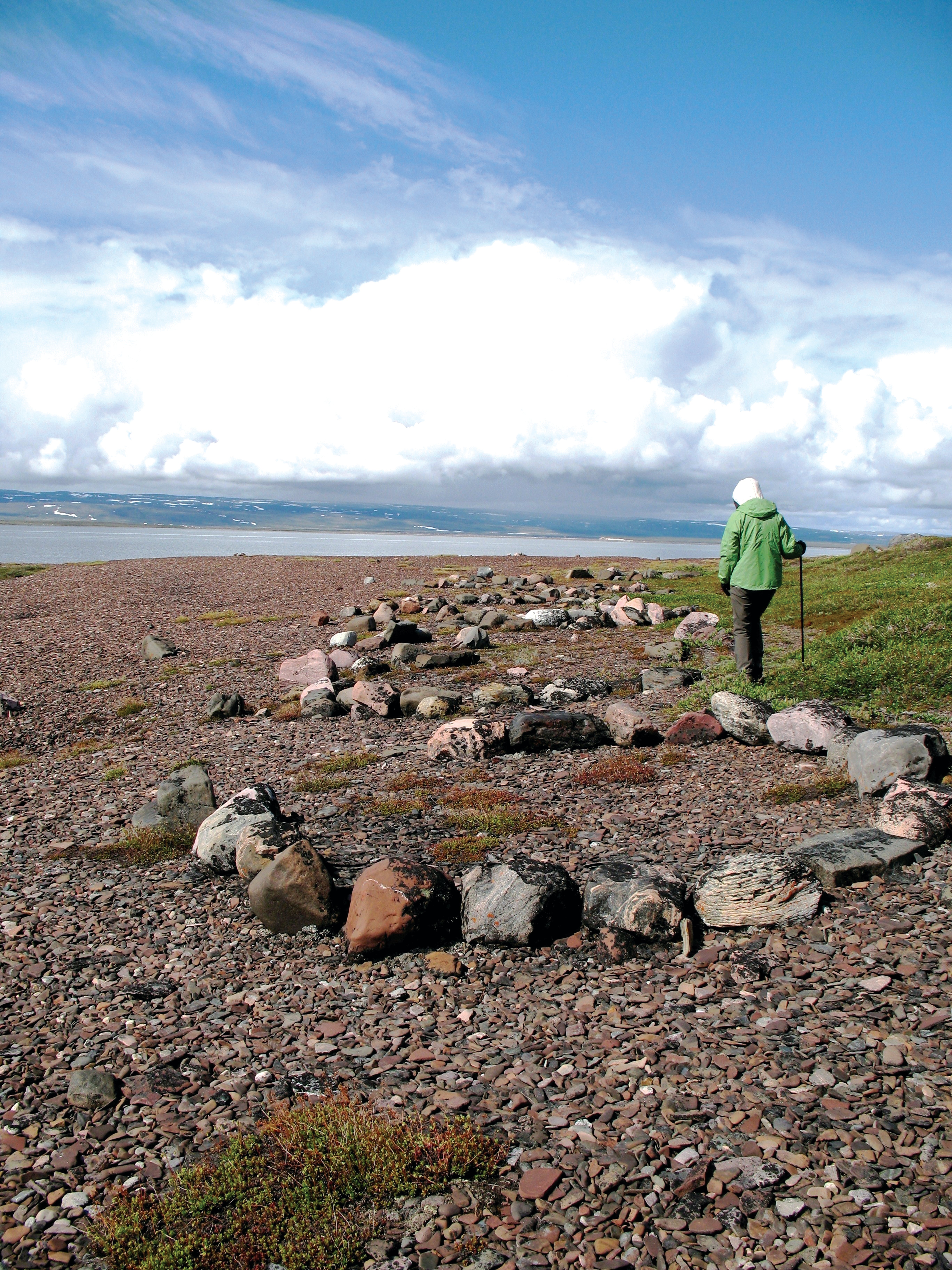
Prior to the development of communities, Inuit lived in caribou or sealskin tents in the summer and early winter while hunting on the land or fishing in rivers. In some areas far from sources of wood, these tents were carefully constructed and supported by only one or two poles. Complex sewing shaped the structure of the tents, which were anchored by stones. The Thule usually used two circles of stones, one inside and one outside. Both the rocks and the circles were large. The modern Inuit used a single ring of stones. Most tent rings included cooking areas, a place to sit and a flat area for sleeping, often delineated by rocks. A layer of twigs in the sleeping area helped keep bedding off the damp ground.
FIRE HEARTHS
Cooking was done outside the tent in good weather, inside in bad. Small fires were kindled in tiny hearths made of three stones, with a slab underneath to support the fire, and sometimes a flat rock on which to cook meat. People used what fuel they could find, including twigs, lichens and the foliage of Labrador tea and Arctic heather, which burn even when green. They used pots carved out of stone to heat water and meat to make soup.
DRYING RACKS
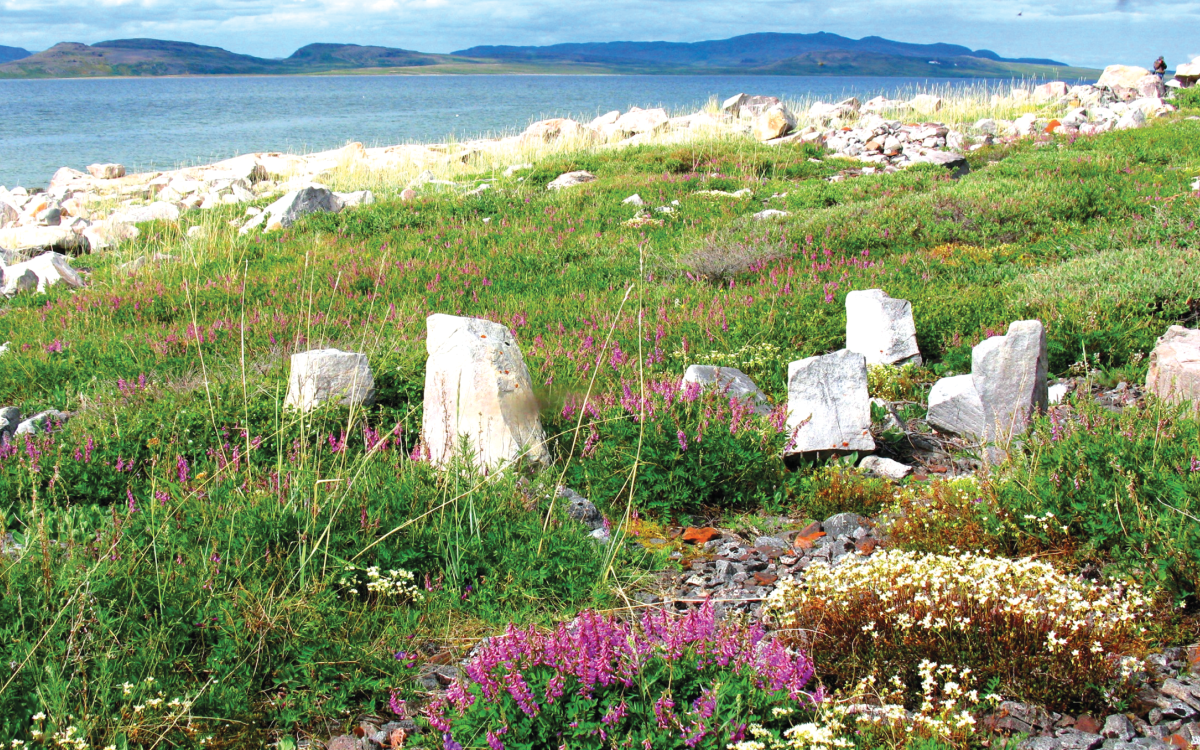
After fishing or hunting (mostly caribou in summer), people often dried the meat to preserve it. To make a drying rack, they set rocks upright and propped them up with other stones, then strung sealskin or caribou-skin thongs from an anchor rock to the top of several stones with a tensioning rock at the other end. As they put fish or meat on the rack, they tightened the thong by adding other stones as counterweights to keep the food off the ground.
STORAGE CACHES
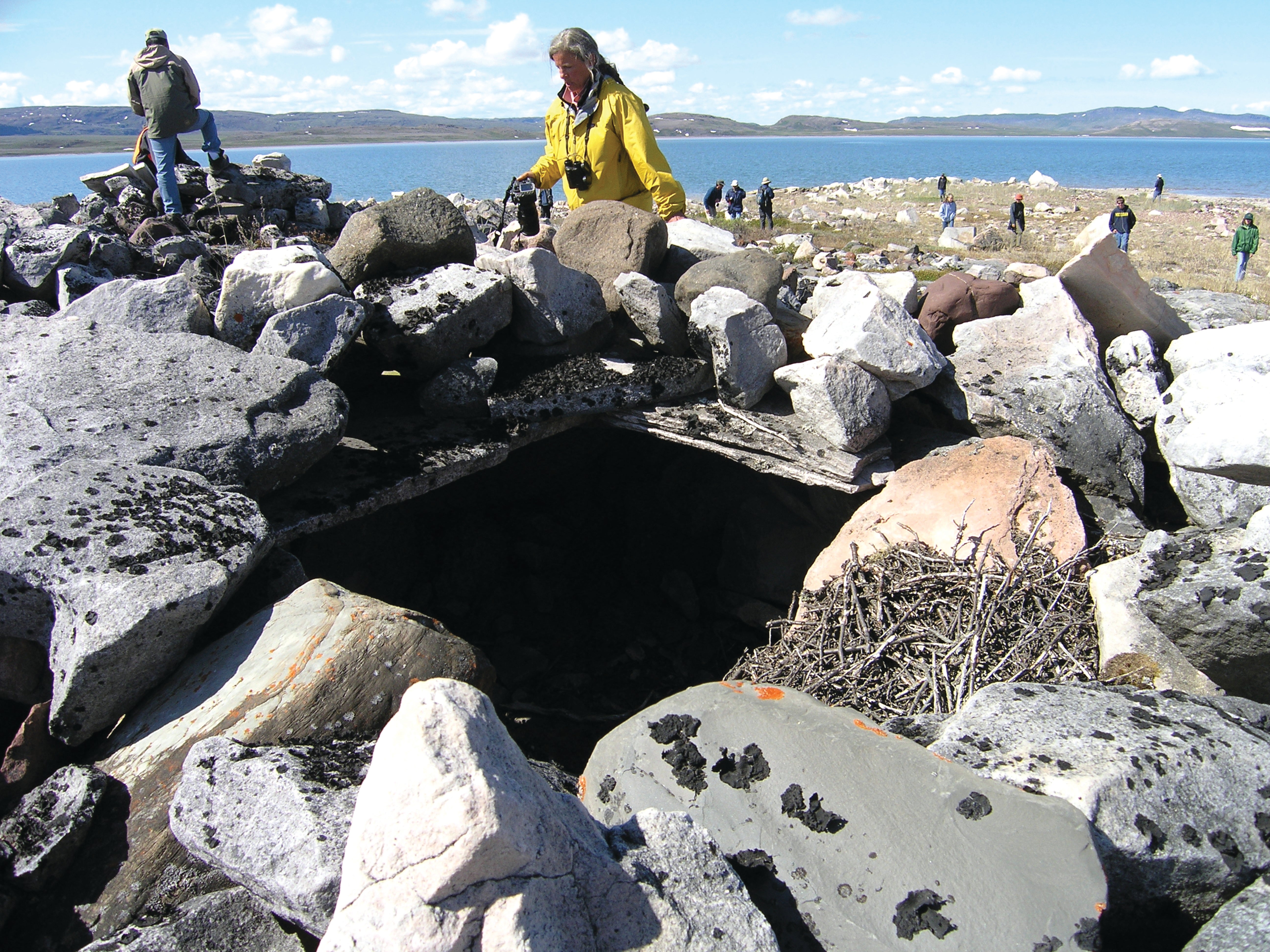
Once the meat dried, they placed it in storage caches for protection from weather and animals, including foxes, wolverines, birds and maybe wolves. But bears could open any cache a human could build.
Some caches near the sea were for storing winter clothing not needed for the trek inland to hunt caribou in summer. These caches were made of large, heavy stones because the clothing was something the people did not want to lose. A layer of twigs at the bottom kept the clothing dry, and the clothing was tightly wrapped in caribou skins to protect it from the damp and from animals. Another layer of caribou skins, with the hair facing up, went over the bundles to shed the rain. Seal harpoons, scoops used to clear ice holes and cooking utensils such as the stone lamps and pots not needed inland would also go in these caches.
People used standing stones at the edge of cliffs and steep hillsides to protect precious items such as bags of seal blubber (fuel for the stone lamps). Using a sled as a ladder, they heaved the sacks up onto the stones. Over time, blubber leaked out and dribbled down the stones, drying into dark waxy streaks still visible today.
KAYAK RACKS
Kayaks were good for manoeuvring to spear caribou in the water or to hunt seals. In the central Arctic, Inuit usually made these single-person boats from dehaired caribou skins stretched over a wood frame. Immersion moistened and loosened the skin, so the kayaks had to be dried out between hunts. Stones supported the boats up on a ridge where they would dry out. These were often adjustable, with the stones on one side leaning against one another. The support stone could be moved in and out to widen the “V” of the rack.
HUNTING "HIDES"

Caribou are highly mobile, often travelling in herds, with many eyes and noses to alert them to danger. Hunters used spears, bows and arrows and occasionally traps to secure their prey. Even the strongest muskox horn bow was effective to only about 15 metres, so hunters had to get close. Game drive systems using stone cairns (inuksuit) helped funnel the caribou into a killing zone. Crescentic stone hunting “hides” (taluit) allowed hunters to crouch behind the walls of the hide, rising up to shoot when the animals came within range.
This is only a light sampling of the signs of traditional Inuit life. The land you may be exploring was home to a resilient and innovative people for centuries. Please refrain from disturbing these places; move no stones and do not camp on any possible archaeological site. It is illegal in Canada to collect any artifacts.