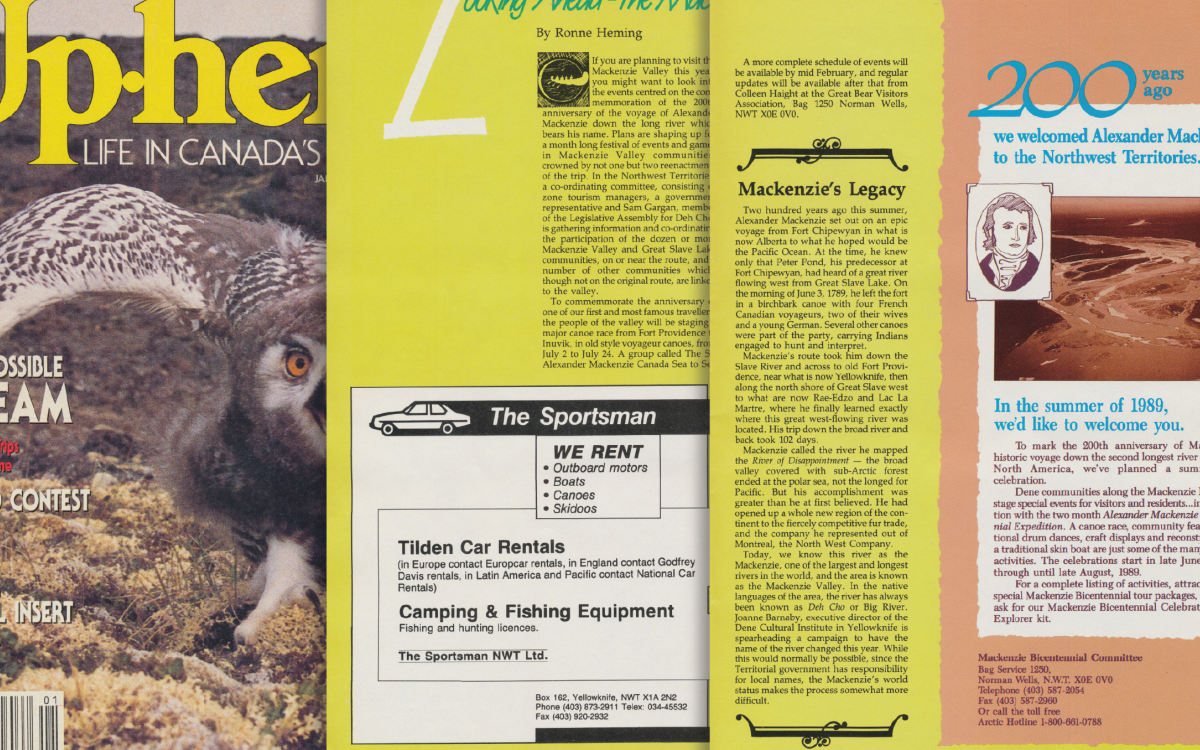

If you are planning to visit the Mackenzie Valley this year, you might want to look into the events centred on the commemoration of the 200th anniversary of the voyage of Alexander Mackenzie down the long river which bears his name. Plans are shaping up for a month-long festival of events and games in Mackenzie Valley communities, crowned by not one but two reenactments of the trip.
In the Northwest Territories, a co-ordinating committee, consisting of zone tourism managers, a government representative and Sam Gargan, member of the Legislative Assembly for Deh Cho, is gathering information and co-ordinating the participation of the dozen or more Mackenzie Valley and Great Slave Lake communities on, or near the route, and a number of other communities which, though not on the original route, are linked to the valley.
To commemorate the anniversary of one of our first and most famous travellers, the people of the valley will be staging a major canoe race from Fort Providence to Inuvik, in old-style voyageur canoes, from July 2 to July 24. A group called The Sir Alexander Mackenzie Canada Sea to Sea Bicentennial Expeditions will also canoe the river from June 28 to July 13 reenacting the event.
Sam Gargan, the NWT’s race organizer, is planning for 27 entries — each a six-man team, drawn from communities in the Mackenzie Valley and across the NWT. At press time, close to half the positions had been reserved.
In addition, each community along the route is planning events to coincide with the arrival of the modern voyageurs, who will spend a day in each community.
Fort Providence leads the list with a festival of the performing arts, starting June 28 and running through July 2, when the canoe race begins. This will involve fiddling, jigging and drumming for both children and adults.
At Hay River, the Hay River Dene Band is planning a feast and harbour boat tours. In Fort Simpson, the canoeists’ arrival will coincide with Deh Cho Days, an annual summer event of community activities and games.
Other communities down river have not finalized plans, but at the very least there will be some sort of festivity connected with the race, a barbeque, a dance or a feast to mark the occasion.
Norman Wells is planning an invitational fastball tournament. Fort Norman is discussing the construction of a mooseskin boat (a traditional form of transport used in the spring to bring valley people back from the mountains). The boat would meet the voyageurs, and travel at least part way down river with them. Fort Good Hope will be hosting the summer Dene Sathu games.
The canoe racers will arrive in Inuvik July 24, where the 1989 Dene National Assembly will take place, and packages will be available to take visitors to other Delta communities.
Starting earlier in the spring, the Sir Alexander Mackenzie Canada Sea to Sea group will reenact Mackenzie’s expedition from May through August in Alberta and the NWT. Jointly organized by Lakehead University and One Step Beyond — the 1989 trip is part of a planned five-year program to promote Canada’s adventurous heritage and the important role that adventure and entrepreneurship play in today’s world.
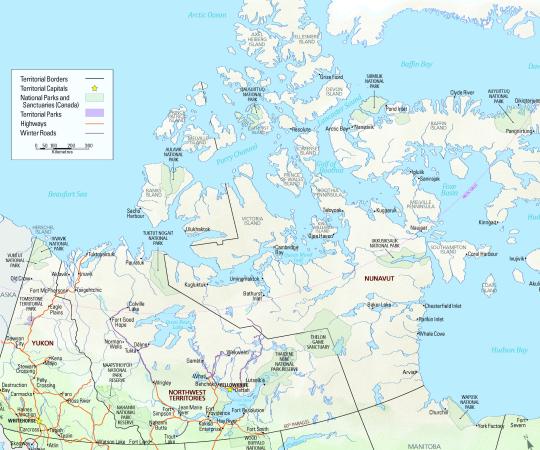
Starting in Fort McMurray, the Canada Sea to Sea group anticipates stopping in Fort Chipewyan, Fort Smith, Yellowknife, Hay River, Fort Providence, Fort Simpson and Inuvik. Other communities may be on the itinerary, at press time plans were still being confirmed. Canada Sea to Sea will stage ceremonial arrivals at each community to help recreate the story of one of Canada’s great adventure travellers.
Mackenzie’s Legacy
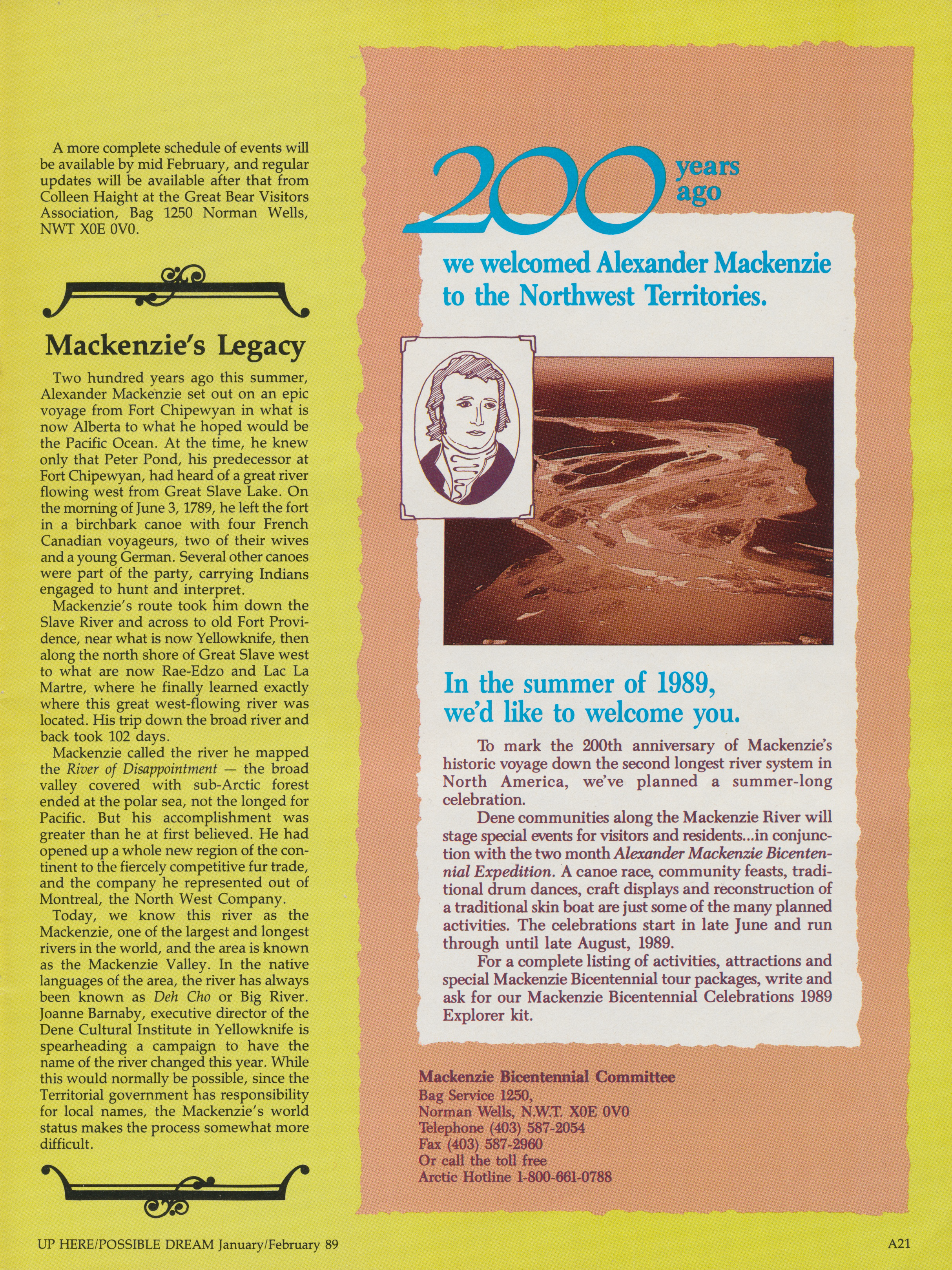
Two hundred years ago this summer, Alexander Mackenzie set out on an epic voyage from Fort Chipewyan in what is now Alberta to what he hoped would be the Pacific Ocean. At the time, he knew only that Peter Pond, his predecessor at Fort Chipewyan, had heard of a great river flowing west from Great Slave Lake.
On the morning of June 3, 1789, he left the fort in a birchbark canoe with four French Canadian voyageurs, two of their wives and a young German. Several other canoes were part of the party, carrying Indians engaged to hunt and interpret.
Mackenzie’s route took him down the Slave River and across old Fort Providence, near what is now Yellowknife, then along the north shore of Great Slave west to what are now Rae-Edzo and Lac La Martre, where he finally learned exactly where this great west-flowing river was located. His trip down the broad river and back took 102 days.
Mackenzie called the river he mapped the River of Disappointment — the broad valley covered with sub-Arctic forest ended at the polar sea, not the Pacific. But his accomplishment was greater than he at first believed. He had opened up a whole new region of the continent to the fiercely competitive fur trade, and the company he represented out of Montreal, the North West Company.
Today, we know this river as the Mackenzie, one of the largest and longest rivers in the world, and the area is known as the Mackenzie Valley. In the native languages of the area, the river has always been known as Deh Cho or Big River.
Joanne Barnaby, executive director of the Dene Cultural Institute in Yellowknife, is spearheading a campaign to have the name of the river changed this year. While this would normally be possible, since the Territorial government has responsibility for local names, the Mackenzie’s world status makes the process somewhat more difficult.
200 years ago we welcomed Alexander Mackenzie to the Northwest Territories.
In the summer of 1989, we’d like to welcome you.
To mark the 200th anniversary of Mackenzie’s historic voyage down the second longest river system in North America, we’ve planned a summer-long celebration.
Dene communities along the Mackenzie River will stage special events for visitors and residents. In conjunction with the two-month Alexander Mackenzie Bicentennial Expedition. A canoe race, community feasts, traditional drum dances, craft displays and reconstruction of a traditional skin boat are just some of the many planned activities. The celebrations start in late June and run through until late August, 1989.
For a complete listing of activities, attractions and special Mackenzie Bicentennial tour packages, write and ask for our Mackenzie Bicentennial Celebrations 1989 Explorer kit.