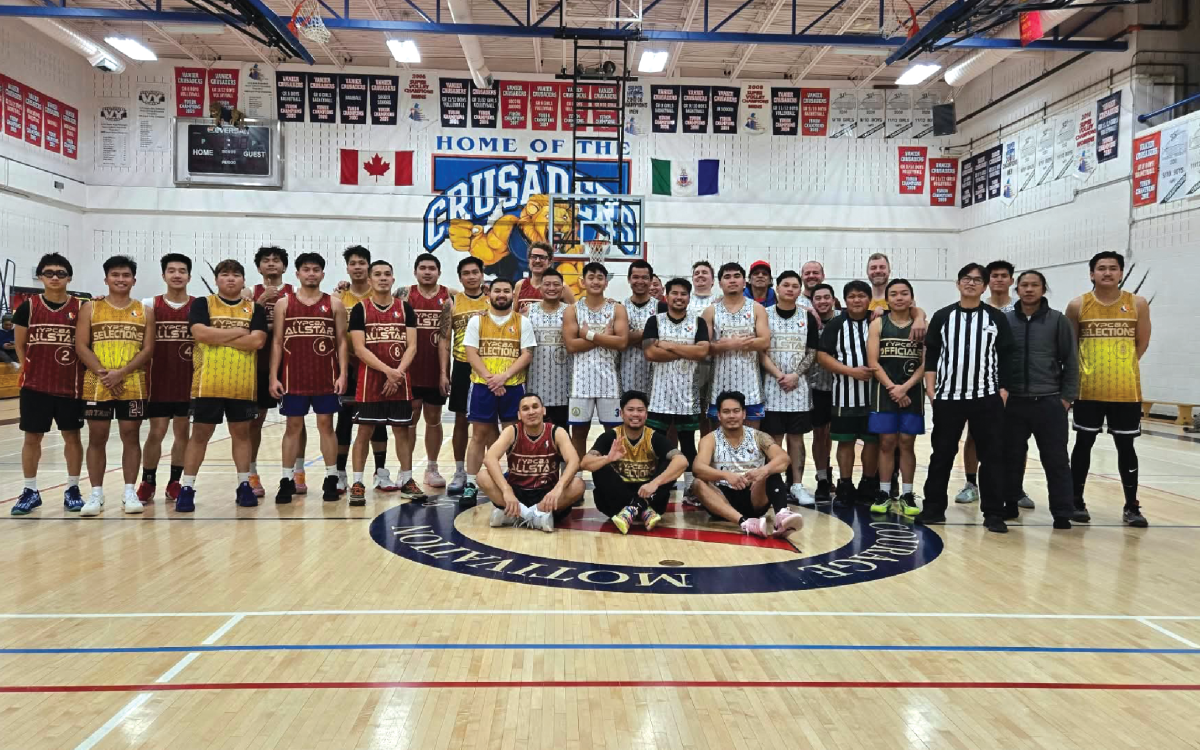
At the Yukon Pinoy Canadian Basketball Association’s December All-Star tournament, Alyssa Nicole Adapon holds a microphone between games and smiles into the camera. “What’s up, YPCBA fam?” she says, taking the hyped tone of a big-league sports broadcaster. She’s live on the association’s Facebook page. “We’re back again after an intense battle… standing right beside me, our player of the game for tonight.”
At Paul-Émile Mercier Secondary School Community Centre in Whitehorse, a three-foot-tall speaker system pulses with lights as announcers call plays in a mix of English and Tagalog. Fans cheer from the bleachers. In the hallway outside the gym, folding tables are spread with pancit canton, puto cheese and pandesal bread. “It’s a Filipino thing,” says association president Jo Aying. “There’s always food.” The snacks aren’t just fuel for players and officials; they’re also for the announcers, reporters and fans watching the games and free-throw and three-point competitions, which last a marathon eight hours. The evening ends just before midnight.
As of 2023, Filipinos made up 21 per cent of the territory’s immigrant communities. The Yukon Bureau of Statistics reported that the population rose to 1,945 in 2021 from 1,190 in 2016. Events such as the All-Star tournament provide a connection to home, not just because of the food and opportunity to come together but because of the game itself.
“Basketball is the number one sport in Philippines,” says Aying, who immigrated to Whitehorse in 2017. “Every corner on the street, there’s a basketball court.” Players who push themselves can land a varsity scholarship. Aying did. Through the experience, he got more than just classroom learning. Basketball taught him discipline and the importance of having respect for everyone on the court—other players, officials, coaches and fans. It’s something college athletic departments consider alongside skill. If you have a piss-poor attitude on the court, they notice.
Aying likes to see the same approach with the YPCBA. The league started in 2007 because Whitehorse’s Filipino community was growing faster than the existing Filipino Canadian Basketball League Yukon could make roster space. That league has 22 teams with an average of 14 players each. The YPCBA, meanwhile, has 16 teams, each with 15 players, that rotate between various high school gyms for two to three games on Saturday and Sunday nights. The league invites non-Filipino players to join, though each team can have a maximum of three and only two can be on the court at a time.
The games aren’t your average local amateur sporting events. If you watch Whitehorse Oldtimers Hockey League action, for example, you’re likely to be the only fan in the stands. If you go to a YPCBA game, it can be tough to find a parking spot. Even when -40°C December evenings have pushed most Yukoners into hibernation, fans fill half the bleachers at Mercier or F.H. Collins Secondary School.
This kind of attendance isn’t specific to All-Star weekends. It’s a season-long phenomenon. Games are livestreamed on Facebook from October to May, complete with a scoreboard in the upper left corner and Adapon congratulating and interviewing the player of the game. Her interviews rack up around 700 views and full games get closer to 1,000. It’s big, not just because the skill level is high, but because of the social aspect.
“Whitehorse is a small town, so there’s not much of an outlet for people,” Aying says. “Work, home, work, home.” This gives everyone a third place to go, whether they’re players like Aying or fans like his wife and daughter. Though, he jokes, they come to coach and critique him just as much as they come to cheer him on.