ONE AFTERNOON in the middle of the NWT diamond rush of the 1990s, I met a friend for coffee at a Yellowknife diner. Mike belonged to a local prospecting family, and I hoped he’d fill me in on the latest chatter from what was then called the “Corridor of Hope.” I don’t remember what was said about diamonds or the novel thought that someone might mine them in the NWT. But I do remember Mike asking my opinion on some issue “as a Northerner.” I choked on my coffee.
I’d lived in Yellowknife for several years and was fairly well travelled in the territories. But I’d never considered myself more than a garden-variety southern transplant. I loved it here, but I missed big city life, and I said so. “Then why do you stick around?” Mike asked.
I thought about all I’d seen in the past few years: the land claim dramas, the looming creation of Nunavut, the brutality of the Giant Mine strike, the last gasps of gold mining in Yellowknife and now, a possible future in diamonds. I looked at Mike and gave him the simple—and honest—answer. “I want to see what happens next.”
“That makes you a Northerner,” Mike said, slapping my shoulder. I demurred, reminding him that I could drive a snowmobile only in a straight line, that I was a danger to myself and others if given control of a boat and that I was confounded by Coleman lamps because the instructions read, “Keep away from open flame.” We debated a little longer and then compromised, agreeing I could at least call myself a Yellowknifer.
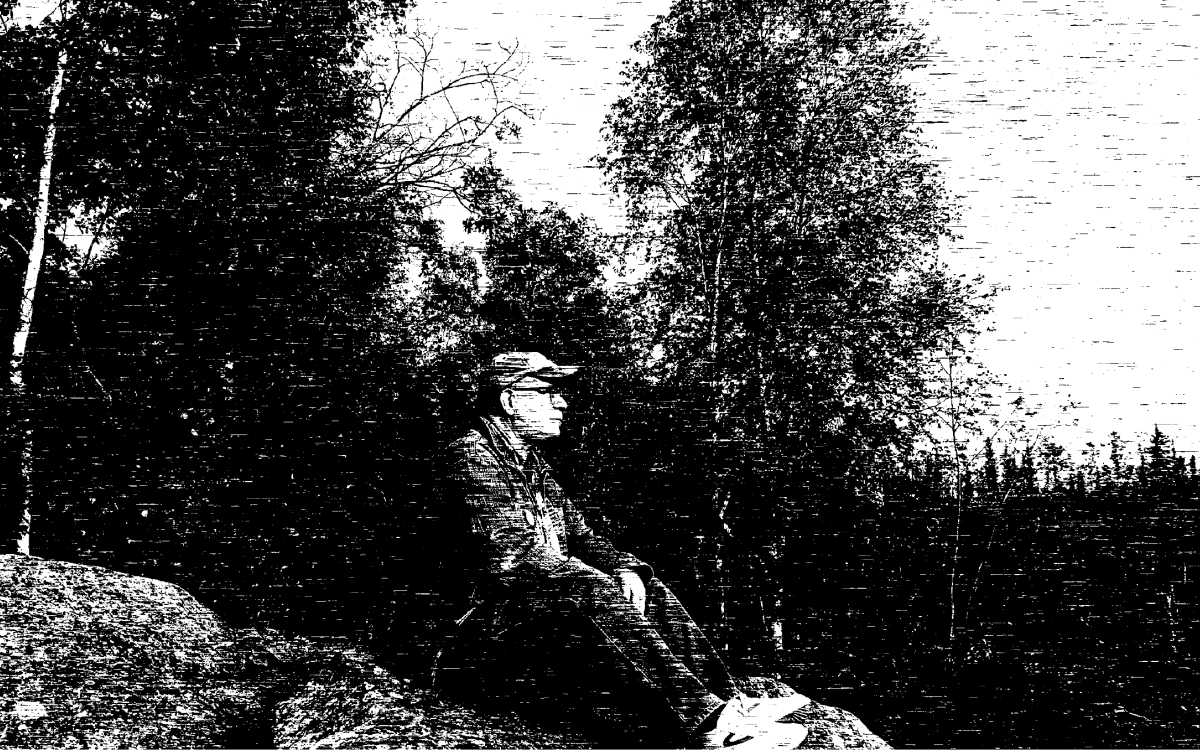
 Photo courtesy of Ed Hardy
That was the first time I consciously felt I belonged to the North, or at least part of it. I can now see other times when I was welcomed into unadorned northern living, and not just the easy middle-class lifestyle that’s generally available to white guys stepping off airplanes. Food was often the gateway to those moments.
The first came in the summer of 1989, not long after I’d arrived in Yellowknife as a reporter for news/north, a newspaper covering the NWT and what would become Nunavut. I was in Whatì —then a fly-in community called Lac La Martre, northwest of Yellowknife—to report on a routine meeting of chiefs from Tłı̨chǫ communities. The agenda at these events ranged from land claims to loose dogs, and I was always a little uncomfortable at them. Like the delegates, I knew media presence did more for the careers of young reporters than their presumed audiences. The people who lived in the communities felt much the same. They’d seen my type many times.
Whatì was different, though. The lake is famous for trout and, as the chiefs retreated to an in-camera session one afternoon, I wandered down to the dock, where I found a couple of guys loading a small boat. Pointing to my camera, I asked if I could come along to take pictures for the newspaper. They paused, shrugged and said, “Sure.”
It was a beautiful day—blue sky, bright sun and big clouds as we motored out to the first spot where Leon and Albert dropped their lines. I was fumbling with my camera when a chilling voice commanded me to stop. “Put that away.” I looked up. It was Leon, squinting at me and frowning. I clumsily returned my camera to its bag, my hands shaking.
My hosts broke out laughing, “We know why you’re here. Come on,” Leon said, handing me a fishing rod. We trolled for the next couple of hours and, when a rain squall passed over, we sheltered on a small, overgrown island. I showed outdoors ineptitude as I stumbled through the thick bramble in shorts and am reliably told that stories about “that reporter with the scarred legs” delighted Whatì residents for years.
That evening, meeting delegates and community members gathered around a bonfire for a cookout. Half a caribou from the community freezer lay on a picnic table, skinned and gutted, for anyone to chop off a piece with a machete. I was looking at the carcass, trying to figure out what to do, when one of the chiefs walked up behind me. “I like the neck,” he said, smiling. His voice was barely above a whisper, but he cut into the animal’s neck with precision and purpose. He then handed me the machete and chuckled as I struggled to free a couple of ribs for myself.
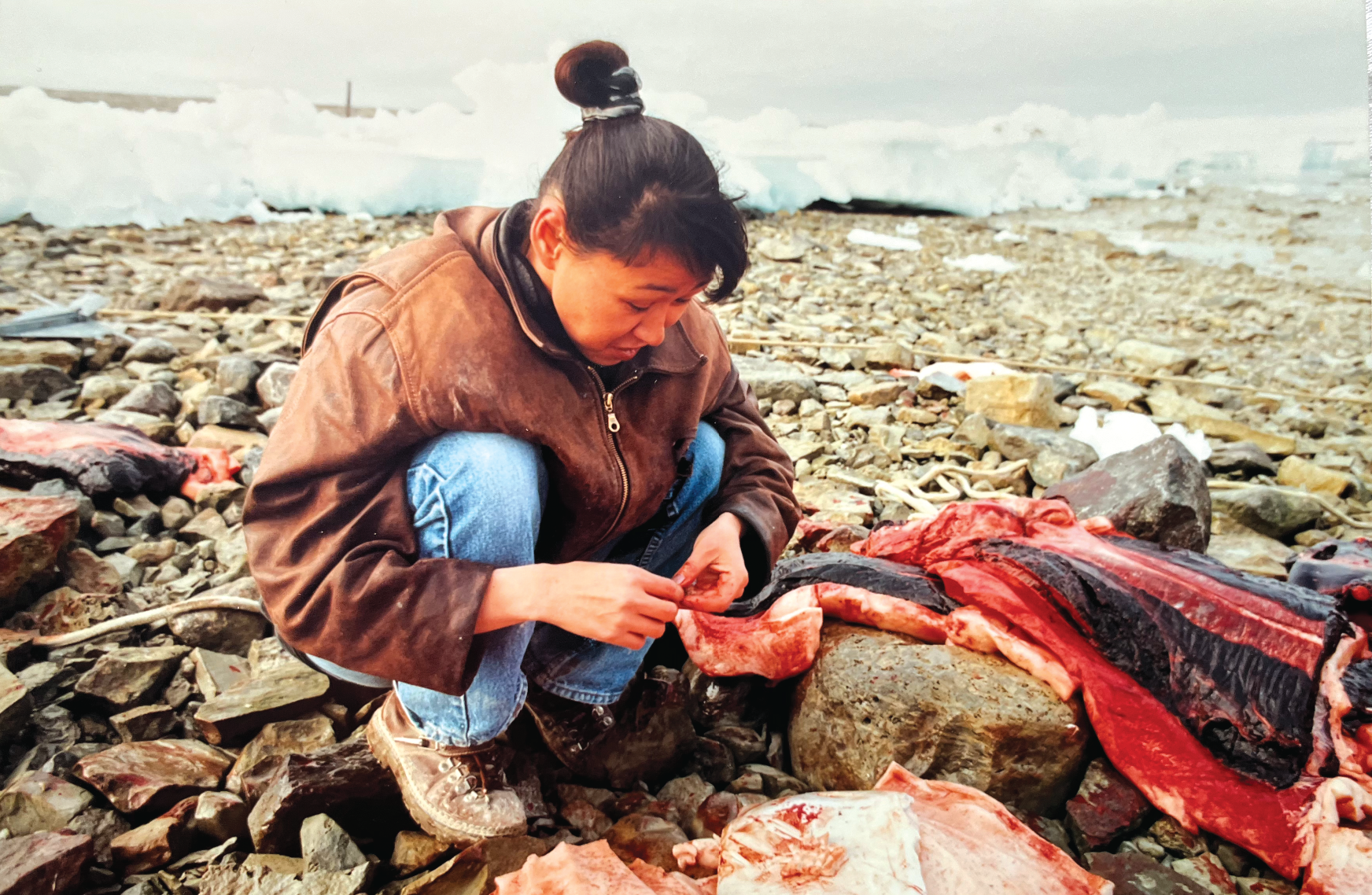
Photo courtesy of Cooper Langford
That warm moment foreshadowed an evening in the company of the people around the fire. They gave me a few phrases in the Tłı̨chǫ language to take home as souvenirs. My favourite was, “My name is Cooper. Don’t panic. I’m from the newspaper.”
A couple of years later, my friend Bill invited me to a dinner party at his home. He’d recently returned from a hunting trip with a group that had won a rare prize: a tag, awarded by lottery, to hunt a bison in the sanctuary around Fort Providence. Bill’s share was more than he and his family could store. So, they hosted a mid-winter get-together, probably in part to free up freezer space.
It was an outstanding, freewheeling meal. I’d eaten country food before, but it had almost always been in the curated environment of licensed restaurants. This dinner had been shot a couple of hours’ drive down the highway and butchered in someone’s garage. It was no less delicious and probably more so as the meal was shared with people I’d heard of but had never met.
My most memorable experience, though, occurred in the fall of 2001. I was in Igloolik to profile Zach Kunuk, whose movie Atanarjuat: The Fast Runner had won the Caméra d’Or at Cannes for best first feature. As I was arriving, I noticed wakes from several boats carving circles in the bay. I discovered why as I made my way through the suddenly hyperactive streets and found Kunuk loading large Rubbermaid containers into the back of a Suburban. “Not now, OK?” were his first words. “I gotta do this. It’s the beluga migration.”
No worries. I was in town for at least the next three days. I wandered off and eventually wound up at the beach, where hunters were depositing whales they had taken while others busily cut sides of blubber into large slabs. I started taking pictures, feeling a kind of stunned wonder. I’d never witnessed anything like it.
The moment broke when someone handed me a piece of blubber about the size of a deck of cards and scored so the fat looked like kernels on a cob of corn. I bit in and was instantly delighted. The blubber had the texture of perfectly prepared calamari and, although flavourless, somehow sweet, like ice water on the hottest summer day.
Soon, my face, like those around me, glistened with whale oil. Then, a sudden flurry of excitement. A woman working on one of the whales a few metres down the beach discovered it was a pregnant cow. She stood up, holding the fetal sac, and several people were waving me toward her. I was unnerved. I knew the Inuit custom of sometimes teasing newcomers to break the ice and irrationally feared this might be a setup. It was a ridiculous thought and the people around me would have been rightfully insulted if they knew what I was thinking. Still, I was tense. Failing to share in the laugh meant people might not talk to me later for my story.
When I reached the woman, I discovered how ignorant my initial fears had been. Government biologists had enlisted local hunters to document and forward any unborn beluga to help develop data on pollutants in food webs. This fetus was a scientific prize, and the woman wanted my help spelling unfamiliar English words as she filled out paperwork. I was more than happy to help. I owed her at least that much.
The teasing came later and more directly, and the next few days were among the most enjoyable in all my years travelling the territories. One of my favourite moments from that trip came as I settled into breakfast at the string of ATCO trailers that served as the local hotel and café. A construction crew from Newfoundland was in a rollicking debate with the local women who worked in the kitchen over the best way to cook seal.
I thought it a strange scene at first, but it quickly started to make sense. These people knew what it meant to grow up on cold, isolated coastlines, where dangerous weather was more common than money. Their cultures shared little in the way of history—just like their ideas on the best parts of a seal—but they were bonded over common experiences, in this case born of hardships. It was a joyful moment.
Those people also knew something it would take me years to figure out. Unfamiliar places can start to feel a little like home, if you let them. And there’s nothing like an unfussy meal, even an impromptu snack, to light that path.