OVERNIGHT SENSATIONS
The frybread kings have scored a Yellowknife hit with Dene street tacos
Story by Chloe Williams
Photo by Pat Kane
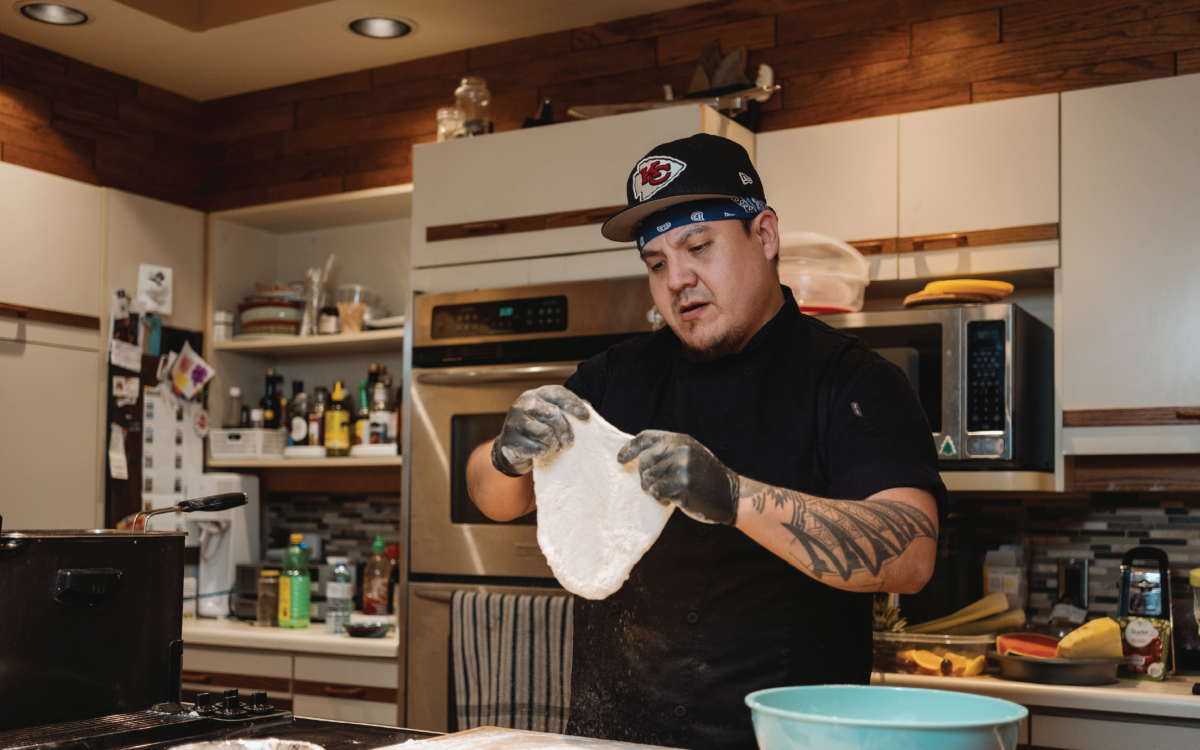
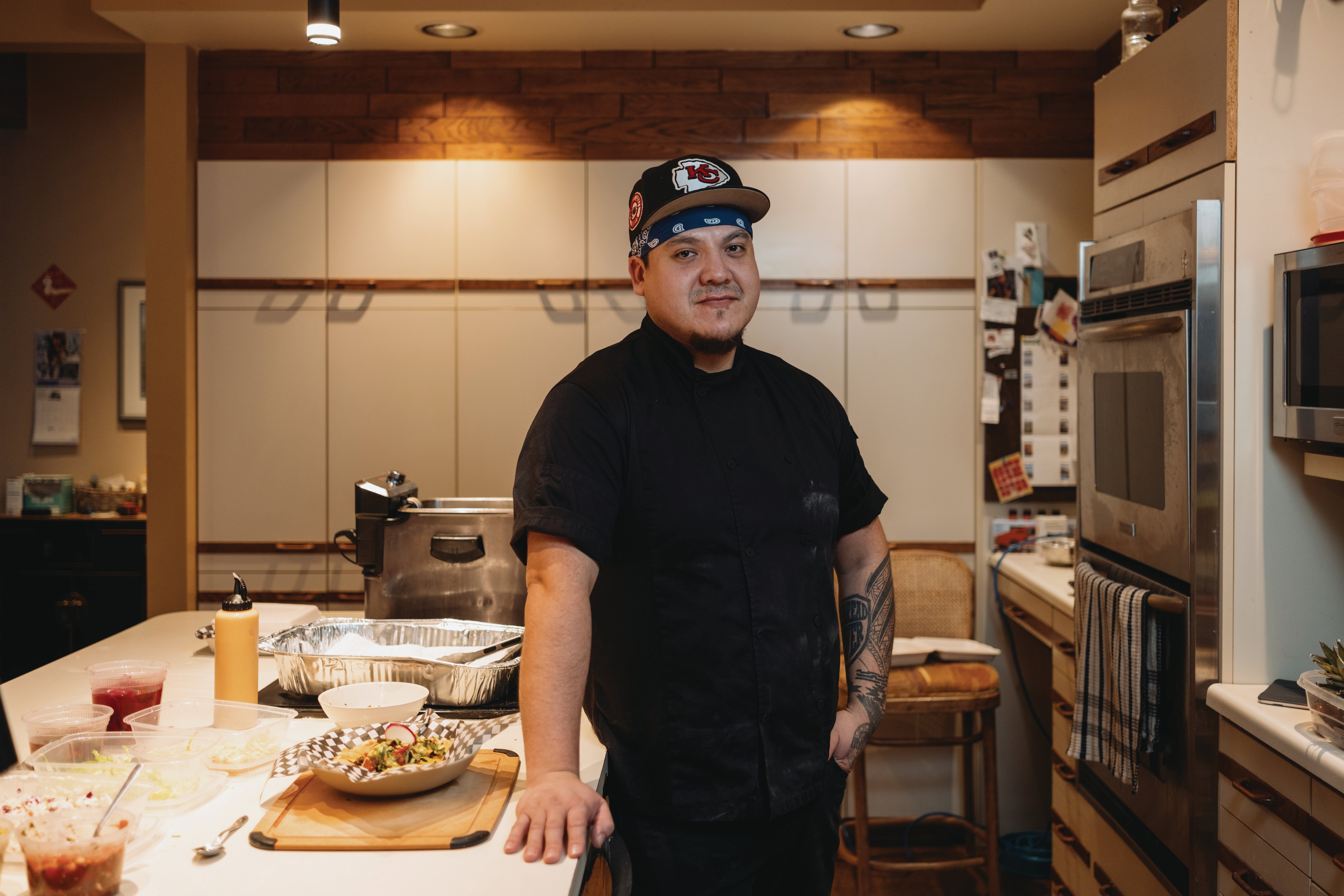
The “Frybread Power” tattoo on Gary Michel’s forearm is a reference to his favourite movie. As a teenager, Michel fell in love with Smoke Signals, which has a character who makes the world’s best frybread. Now, as the co-founder of Frybread Kings, a Yellowknife caterer and food vendor, he’s made the golden, deep-fried dish his signature offering. Turns out, he’s not the only Northerner who loves it.
Michel started the business, which specializes in Indigenous-Mexican fusion, in 2024 with his high-school best friend, Josh Judas. Frybread—made from a simple dough flattened into a disc and deep fried—is an Indigenous staple in the south that originated as a survival food when Indigenous peoples such as the Navajo were removed from their homelands. Growing up in Łutsël K’é, Michel ate bannock and first tried a frybread taco at an Alberta powwow when he was about 16. The crispy, fluffy dough was topped with ground beef, lettuce, tomatoes, salsa and sour cream. “I was like, ‘What is this?’” he says. “‘It’s delicious.’”
Back home, he tried to imitate the dish. Through trial and error and what he learned working in various kitchens over the years, he perfected his own recipe. At first, Michel and Judas made frybread tacos with simple toppings for Sunday family dinners. After several trips to Mexico to learn about that country’s cuisine, they elevated the dish with fresher ingredients and more authentic fillings. Today, they’re best known for their Dene street tacos: frybread loaded with toppings such as pulled pork, coleslaw and jalapeno salsa or cilantro, pickled onions and birria—shredded beef slow-cooked in a rich, chili-flavoured broth.
When Michel and Judas served their tacos at an Indigenous Peoples’ Day gathering near Dettah, they were surprised their food was such a hit. Later, they ran a stall at the Yellowknife Farmers Market, and for a six-month stint, they had a restaurant in the Underground, a downtown bar. Michel describes the latter as a “trial run,” adding that they weren’t ready to expand that much. Now, Frybread Kings focuses on catering and pop-up events such as meetings and festivals in NWT communities. For special occasions, including New Year’s Eve, customers can pre-order frybread tacos and desserts for pickup or delivery.
The company’s catering options range from soups, stews and salads to hot buffet-style items such as sliders and vegetarian curry. Other frybread-based dishes include pizzas, smash burgers and Klik-and-egg sandwiches. Future plans include a food truck and, eventually, a family restaurant. Meanwhile, the sudden popularity of the food has created a problem: Although the Frybread Kings isn’t a late-night vendor, Michel says, “People call me in the middle of the night for taco orders.”
Cooking is about reconnecting with himself and his culture. At 18, he left Łutsël K’é for a career as a chef. “My brothers and cousins, they’re all hunters and gatherers,” he says. “I just pursued another way of living.” Now 40, Michel wants to experiment with ingredients from the land. “It’s an everyday learning thing,” he says. “We’re just teaching ourselves to be more connected with the natural resources that we have up here.”
HOME COOK
Antoinette Greenoliph serves $300-a-plate seven-course dinners in her house. and business is brisk
Story by Amy Kenny
Photo by Cathie Archbould
“Stop cooking all this food, I’m getting fat,” Antoinette GreenOliph’s wife, Inga, told her four years ago. But cooking was a hard habit to break for someone who ran a busy Caribbean restaurant in downtown Whitehorse for 11 years. After selling Antoinette’s in 2021, she needed a culinary creative outlet and found her fix when she offered a home-cooked four-course meal as an item for a fundraising auction at her church. Despite no interest in serving 65 people a night again, she discovered small groups satisfied her.
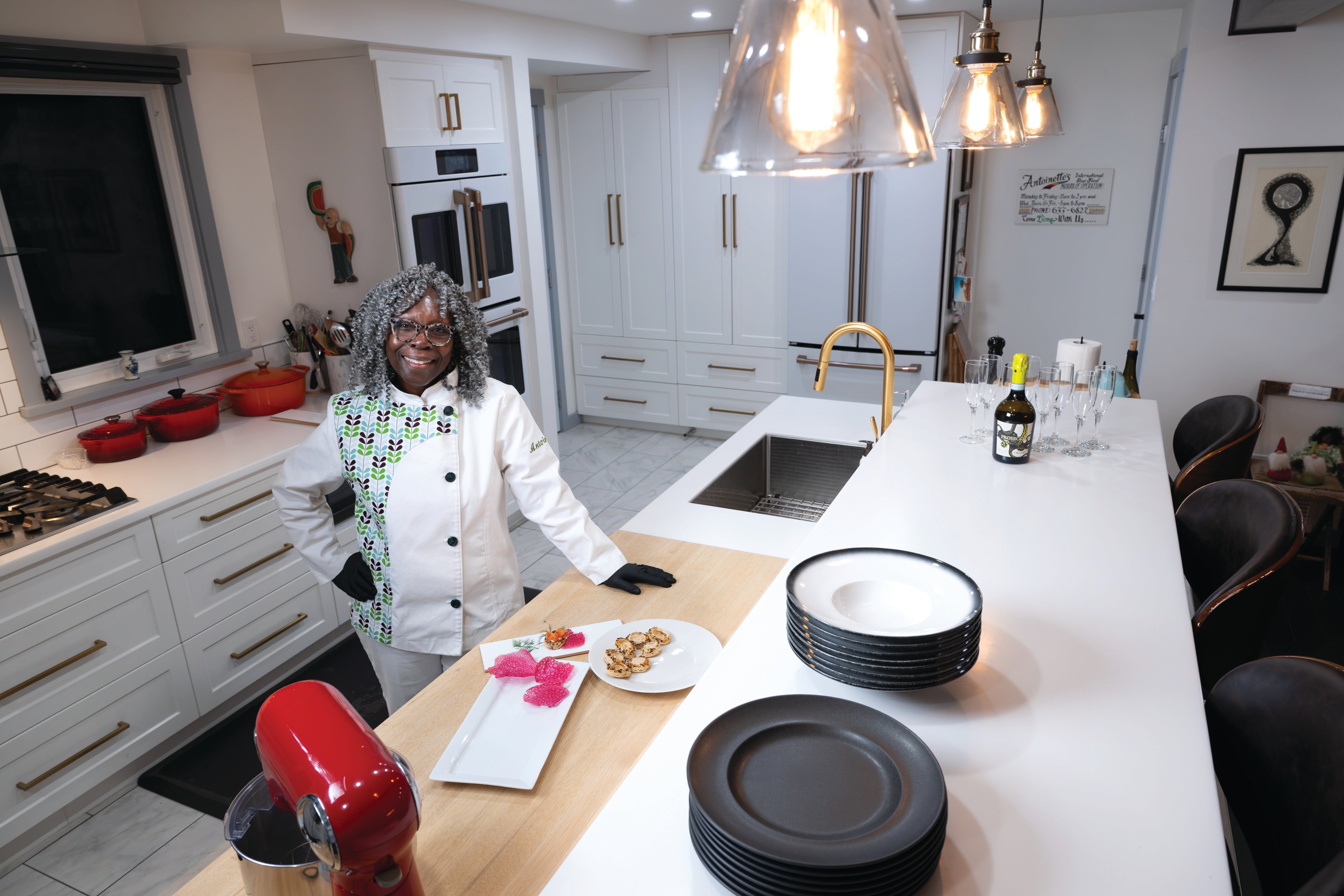
As it turned out, that format worked for diners, too. Strictly through word of mouth, GreenOliph easily fills seats for $300-a-plate seven-course meals in the home she renovated specifically for hosting. The left side of her Takhini North duplex features a long, rectangular dining table and a 33-inch countertop that’s custom-built for her small stature. The right side is for lounging and chatting. She decorated the powder room with framed menus from previous meals—gougères with gravlax; sweet potato and ginger soup; and mahalabia, a Middle Eastern pudding garnished with pistachios and dried roses.
Diners don’t get a say in the menu. That’s part of the appeal for GreenOliph. Antoinette’s was hers: her name on the façade, her hands on the dishes and her face often in the dining room, greeting people. But this feels more personal. “I get to absolutely do exactly what I want,” she says. “I’m in complete control.”
She still makes Caribbean dishes, as she did at Antoinette’s. You can sometimes taste the influence of her mother, a woman whose goal was to leave the Caribbean, who made her kids eat with a knife and fork rather than the spoons they used back home and who put raisins and fruit in her pelau (a rice dish) instead of vegetables. It affected GreenOliph’s palate early on. And when she serves her meals, she sometimes tells stories from her mother and grandmother.
When guests arrive to one of her dinners, she greets them with a glass of champagne. She serves the first four courses in the dining room, then everyone mingles in the living room while she preps entrees, which follow in the dining room. After that come the dessert and cheese courses.
GreenOliph offers a maximum of one dinner a month, for no more than eight people who must book at least two weeks in advance. She’s too busy for more than that because it’s a lot of work just to pair dishes with drinks and stories. “I got stuff going on,” she says, citing a cookbook she’s writing. “I mean, I’m 69. I better get this shit done before I croak.”
The whole production is for her guests, she says, but it must satisfy her, too. She loves to hear someone say a plate is too pretty to eat, then see them finish everything on it. “Food’s almost orgasmic,” says GreenOliph, who understands why people get addicted. “It doesn’t disappoint you or argue with you. You just eat it and feel good.”
QUARTER MASTERS
The staff at Iqaluit’s Qajuqturvik Community Food Centre do their part
Story by Arty Sarkisian
Photo by Arty Sarkisian
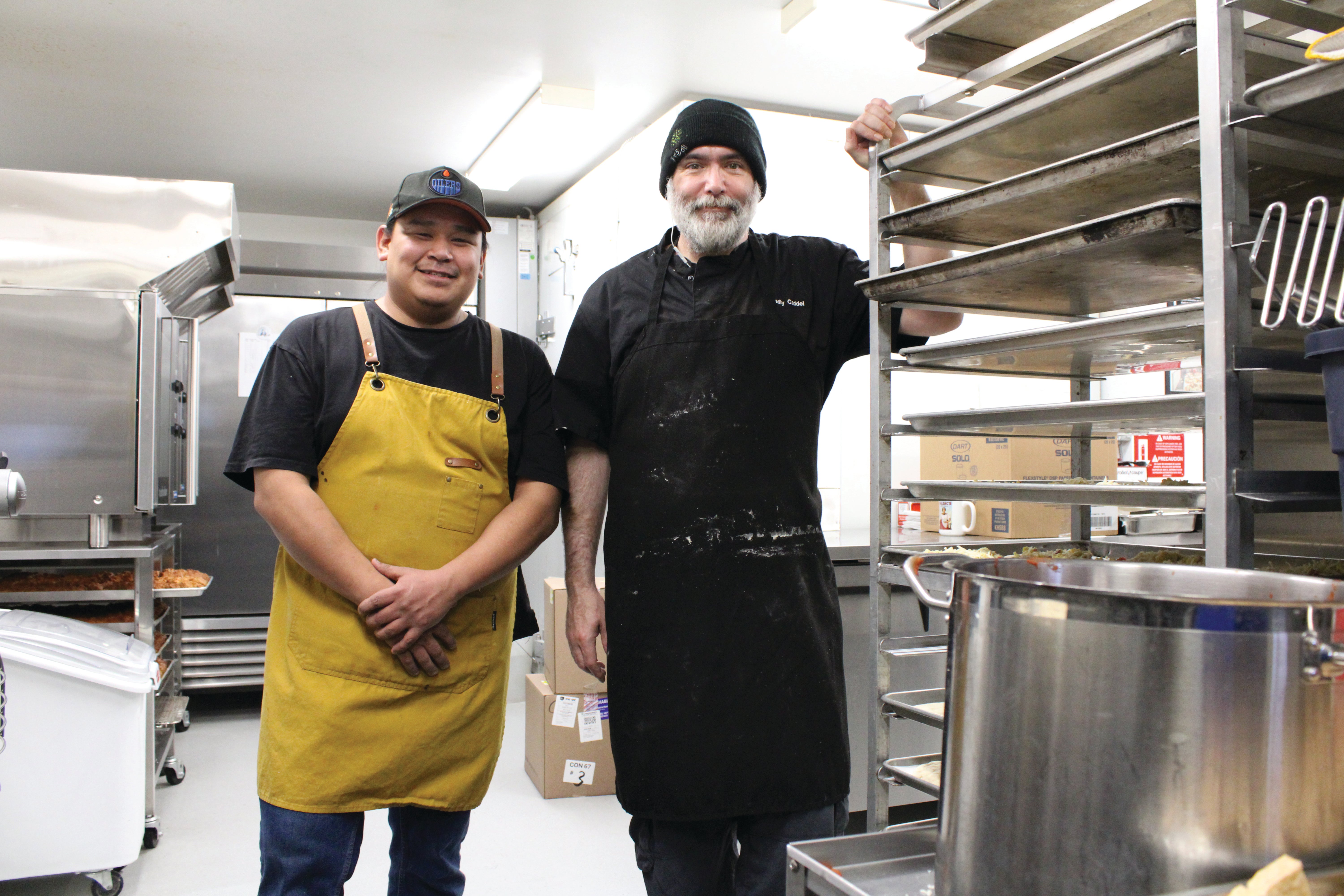
“Can I work and talk?” Brad Caddel asks while doling out steaming mushroom soup one early January morning. He’s filled more than 100 white paper bowls, but he isn’t even halfway finished his soup duties. Iqaluit’s Qajuqturvik Community Food Centre, a small one-storey, green-ish house on high stilts close to St. Jude’s Cathedral, serves from 250 to 400 portions daily. In September, the soup kitchen––Qajuqturvik means “place to eat” in Inuktitut—hit a record of more than 600 servings in one day, but it still couldn’t meet the demand in a community where, according to Statistics Canada, about half of the population is food insecure.
“It can get overwhelming sometimes with the volume,” Caddel says, “and we also try to serve different things so that people are not—hang on...” He stops mid-sentence as kitchen manager Jamie Papatsie wheels in a baking rack with about 20 trays of pizza dough, two bags of grated cheese and a big bowl of tomato sauce.
Caddel puts aside the soup ladling to help lay out the dough. The pizza will come together with leftovers from previous days. “Nothing goes to waste here,” Papatsie says. “We have some cheese? A bit of sausages? We are making 200 breakfast pizzas.”
Both men have worked here for just more than a year as part of Qajuqturvik’s nine-member full-time kitchen staff. Along with the daily meals, the centre runs a weekly food box program, distributing produce to Nunavummiut in need on a pay-what-you-can basis.
Papatsie, who’s originally from Iqaluit, learned to cook in restaurants with various levels of highbrow-ness, preparing everything from chicken wings at Iqaluit’s Storehouse Grill & Bar to Chinese noodles at southern restaurants. But he’s never been happier at work than when a food centre client thanks him at the end of a busy shift. “You know, that’s obviously not the reason why we are here,” he says while spreading tomato sauce on pizza dough, “but it absolutely means the world.”
Meanwhile, Caddel moves on to bannock. Every day, he makes four large sheets of it. “I was once on the other side of all of this, you know,” he says, slicing the crispy bread into roughly 160 10-centimetre-by-10-centimetre pieces. Laid off from a web development gig seven years ago, he abandoned that career and left Edmonton for Iqaluit, where he held many jobs including at the jail, a boarding home and a men’s shelter. But, about a year ago, he was out of work and “late on the funds.” He started coming to Qajuqturvik for caribou stew, chicken soup and Arctic char steak.
A Qajuqturvik chef encouraged him to drop off his resumé and before long he was wearing an apron mixing up dough for his now-famous bannock. “Just look at this,” he says, showing off a particularly crispy piece. Sometimes, people come just for that bannock, Papatsie says as he tops off the pizzas with cheese. “Yeah, feels good,” Caddel says as he wraps bannock in paper. “Feels like I made a difference.”
PIE MAN
Mike Mancini has made a name for himself slinging wheels for two Yukon towns
Story by Amy Kenny
Photos by Edward Brown
The kids called him Pizza Mike until the principal intervened. She told a class of Grade 1, 2 and 3 students at Mayo’s J.V. Clark School to use honorifics. “His name is Mr. Mancini,” she said. Then she turned to their substitute teacher. “You know, you’ve got to keep them under control.” There was no more Pizza Mike in the classroom, even if that’s what everyone has called Mike Mancini for 30 years.
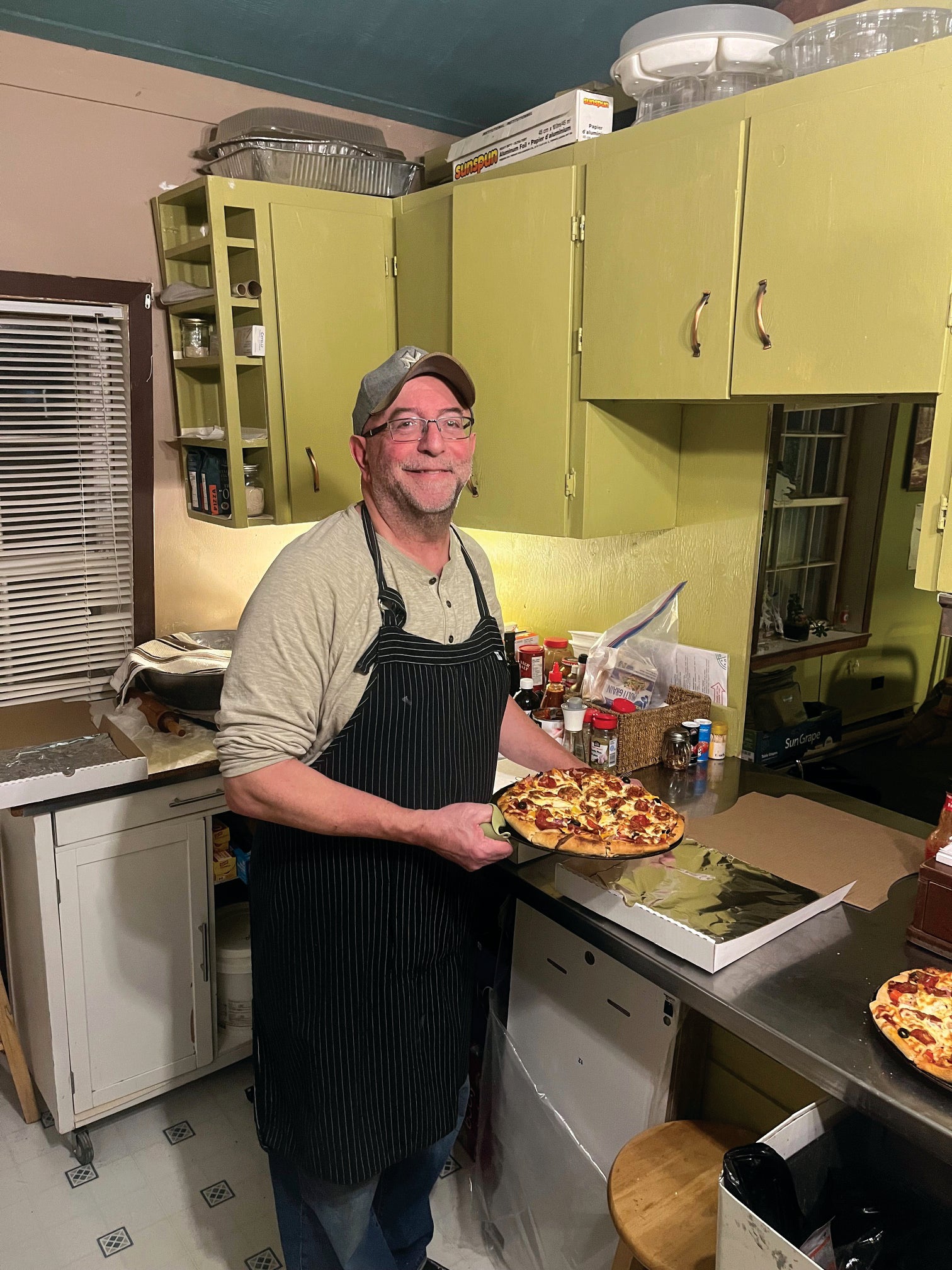
The Yukoner’s teaching stint six years ago was one of many side hustles he’s taken on in the fall, winter and spring to supplement “his hobby.” He started slinging wheels at the Keno Snack Bar in 1996, but after everyone—staff, parents, kids—in Mayo asked him to make pizza, he opened a second location in a rented 100-year-old log cabin with 12-pane windows. Also called the Keno Snack Bar (he tells callers they’ve reached the Mayo division), it does better business than the original.
Always a tough go, running a pizzeria in Keno, population 19, has become even harder. At one point, it seemed increased mining activity in the area might help. Mancini grew up 13 kilometres down the Silver Trail in Elsa; now a ghost town, it's where he and his father once worked for the United Keno Hill mining company. He remembers when Elsa was prosperous, but now the region’s mines are self-contained, with workers flying in and out and no one driving to town on a pizza run. Still, he could count on the summer boom with RV traffic and the Keno City Music Festival until forest fires tanked even that. “I got all set up this last summer and then the fires came,” Mancini says. “There were no visitors.”
Mancini spends a few months each summer at the Snack Bar, where he’s served people from all over the world, including a pair of Keno-loving Italian filmmaking brothers who once let him vacation in their Roman villa. But most of his efforts now go to the restaurant in Mayo, population 188. Although the eight seats support a regular breakfast rush, he has staff only when a friend pitches in or his sister comes up from Nanaimo, B.C., to visit and help make pizzas, breakfast sandwiches, their mother’s cannelloni or prime rib. Because Mancini lives a couple of doors down, he’s able to keep 9 a.m. to 9 p.m. hours without being in the restaurant the whole time. When he leaves, he puts a sign with his cell number on the door.
That flexibility is important to him. He’s 65 and, he says, aging quickly. He jokes that if he could do it all over again, he’d get a government job, but he loves cooking too much. He hopes to be in business for another few years and the Mayo location may make that possible. Not only are there more people around, maintaining a full menu is easier because the town has a grocery store. Although there have been challenges, he’s in a business that’ll always do business because, he says, “People have to eat.”
COMBO CREATOR
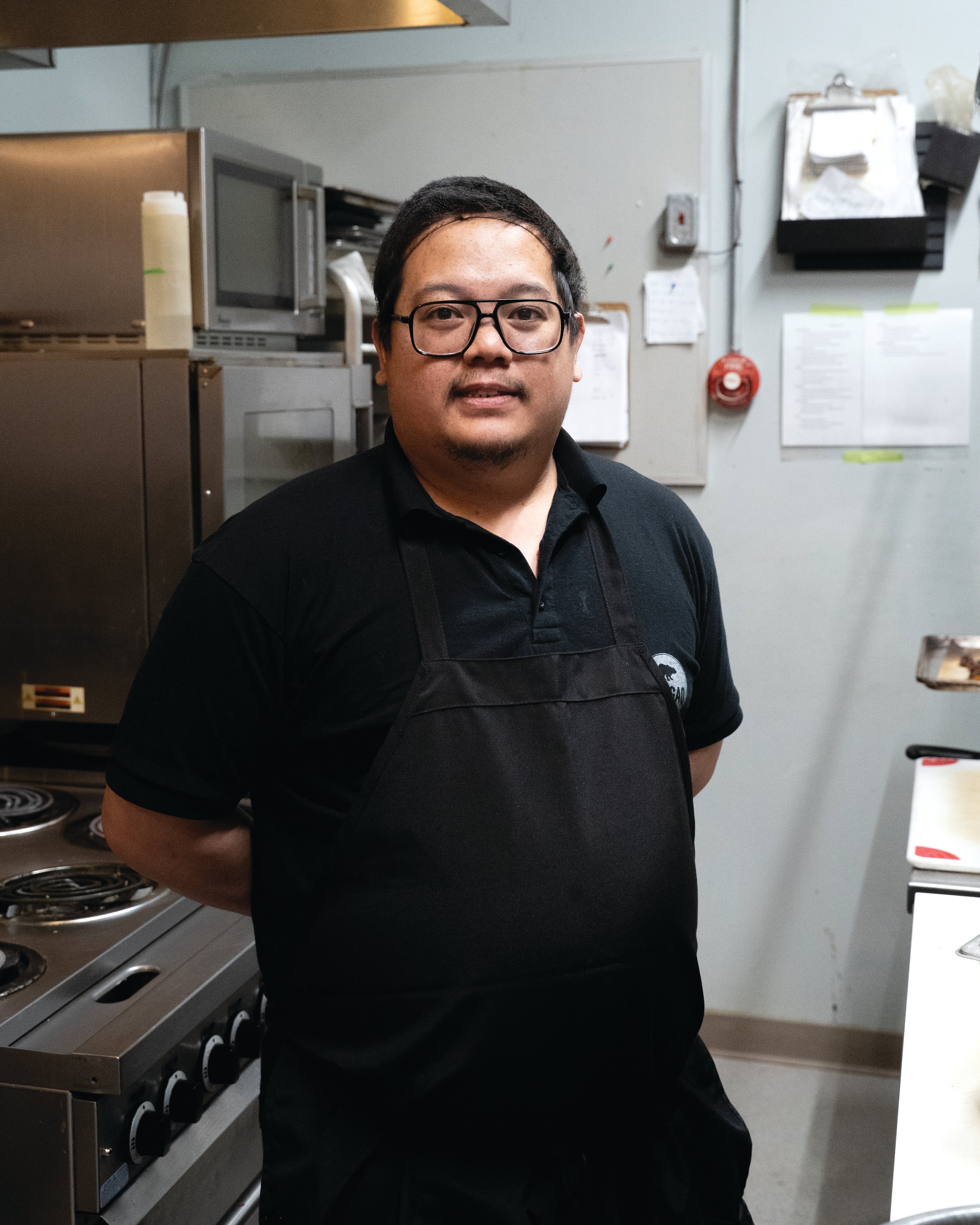
James Quiñones and his Asian-Inuit fusion have tongues wagging in Cambridge Bay
Story by Arty Sarkisian
Photo by Brodie Larocque
In October 2022, James Quiñones landed on a snowy gravel runway after a more-than-10,000-kilometre trip that took him from Dubai to Vancouver to Toronto to Edmonton to Yellowknife and, finally, to Cambridge Bay. Nunavut was foreign to him in many ways. Instead of 30°C heat, he experienced -30°C cold and snow. Instead of one of the world’s tallest buildings, he saw one-storey Arctic homes on wooden stilts. And, most of all, instead of people who ate the beef and pork he usually cooked, he met people more used to seals and narwals. But both he and the community were about to learn something new.
Like most newcomer Nunavut cooks, Quiñones went through the show-us-what-you-can phase. For weeks after becoming the chef at Cambridge Bay’s Kuugaq Café, Quiñones made burgers, roast beef, barbecue ribs, onion rings and poutine “like no tomorrow.” But he also made occasional Asian dishes of the day for guests who were tired of the pedestrian BLT. “They just wanted to see if I was any good,” he says. “I think I made them happy.” For weeks after he arrived, the café was more packed than usual with many diners ordering his special pork sisig or egg rolls or beef broccoli with fried rice.
The restaurant is an open-kitchen design with leather chairs and couches for about 40 people and paintings of caribou and muskoxen on the walls. Cambridge Bay, a community of about 1,800 people, is one of the biggest fishing towns in western Nunavut, and the nearby Ekalluk River is the biggest gathering place for locals. So, Kuugaq, which means “river” in Inuinnaqtun, serves as another spot for people to come together.
Since the completion of the Canadian High Arctic Research Station in 2019, the mix of Arctic researchers with PhDs and Inuk hunters makes for an unusual crowd. But Quiñones offers something for everyone, with Canadian classics such as bacon cheeseburgers and grilled cheese sandwiches; Inuit-flavoured dishes, including char chowder, muskox and caribou burger; and Asian fare such as mee laksa and ayam pandan.
Originally from Baguio City, a metropolis of just more than 400,000 people in northern Philippines, Quiñones was earning $200 a month cooking traditional Filipino chicken inasal, adobo and sinigang. After briefly working at Red Lobster and Olive Garden restaurants in Malaysia, he spent three years cooking in a Turkish one in Dubai. But once he moved to Cambridge Bay, he had to learn to debone Arctic char and butcher caribou—not as difficult as it might sound, he says, though he admits, “I can’t really tell the difference between char and salmon or muskox and beef.”
A lover of culinary experiments, he soon started making Asian-Inuit fusions—a first for the Cambridge Bay café goers. The combinations of caribou stew and lemongrass, bang bang char with sweet chili mayo and muskox with bay leaves became his classic chef’s specials. And the community that was as new to that kind of cuisine as Quiñones was to -30°C cold loved the Asian flavours. “I brought this new culture and I did my best,” Quiñones says. “I think I passed the test.”
TUK'S TRADITIONALIST
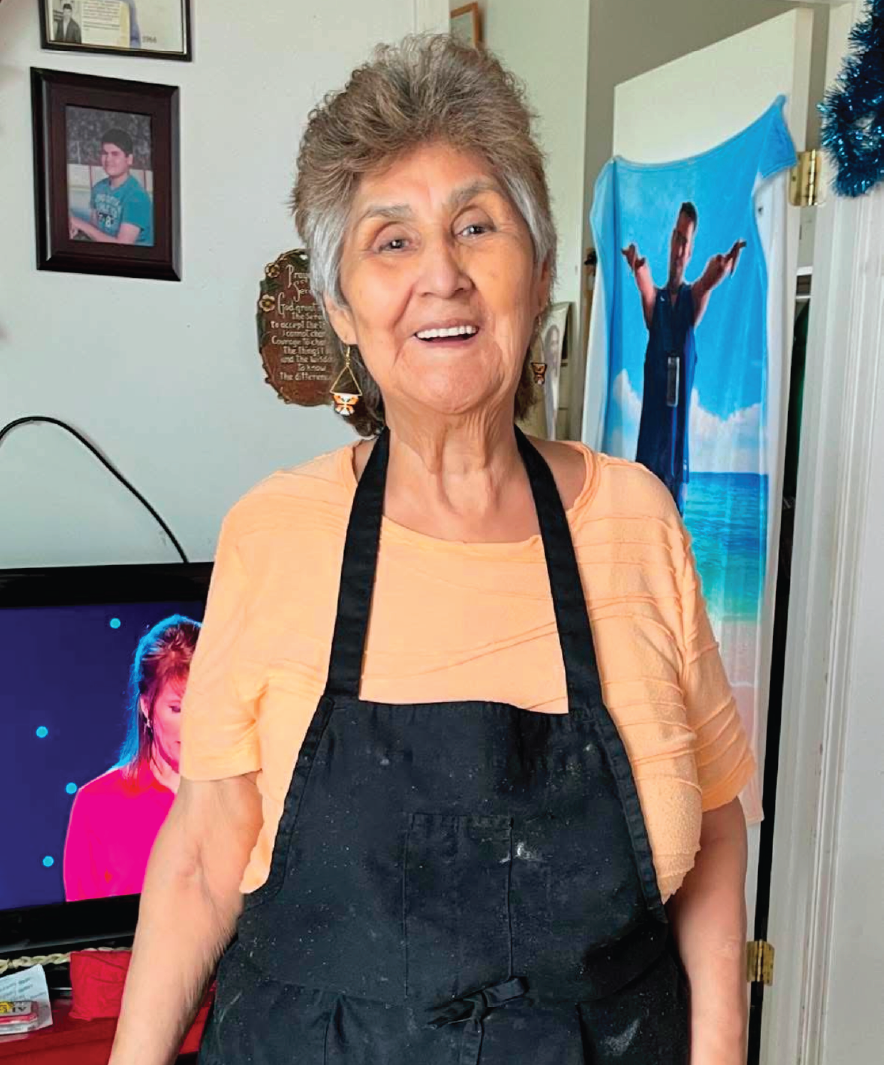
Eileen gruben serves wild meat and berries to tourists—with a side of her stories
Story by Genesee Keevil
Photo courtesy of Eileen Gruben
For close to two decades, Eileen Gruben worked on tugboats as they pushed their way from Hay River across Great Slave Lake and down the Mackenzie River into the Arctic Ocean. The Inuvialuit chef began in the galley as a mess cook, making salads, cleaning pots and finding her sea legs—sometimes prepping food while huge waves crashed over the tug. Gruben also cooked on offshore oil rigs, but the tug trips were her favourite. “We went to Sachs Harbour, Ulukhaktok, Cambridge Bay, Gjoa Haven, Kugluktuk, so many places,” she says, “and I got to visit friends and relatives in all these communities.”
After Gruben moved back to Tuktoyaktuk to care for her aging mother, the hamlet asked her to make food for tourists, because the only restaurant in town was shuttered for the summer.
Melding what she had learned on the tugs with the traditional foods that she grew up eating, Gruben began offering home-cooked meals in her mother’s house in 2024. She calls her business Guatsie’s Catering, using the nickname she’s had since she was a baby and her older sister rocked her on her lap singing “Guatsie, Guatsie.”
Gruben dishes up whatever suits her fancy: moose chili, roast Canada goose, smoked whitefish sticks, caribou spaghetti and ukpik (cloudberry) cheesecake. Lucky diners get to try pan-fried whale with onions, and she wants to start serving stir-fried seal. She buys her country food from local hunters and foragers. A small bag of ukpik sells for $50; a caribou costs $500. But, she says, “It helps local people in the communities.”
And she knows hunting and gathering is hard work. Gruben grew up harvesting wild meat and picking berries on the land, but when she was 12, a floatplane showed up at the family’s camp to take her away to residential school. Her father, who knew the ashamed-looking pilot, refused until an RCMP officer climbed out of the plane and threatened to throw him in jail. “I never forgave the system for that,” says Gruben, who resisted in her own way. “At school, they called me incorrigible and tried to kick me out, but I graduated.”
Now 77, she still doesn’t “take any guff,” even when government officials give her trouble for providing wild-harvested meat and fish meals in her home. “They tell me I can’t serve my traditional foods,” she says. “But I’m a fighter and I’ll keep doing what I do until I don’t want to anymore.”
Reservations are already coming in for this summer. Gruben can squeeze 22 diners into her home for her four-course meals using the dining room table, couches and folding chairs with cafeteria trays. People from all over the world come to eat her dinners and hear stories of growing up on the land, residential school and adventures on the tugboats. “Up here, we’re lucky we can still eat our traditional foods,” says Gruben, who jokes that she also makes “white-man sides” such as salad and mashed potatoes. “I’m not running a restaurant or a takeout,” she says. “It’s a private home and what I eat is what I provide.”