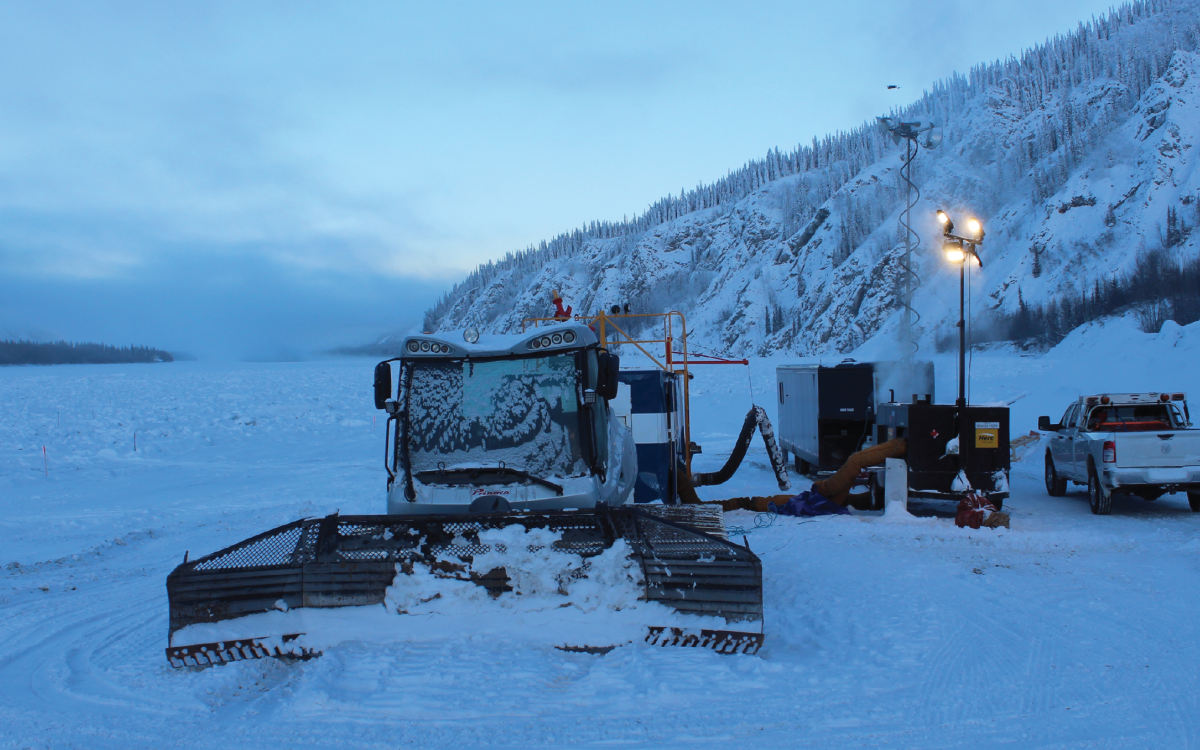
AT THIRTY BELOW, everything malfunctions. Something’s wrong with the wiring in a snowcat. A bigger snowcat won’t even start. Neither will a pickup truck. The controls on a water pump aren’t working. A skid steer meant to replace the small snowcat has a dead battery. “If it moves,” says Will Fellers, “it breaks.”
Fellers leads the Cobalt Construction crew that builds Dawson City’s government-sanctioned ice bridge on the Yukon River every year. As a placer miner who lives off-grid across the river, he’s used to the cold—and to fixing things. On this frigid weekend in December 2024, he wears a knit toque on top of a ball cap, bunny boots and, rather than messing with mitts or gloves, sticks his hands into the pockets of his camo jacket. He hooks the small snowcat up to his Dodge truck. When another pickup needs a boost, he switches the jumper cables over. An RCMP truck drives by and an officer calls out the window: “You can’t let people see a Dodge boosting a Ford!”
Fellers fixes the wiring issue on the small snowcat, then drives it onto the river, clearing the chunky ice to create a smooth path. His 25-year-old son tries unsuccessfully to jumpstart the big snowcat until he puts a heater directly onto the battery. Then the engine starts up in a thick cloud of exhaust. But the small snowcat has stopped working again. Fellers investigates, finds a broken push rod, and says, “I’m gonna see if I can’t do some MacGyvering and fix this.”
Welcome to winter road construction. While Dawson’s ice bridge is only 400 metres long, the NWT has several longer routes that are an essential part of the transportation network. In many communities that don’t have summer road access, residents rely on winter routes to get supplies and reach appointments. Governments transport fuel, construction supplies and other large shipments. Mining companies truck heavy equipment to sites.
But as the climate changes, winter weather in the North is increasingly inconsistent. Sudden temperature swings, increased precipitation and shallower rivers make the construction process less surefire than it used to be. The Northerners who build these roads are clocking the unpredictability, but they’re not worried. Yet. Yes, the climate is changing, but they’ve been able to adapt by getting creative and preparing for the unexpected. Their mentality is: We’ll get a road in, some way, somehow—even if that means, for Dawsonites, a makeshift bridge built by locals. For the foreseeable future, winter roads will be a viable mode of transportation. Just maybe not forever.
AT 10 A.M. in Dawson, the sky is pitch black except for a full moon and fading aurora. A floodlight illuminates the work site, where the crew meets in a heated trailer. Kevin Rattray has an insulated mug in his hand and a smile on his face. It’s -31°C—perfect weather for building an ice bridge. He and his colleague, Dylan Cook, are clad in fluorescent yellow jackets with reflective strips, headlamps and steel-toed boots with strapped-on ice spikes. They work for Alietum Ice, a Yellowknife engineering firm, and they’re in Dawson to oversee construction of the bridge.
The roadway will connect the off-grid communities of West Dawson and Sunnydale (population: 140) to Dawson City and the other 2,200 residents of the Klondike. Without access to town, people across the river are cut off from the hospital, gas stations, grocery stores, restaurants and bars, hockey and curling rinks, the library and the airport. A ferry operates in the summer, but every fall, the George Black comes out of the water, marking the start of freeze-up, the weeks-long period when residents on the west side of the river can’t get to town. During freeze-up, some people leave altogether, staying in town or Whitehorse.
Typically, the ice bridge opens by the end of December. But over the past 12 years, open water has remained on the river during five winters. Except for the year the government built the bridge in an alternate location, that meant no official crossing, stranding West Dawson and Sunnydale residents, unless they cross DIY bridges. Once, two men used a dead tree and some rope to make the ice freeze. Another time, a group cut a slab of ice with chainsaws, then manoeuvred it to cause a jam. In late 2025, roughly two dozen West Dawsonites formed a volunteer association to provide emergency medical services when ambulances can’t get across the river.
For decades, Fellers’s dad built unofficial crossings, often weeks before the Yukon government’s bridge opened. The family lived on an off-grid farm in Sunnydale, and Fellers helped his father, learning how thick the ice should be to accommodate the weights of different vehicles, from plow trucks to tractors to graders. He still lives in Sunnydale, so he knows how important the crossing is. The bridge’s official opening is a much-anticipated event.
One day in December 2024, five vehicles cruised by the construction site seemingly just to ogle the progress. By that point, Rattray and Cook had measured the ice—again—and Fellers’s crew had inserted wooden stakes to indicate safe and no-go zones. As the sky lightened from black to dark blue, Rattray drilled holes with a skinny, metre-long electric auger and Cook used a measuring stick they’d picked up at Canadian Tire in Whitehorse and hand-marked with Sharpie ticks. The day before, they’d dragged a 23-kilogram ground-penetrating radar unit in a sled across the river, along a snowmobile path, and now they wanted to see if the flooding the crew did had built up the ice in the right places. This process of flooding and checking thickness will continue until Alietum signs off on the load-bearing capacity. Then the Yukon government will announce the bridge is open.
Engineers’ involvement in ice and winter roads is common now, but it wasn’t always. Al Fitzgerald, a civil engineer who spent two decades in the army, was at the forefront of this change. He first worked on the Tibbitt to Contwoyto Winter Road in 2007. The 400-kilometre route starts at the end of the Ingraham Trail near Yellowknife and serves the Ekati, Diavik and Gahcho Kué diamond mines. As Fitzgerald learned more about ice and its properties, he co-founded an ice-engineering company in 2012. Just a few years later, temperature fluctuations started happening more often. “That does seem to drive more due diligence from folks who are working on ice,” says Fitzgerald, who started Alietum Ice with Rattray and Jennifer Waugh in 2022 to work on winter roads across northern Canada. “They want to keep everybody safe, and it gives them peace of mind to take that engineering approach.”
While the terms are sometimes used interchangeably, “ice roads” typically refer to routes over water; “winter roads” go over land and water. The Yukon’s only public ice route is Dawson’s bridge, but there are many in the NWT. A popular novelty to tourists, they’re a critical link for residents in remote communities. “It’s their lifeline,” says Dustin Dewar, regional highway manager for the Dehcho. A civil engineering technologist, he also oversees the winter network in the Sahtu. “It’s the only time of the year that they can get out without having to rely on air travel, which is prohibitively expensive for a lot of the community members up there.”
The Mackenzie Valley Winter Road connects five communities without all-season road access. Further north, residents of Aklavik, a Mackenzie Delta community of about 500 people, drive a 120-kilometre ice road to Inuvik for grocery shopping, gas and flights to medical appointments in Yellowknife. Mina and Dave McLeod have built the road for more than 25 years, and they rely on it just like everyone else in Aklavik. “Sometimes, there’s a really big bingo, when you get a lot of people on a Saturday going to Inuvik,” Mina says with a laugh.
Winter roads have been a northern feature for decades, and builders have learned a lot in that time. Twenty years ago, the common practice for testing ice was to drill holes every 100 metres, then assume uniform thickness. Turns out, ice is more nuanced than that. The lack of understanding contributed to what were, in hindsight, preventable tragedies: people falling through the ice and dying. Edith Iglauer’s 1974 book Denison’s Ice Road details the come-hell-or-high-water efforts to build a winter road to a silver mine on Great Bear Lake. She describes men driving machinery with one hand on the door handle, ready to jump out if they broke through the ice—and they did, with some regularity. Today, the process is much more regulated, thanks to health and safety standards. But it’s still risky.
Fellers, who also needs the bridge to get home, likes some aspects of the gig: He employs men who work at his mine in the summer, giving them a chance to make winter money. And he finds it fun. Sometimes. But he doesn’t like that the first step of the construction process involves taking measurements of the ice by hand. The men wear floater suits and harnesses and use a drill to put holes in the ice every three metres. From that data, they can tell whether it’s safe for a snowmobile. Ground-penetrating radar can’t be used at this stage because rivers freeze in chunks, rather than smoothly, which makes manoeuvring the GPR toboggan through the rubble ice too difficult. Fellers would love to use the technology via drone someday. “Right now,” he says, “we have to put people out there to prove it’s safe to go out there.”
He has reason to be cautious. In January 2019, he was clearing a section of the Yukon River in a snowcat. Open water remained at the crossing that year, so the Yukon government brought in a spray-ice machine, hoping that the slush would encourage ice growth. The ice should have been thick enough to support the 8,000-kilogram vehicle, plus Fellers and a trainee in the cab. It was late in the day, starting to get dark, when a section of ice about the size of four football fields broke. “It just shattered like glass,” he says. He later learned, after an engineering analysis, that the water from the spray unit had added significant weight to the ice, pushing it down and allowing water from the open lead to come up on top, further loading it.
Fellers looked around. He was about four metres from 90-centimetre ice extending from the shore. As he tried to drive to that ledge, the snowcat started to sink. He told his trainee to jump and Fellers followed, getting wet up to his waist as he crawled onto the ledge. The snowcat was gone and so was the ice they’d been on. All they could see was black water. Fellers had meetings in Whitehorse the next morning, so he got in his truck to drive the six hours south. “That’s when it hit—I almost died,” he says. “I was shaking once the shock wore off.”
After spending $150,000, the Yukon government gave up on building the bridge that winter.
“MY NORMAL SPIEL, because I’m a redneck, is we build an ice road every year, so global warming doesn’t really affect us much,” jokes Barry Henkel, director of the Tibbitt to Contwoyto Winter Road. In the summer, the diamond mines are fly-in only. Without the winter road to transport heavy equipment and millions of litres of fuel, mining in the region wouldn’t be viable. Having lived in Yellowknife for 40 years and built winter roads since the 1990s, Henkel has, in fact, seen environmental changes. Ice on the Tibbitt to Contwoyto’s southern end is now thinner earlier in the season. During construction last year, the ice on MacKay Lake, about 200 kilometres north, hovered around 45 centimetres and wasn’t thickening up. Henkel sent smaller, lighter pieces of equipment—snowcats and plow trucks—north to help clear the snow off MacKay so the lake would freeze more quickly.
Government roads face similar challenges. In the spring of 2019, the temperature along the Mackenzie Valley Winter Road rose to 20°C—unheard of for March. In some sections, the road turned to thick mud. The NWT government had to tow stuck vehicles out before the road shut down for the season.
In the summer, barges deliver fuel, dry goods and non-perishable food to Mackenzie River communities. But water levels were so low in 2024 that the barges couldn’t travel. (This meant fuel had to be flown into Norman Wells that fall, at an exorbitant cost to residents. The community declared a state of emergency.) As winter approached, Dewar knew the roads needed to be prepared for increased traffic. The NWT government planned for up to 800 truckloads of supplies that winter—roughly double the usual volume—and allocated more funding for the winter road. Crews spent November and December building up the route even more than usual, doing additional flooding to thicken the ice. Then, in mid-December, the mercury rose to nearly zero degrees. “Unfortunately, a lot of that work was destroyed by the warmer temperatures,” Dewar says. “It was very frustrating.”
Where they can, builders find workarounds. When the weather gets mild, the NWT government closes roads during the day, allowing vehicles to travel at night when it’s cooler. In Aklavik, the McLeods’ knowledge of the Mackenzie River comes in handy as they build the ice road. Twice, they’ve had to adjust the route due to the ice freezing in chunky piles on certain sections of the river. The Mackenzie has multiple channels near Aklavik, so the McLeods rerouted the road to a section that had frozen up more smoothly. “Dave knows all of the channels and the rivers and the routes,” Mina says. Though they’ve seen changes in ice conditions—one year, it took longer to open the road because of heavy snowfall; another year, a small section took two weeks to freeze—they’re not worried about the ice road’s viability. “We’ll figure it out each year,” Dave says. “There’s always gonna be a cold spell.”
New technology improves the construction process. Henkel’s crews do an initial profile with a ground-penetrating radar unit on the back of a “fat truck,” which has huge tires and a fully sealed cab. If it breaks through ice, it floats. Henkel also enlists a spray-ice machine, a high-volume water pump that shoots slush about 30 metres into the air. In the late 2000s, Waite Lake, a warm, shallow body of water about 50 kilometres up the road, thawed in February. It was a mess: The mines had to get helicopters to haul out freight—“a very expensive endeavour,” says Henkel. Now, he puts a spray unit at Waite Lake for a month, building the thickness to 90 to 100 centimetres. “It’s just a new way of doing things.”
Meanwhile, the Yukon government is exploring options such as ice booms to help control the flow of ice at Dawson. Some Klondike residents want a permanent bridge, while others wonder if an alternate route could suffice. In 2018, the territory enlisted the National Research Council Canada to analyze why the river wasn’t freezing. Its report listed possible factors: climate change; effluent from the town’s wastewater treatment plant; and a growing sandbar at the confluence of the Yukon and Klondike rivers, upstream from the bridge location (Fellers subscribes to this theory). Still, this winter’s bridge opened on December 18.
In the NWT, this winter will be Henkel’s last as head of the Tibbitt to Contwoyto road. He’s had the gig for five years, but before that, he was on the construction crew. He believes it’s less of a job and more of a passion. “In the middle of summer, we’ll talk about it,” he says. “It just gets in your blood.” Though he’s retiring and his successor will have to contend with future climatic changes, Henkel says the road will exist as long as mining companies need it. “We’ll just change our methods to accommodate the environment and the conditions,” he says. “We’re too stubborn to lose. That’s our motto.”