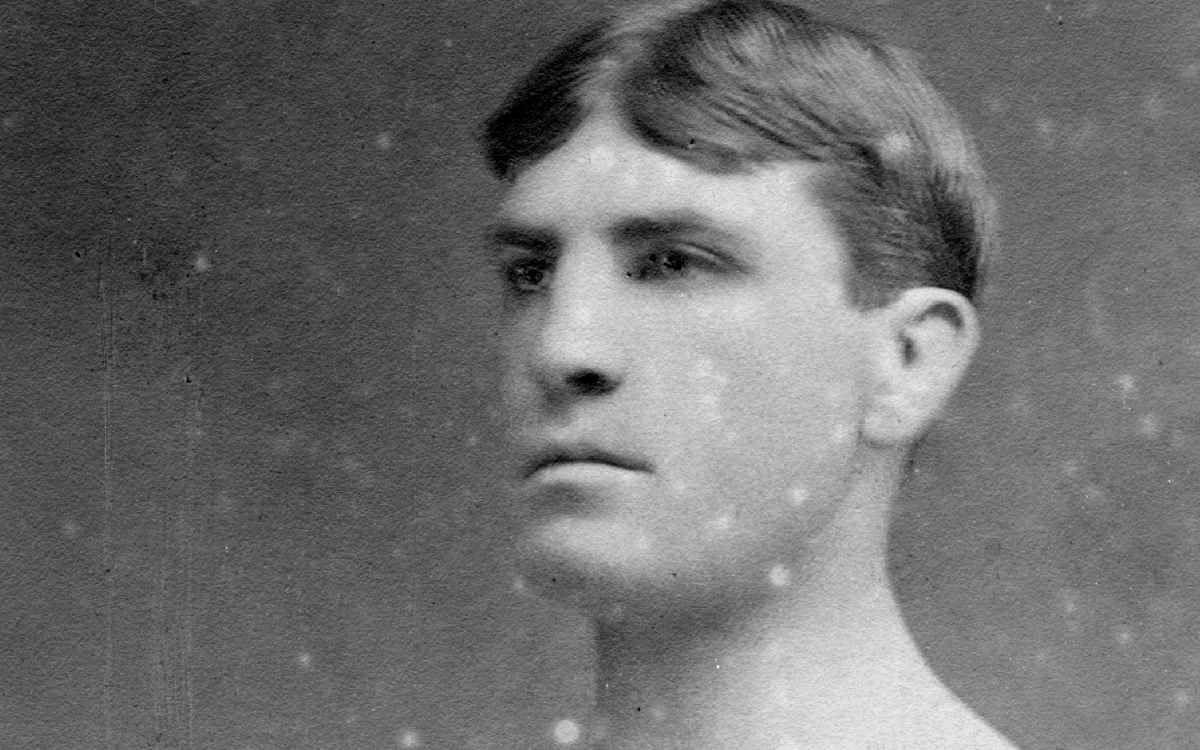
By the time Frank Slavin reached Lake Bennett in August 1897, the heavyweight boxer cut a rough figure with an axe hung from his shoulder and his clothes in tatters. A San Francisco Examiner correspondent saw the Australian with manager Joe Boyle and fellow fighter Frank Raphael and wrote that Slavin looked “as though he had been forty years in the wilderness.”
For Slavin, it was just one more adventure in a life full of them. The strapping “Sydney Cornstalk” came to the North with a reputation as one of the era’s best heavyweights. In boxing-mad Dawson, he quickly became its star attraction—but younger challengers, unruly fights and years of hard living would put his reputation to the test.
Slavin was in San Francisco for an April 1897 fight when his opponent backed out and a bout against a replacement boxer ended in a bizarre disqualification. They weren’t getting rich, so Slavin and Boyle needed a new plan. With Raphael, they travelled to Juneau, which Slavin later called “the wildest town” he’d ever seen. Despite a request for Slavin and Boyle to box a few rounds, they had no permit—why would they in a lawless place like Juneau?—so the sheriff wouldn’t allow it.
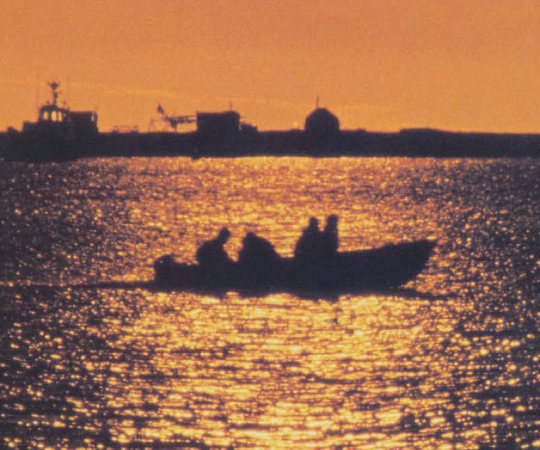
From Juneau, the three men went to Skagway and, instead of climbing the Chilkoot Trail, they joined 11 others and went up the White Pass Trail. Just a survey route at the time, it ended at the peak; the descent to the lakes was largely unexplored. They expected to reach the summit in a day; it took two and a half, as their horses struggled through muskeg, narrow gorges and treacherous footing. Then they spent two weeks hacking out 23 kilometres of trail, becoming the first group to reach the headwaters of the Yukon River via the White Pass. Finally, it was on to Dawson.
Boxing was popular across North America, but it had a particular appeal in the Klondike, where there was plenty of money to spend and a strong appetite for gambling and sport. Bouts took place at the Orpheum Theatre and at rowdy Front Street theatres, including the Combination (later renamed the Tivoli). The theatre at the back of the Monte Carlo, owned by a showman named Jack Smith and Dawson character “Swiftwater” Bill Gates, also hosted fights. At the Palace Grand, boxing shared the stage with comedy, music and variety acts. Serious money rode on these matches, with crowds paying up to $25 a seat and waging thousands of dollars on the outcome.
While Slavin tried his hand at prospecting, filing a claim on Eureka Creek, and bought a town lot in Dawson, whenever there was money to be made in a fight, he was ready. Archie “Biff” Hoffman, the self-proclaimed “heavyweight champion of the Pacific Coast,” crossed paths with Slavin at the Monte Carlo in December 1898. Both men were drunk. When an argument turned physical, Hoffman caught Slavin off guard and knocked him to the floor. Slavin got up. “My man,” he told him, “you can knock me about a saloon when I’m drunk, but I’ll show you what I can do in a ring when I’m sober.”
George “Tex” Rickard, a former Texas lawman who came north chasing gold and gambling, saw there was also money to be made in the ring. He booked a fight between Slavin and Hoffman at the Monte Carlo. Hoffman climbed into the ring in boxing trunks; Slavin came out in flannel trousers and a white turtleneck sweater. His outfit didn’t matter much because he barely broke a sweat. Slavin bobbed and weaved, then landed a hard right to Hoffman’s jaw. Hoffman crumpled. Slavin collected $1,000.
Rickard realized the fight was only part of what attracted paying customers. Rivalries and personalities sold tickets. He promoted friends Slavin and Boyle as bitter enemies, billing Boyle as the man who had defied “Soapy” Smith and Slavin as the “Sydney Slasher.” The story was a little twisted, though: Slavin, not Boyle, had tangled with the Skagway gangster in 1898. Rickard went on to promote fights in Nevada and New York, becoming one of boxing’s most important figures.
The sport’s popularity outlasted the rush to the Klondike goldfields. In May 1902, Slavin met Nick Burley, a dangerous local fighter, at the Orpheum. After nine rounds, Slavin threw up his hands.It was over.
Burley also understood entertainment. Later that year, he issued a challenge in the Klondike Nugget to two local wrestlers. He put up $250 that he could beat them within 10 rounds in back-to-back boxing bouts. (A few days later, the wrestlers held a comedy exhibition at the Orpheum, but there’s no evidence they fought Burley.)
The Dawson Amateur Athletic Association (DAAA) clubhouse opened that November. Boyle had worked on the building committee, helped draft the association’s constitution, invested in the project and later served on its first board of directors. The gymnasium had a ring at its centre, brightly lit and surrounded by tiered seating for spectators. The club’s first card, held in February 1903, featured four contests, including a heavyweight bout between two young local fighters.
Though Slavin never boxed at the DAAA, he continued fighting until December 1907, when he faced Burley again. Unfortunately, Slavin had nothing left by the seventh round. He staggered to the ropes, spat out a pinkish mouthful of water and teeth and told the crowd, “It ain’t no use to continue the bloody go.”
He stayed in Dawson, drifting between prospecting and odd jobs. Boyle, now a mining magnate, gave his friend a cushy job as a guard. In 1913, Slavin left the Yukon for Victoria. When the First World War broke out, he enlisted with the Canadian Expeditionary Force and went overseas, returning in poor health.
After Slavin died in 1929, journalist Archie Wills noted that many men had been to war, some had chased Klondike gold and a handful fought in the bare-knuckle days of boxing. But how many had done all three? “Just one! That one is Frank P. Slavin, of Victoria, B.C.”
Boxing in the Yukon didn’t disappear with Slavin and the other fighters who came north during the gold rush. The DAAA continued to put on regular cards, and a new generation of pugilists took their turn in the ring. In Dawson, a crowd always turned out for a fight.