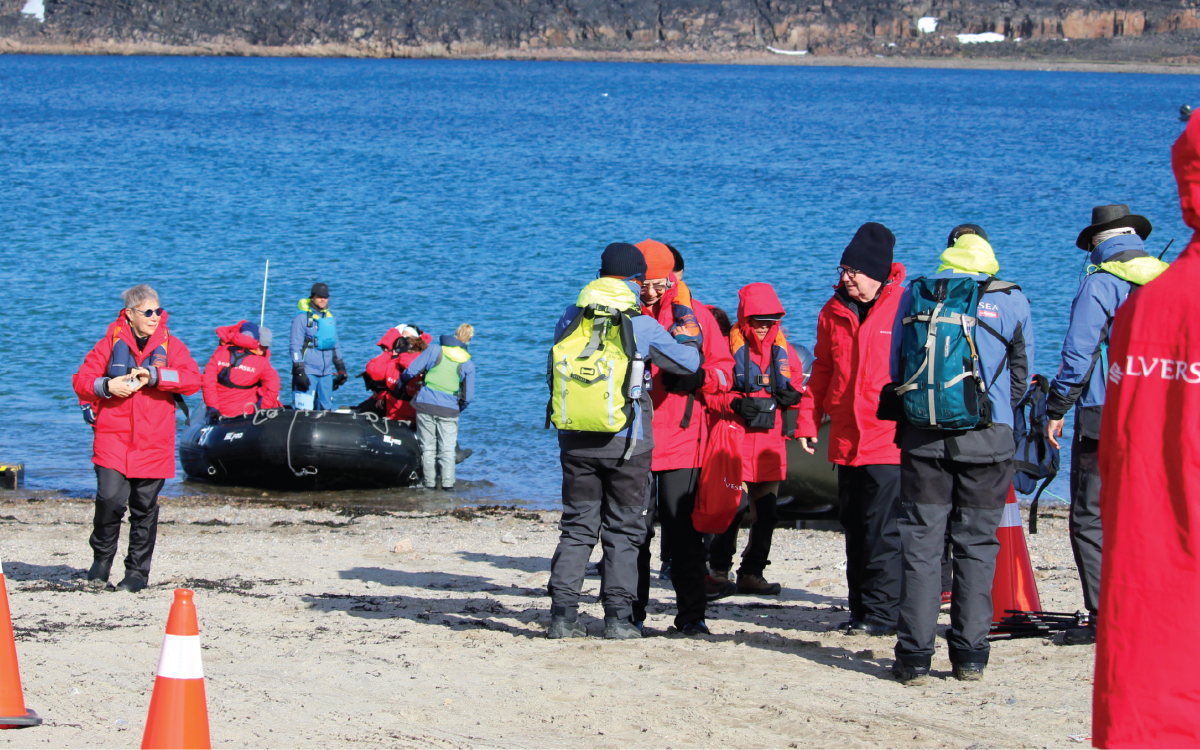
"Finally,” says Silaqqi Alariaq. Tiny black dots fast approach us as we stand on the shore of the Foxe Channel. For the past two hours, she has been breathing into her hands, trying to warm up in a frosty mid-July Kinngait wind. Alariaq turns around and starts giving directions to her staff, about a half-dozen people who have been waiting for the tardy Zodiacs filled with guests.
One of Alariaq’s employees pulls out a welcome sign attached to a piece of plywood and sticks it in the sand. Some pull down the hoods of their coats to look more presentable, while others call their families to share that “they” have arrived. As an employee for Huit Huit Tours who has helped organize cruise ship tours for the past 31 years, Alariaq witnesses this scene annually. “It’s always a big deal,” she tells me. She has welcomed hundreds of guests and dozens of ships to her hometown, but this one is the largest she’s encountered: a 10-deck, 20,500-tonne ship named the Silver Endeavour that touts itself as an “ultra-luxury mega-yacht.”
I’m an Iqaluit newspaper reporter in Kinngait for a week covering the territory’s housing crisis. My trip has coincided with the Silver Endeavour’s arrival, so I decide to follow the guests around. Kinngait is the third stop on the 17-day tour from Iqaluit to Kangerlussuaq, Greenland. To my surprise, I learn the passengers are often disinterested in the communities they visit. A ship employee tells me most guests spend the entire trip on board, which makes me wonder if taking the cruise is a status symbol. Do they come to the Arctic just so they can say they did? It strikes me that they’re missing an opportunity to see Nunavut’s remote, unique communities.
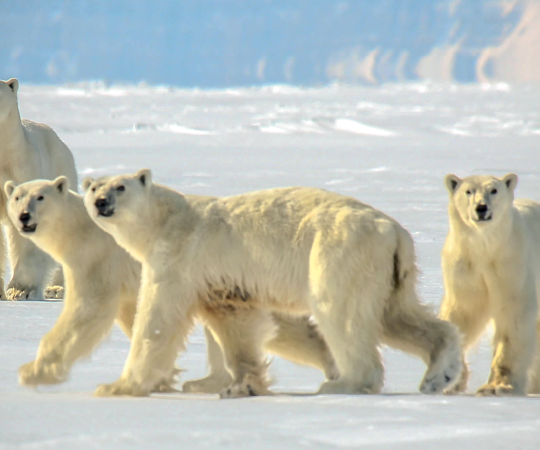
There’s plenty that draws tourists to Nunavut. Many are photographers looking for polar bears, ideally on a piece of melting ice, so they can take the go-to climate change photo featured in news articles around the world. Some are hikers or self-described “Arctic explorers.” And then there are the cruise ship guests, who spend $40,000 or more on the luxury experience.
The black Zodiacs reach the shore just before 9 a.m., each carrying about 10 people in bright red coats and black gum boots. The ship is docked further away in the channel; only about a third of the 200 guests have disembarked. I hear French, German and Australian accents as the visitors step onto Kinngait’s sand beach. “Are you gonna join us?” an 81-year-old Floridian asks me, looking at my camera and noting that I’m not one of the “natives.”
I, too, am seeing Kinngait for the first time. Inuktitut for “mountains,” it’s known as the world’s capital of Inuit art. Prints, drawings and sculptures from the community are on display in Canadian museums, and Canada’s ambassador to Denmark told me that Kinngait carvings are diplomats’ go-to gift for their foreign colleagues. Uninhabited Mallik Island, about two kilometres away, has traces of Indigenous civilizations that lived there more than 3,000 years ago, including tent rings, the stone foundations of traditional Inuit houses. The island is peppered with the bones of harvested polar bears. One lower jawbone is the size of my foot.
The guests are divided into groups, each with a local guide. One group heads to the Kenojuak Cultural Centre and Print Shop, the territory’s hub for traditional printmaking. Guests tour the centre, with its printing presses and drawing studios. Prints and large carvings range from a few hundred to a few thousand dollars—a bit steep for the average person but likely a more than reasonable price for international travellers on a high-end cruise. After all, why visit the “world’s capital of Inuit art” if not to buy a soapstone walrus, polar bear or owl? Yet, only two or three people pull out their wallets—for $7 magnets with a drawing by Kenojuak Ashevak.
At the community hall, artists try to sell their pieces from rows of tables. Qiatsuq Ragee, a 57-year-old with close-cut hair and a moustache, has a big drawing of a polar bear for $250. A father of four and grandfather of three, he lives with 10 family members in a one-storey house that has cracks and holes in the walls and old, queen-sized mattresses filling the floors of the tiny three bedrooms. “Are you from here?” an Australian guest asks him. Ragee replies that he was born “on the land” just outside of Kinngait. “It’s such a different life,” the woman says, but declines to buy the drawing. She has too much of that “stuff” at home.
The guests return to the ship for lunch and a “cultural program” in the onboard theatre—the lighting of qulliq, a traditional oil lamp, by an Elder and a performance by two throat singers. At white tables with turquoise napkins, passengers sip wine and eat rib-eye steaks, baked potatoes and steamed vegetables covered in a yellow sauce—something French, buttery and delicious, a young waiter with a slight German accent tells me. For dessert, kiwi pie and a piece of chocolate cake patterned with grapefruit. “When you write your scathing review,” a balding man in a Hawaiian shirt jokes, “please note that we haven’t seen any bears yet. If I don’t see one, I might be asking for a refund.”
After lunch, ship employees take me, along with the Elder and throat singers, back to the community on a Zodiac. The Silver Endeavour leaves the Foxe Channel, and I reflect on Kinngait’s extremes. World-renowned artists live in substandard government housing. The crime rate is high, and almost everyone has lost a loved one to suicide. But like many Nunavut communities, it’s also a place of hope. Even I—a stranger to Kinngait who also bought a $7 magnet and was disappointed not to see any polar bears—could sense that. But most of the cruise ship guests didn’t even try to notice.
I tell one of the singers how jarring it is to see a ship full of millionaires a day after walking through Ragee’s small, mouldy home. She disagrees. As a non-Inuk, I’m not used to seeing the contrast of Inuit and non-Inuit lives, she tells me. “It’s not new,” she says. “It has always been this way.”