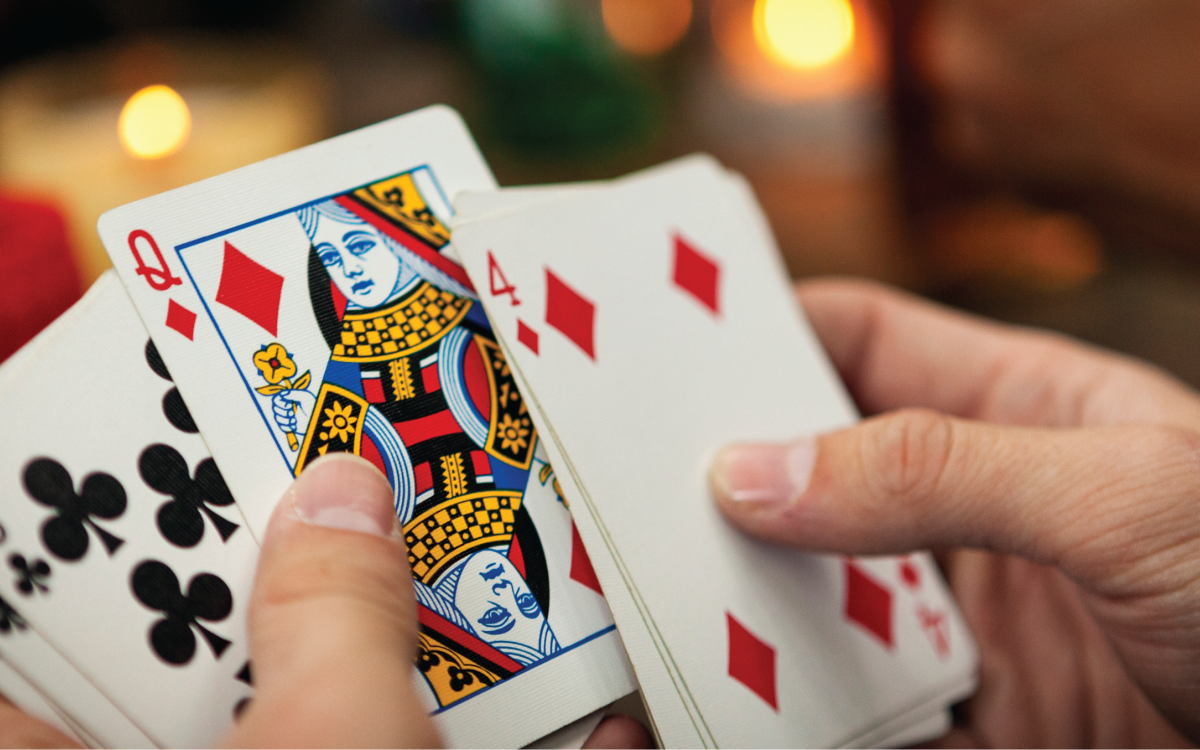
Chic Callas is always rusty during the first two hands. His mind is still on outside responsibilities, including water leaks, family commitments and making sure a kibitzer (the bridge term for a spectator) on his left understands what’s happening. Tall, with white hair, Callas wears dark jeans and a Swiss Army watch. His opponents, two retirees who’ve been playing together for 17 years, compliment his new button-down shirt. After the losses, he apologizes to his partner, Jordan, who shrugs it off. There are plenty of hands to come during Tuesday night bridge at Whitehorse’s Golden Age Society.
While official results are recorded on flashy calculators called BridgeMates—transported in a hard-sided black case with foam eggshell interior, as if this was a spy movie—Callas is old school. He documents everything on a newsprint scoresheet he keeps in a protective plastic cover. By the end of regulation play this September evening, he and Jordan finish third among 16 teams, though winning isn’t his primary concern. His goal is achieving Gold Life Master status—a designation granted by the American Contract Bridge League (ACBL) that reflects the number of games played.
Two days before his 69th birthday in October, Callas racked up the final 0.29 points he needed, making him the first player in the North to earn the title. For his efforts, he got a certificate and a mention in the December bridge bulletin. “Basically, we bridge players toil in obscurity,” he says. And he still considers himself a novice. “I’ve never called myself an expert and I probably never will,” he says. To him, being an expert at a game this intricate, this full of ups and downs, with more than 630 billion possible hands, is impossible.
Callas started playing bridge, a card game that marries skill and strategy, in 1974. As a University of Alberta student, he joined a game at his residence one night. A month later, he’d stopped going to his pre-med classes in favour of a new timetable: Wake up at noon, study The Encyclopedia of Bridge until his peers returned from class, play bridge until 2 a.m., repeat. He failed the year, the biggest embarrassment of his life.
He abandoned his medical-school ambitions but not bridge. In 1986, he was in the middle of a game when his wife went into labour with their first son. Callas didn’t finish the hand, but he waited for the other players to cash out before taking his wife to the hospital. After two more sons followed, he took a break to raise his family and work as a project manager with the Yukon government. He returned to cards in his 50s, after his mother was diagnosed with dementia and he wanted to exercise his own mind. Eventually, he started racking up the 2,500 points necessary for Gold status, on Tuesday nights, at tournaments in Alaska and via online games, which the ACBL started recognizing during the pandemic.
Bridge fascinates Callas because it’s so complicated that he’s still learning about it, and yet an eight-year-old can play. It’s taught him humility—“You’re only as good as your last hand, so there is no bragging. Winning is just an illusion”—and about partnership. He’s more interested in playing with someone who’s thoughtful, kind and intelligent than with a card shark who’s great at the game but mean at the table.
He tries to be that type of partner himself. When he hit his golden milestone last fall, he felt a punch of joy, followed by overwhelming relief at being able to spend more time learning Spanish on Duolingo and jamming with his band, the DanChic Duo. Then he emailed a thank you to all his bridge partners. “After that, I just took a week off from playing,” he says. “That was my celebration.”