Update: The Cathedral has repaid the $64,000 it owed the City of Iqaluit with the help of donations from other parishes in the North and across the country. The city also exempted places of worship from the tax in 2026. But Bishop Alexander Pryor says the church faces another round of uncertainty stemming from the “tax foolishness.” As of June 2026, the church and the city still disagreed on whether a portion of the cathedral's gravel parking lot is eligible for an exemption. “At this point,” says Pryor, “I hate to even think about the terrible waste of time and resources this tax nightmare has been on all sides.”
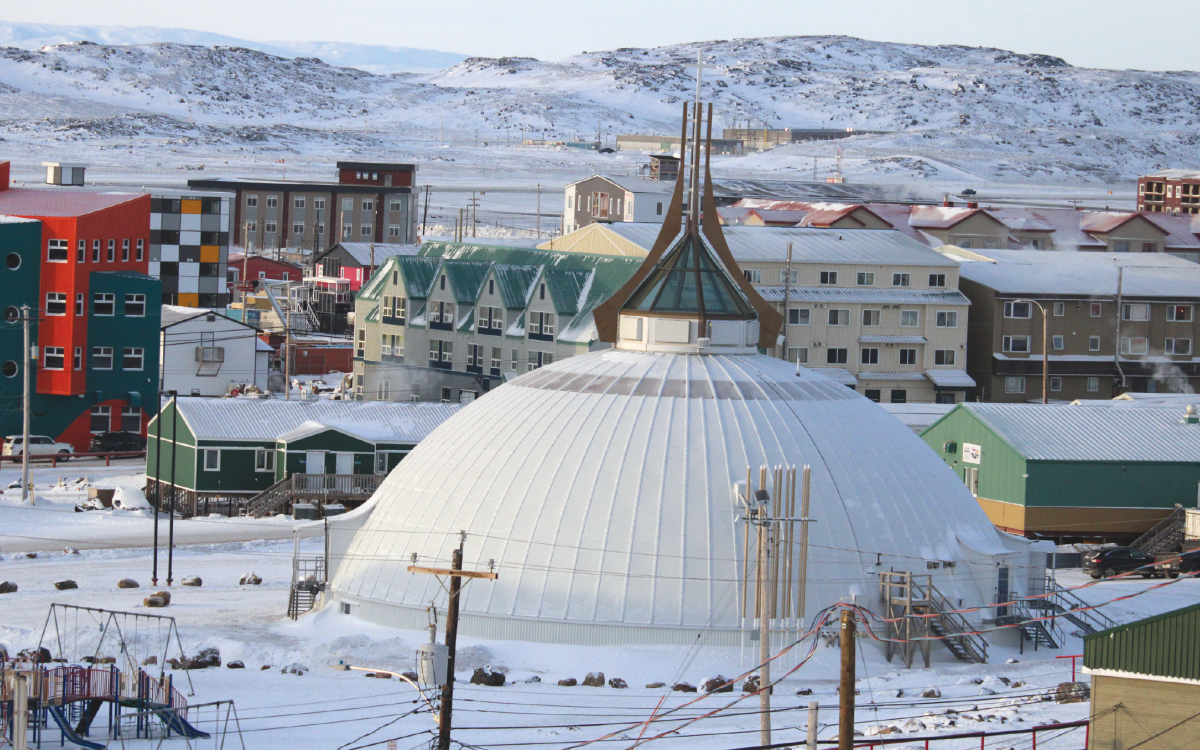
“DO WE NEED TO TURN ON THE LIGHTS?” asks Anglican pastor Abraham Kublu. He points at big floodlights on the dome of the iglu-shaped St. Jude’s Cathedral in downtown Iqaluit. “These things take a lot of power.” Power is money, and the cathedral doesn’t have a lot of that. Kublu pulls out a spreadsheet showing the church’s financial situation. Things are dim and a uniquely Iqaluit tax could spell the end of St. Jude’s.
In October, the city’s only cathedral made $43,400 from donations, fundraisers and rent from the parish hall and other properties. But with heat, water and electricity expenses, it finished the month about $9,650 in the red. On top of utility bills, the parish is facing a property tax debt of $64,000, which could lead the city to auction off the cathedral to cover the arrears.
Originally from Pond Inlet, Kublu started at St. Jude’s in 2023 shortly after Iqaluit became Canada’s only jurisdiction to tax places of worship. (Some other cities charge levies on church-owned property not used for religious practice.) The move was then-mayor Kenny Bell’s response to the discovery of 751 suspected unmarked graves at the former Catholic Marieval Indian Residential School in Saskatchewan. At the time, he said, “It’s very clear that the Catholic Church hasn’t done the community any good.”
The sole Catholic priest in town, Rev. Barry Bercier, has called the tax “punitive” and an infringement on religious freedoms, which in a few years could destroy his church, Our Lady of Assumption. And even though Bell’s initial rage was directed at the Catholic church, parishes of other denominations and the town’s sole mosque must all pay the tax. The levy adds to St. Jude’s financial troubles and it can’t turn to the Anglican Diocese of the Arctic for help.
The diocese has the largest number of followers among religious groups in Nunavut with 39 per cent of Nunavummiut calling themselves Anglican in the 2021 census. It manages 47 churches across Nunavut, Nunavik and the NWT and gets grants from southern, more profitable parishes. But it still finds itself with close to $1 million in unpaid power bills, salaries and the lingering debt in reconstruction costs of St. Jude’s following a fire more than two decades ago.
After volunteers built the original wooden cathedral in 1972, it suffered many break-ins and was then destroyed by arson in 2005. Rebuilding the Anglican cathedral—this time in stone—took seven years and more than $10 million. Inside its white dome, St. Jude’s has golden wall hangings, Inuit drawings and an altar cross made from narwhal tusks.
Other Nunavut churches are also suffering for want of money, insurance or maintenance. St. Philip’s Anglican Church in Sanikiluaq has sat empty for the past decade without heating, and parishioners run Sunday services and funerals at the local elementary school’s gym. But the bishop of the diocese says it’s not the church’s mandate to pay taxes, run furnaces or pay staff on time. “As a diocese, our charitable purposes are all about ministry, not building maintenance,” says Bishop Alexander Pryor. He believes local parishes are too “fixated” on the finances. If St. Jude’s iglu-shaped building must be sold, the congregation could move to a rented meeting room or someone’s home to “proclaim the good news of Jesus.” Tea around a kitchen table “will do just fine.”
But that wouldn’t do for Kublu. The end of St. Jude’s—the Arctic’s “mother church,” as he calls it—would also mean the end of his career as a pastor. In the past three years, the cathedral has become his home and he says he would rather take an early retirement than continue working without it. “It would be too shameful to carry on.”