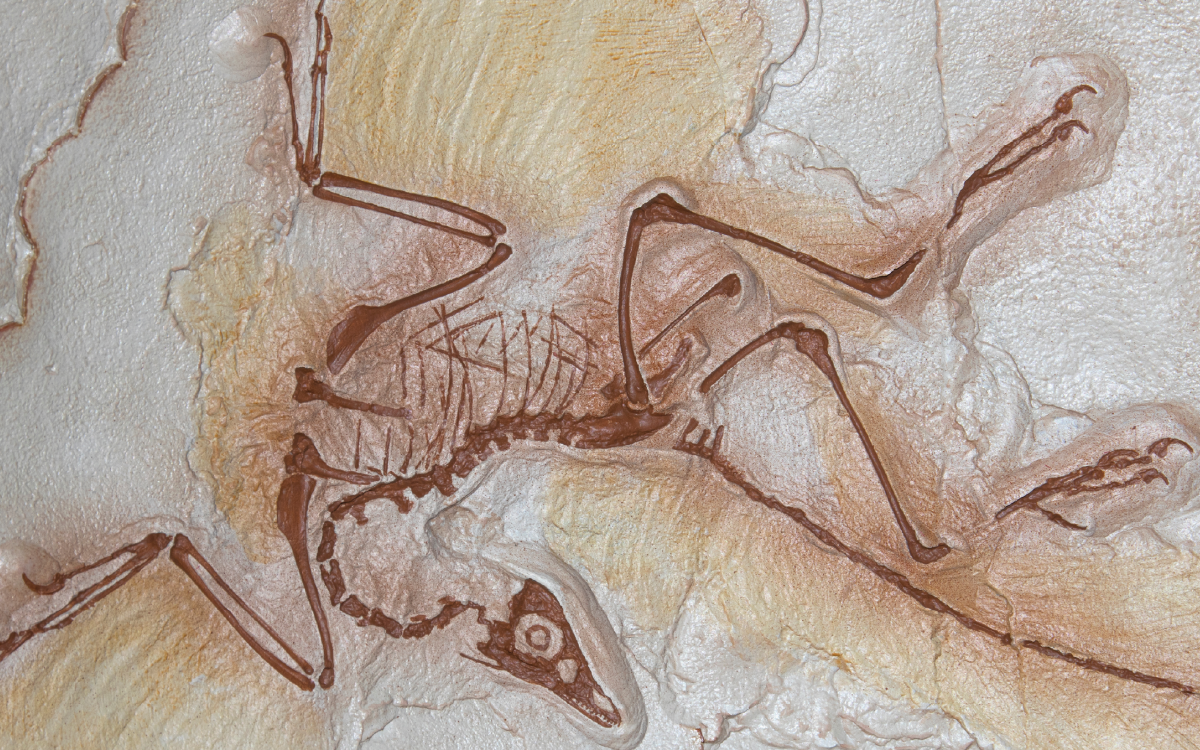
In the mid-1800s, interest in art and science became popular among Europe’s affluent upper classes. And that interest expanded to include delicate and attractive fossils. In the Solnhofen region of Germany, the fine-grained Upper Jurassic limestones were rich in fossils. Several doctors in this rural area accepted exquisite specimens in payment for medical treatments.
One day, a quarryman gave a delicate crow-sized fossil to Dr. Häberlein of Pappenheim, who eventually sold it to Sir Richard Owen of the British Museum for £700 (about $100,000 today). Widely acclaimed as “the most valuable specimen of anything, anywhere,” it was the first example of one of the earliest feathered reptiles that was likely able to fly. Named Archaeopteryx lithographica, which means “ancient wing, written in stone,” the fossil was detailed enough that the feathers were clearly visible and thus contributed substantially to the understanding of the development of flight in the transition of reptiles to birds.
During the Jurassic Period (201 million to 143 million years ago), most continents were still almost connected—what would become North and South America were quite close to what would later be known as Europe. Dinosaurs were common; many were carnivorous swift creatures hunting smaller reptiles and other animals. Some were warm-blooded, able to control their temperatures.
The theropod dinosaur ancestors of birds were bipedal, meaning they walked on their hind legs, with three weight-bearing toes with sharp claws. Many had hollow bones and wishbones that were flexible bones in the thorax, which strengthened the skeleton where wing muscles attached. Varying greatly in size—from large predaceous dinosaurs (yep, Tyrannosaurus rex and relatives) to tiny, speedy hunters dashing through the undergrowth—they were similar to the velociraptors of the Jurassic Park movies, but they were a bit less dramatic and they found no human prey.
Recent advances in paleontology are enabling scientists to identify pigments in skin and feathers of fossils, and there’s increasing evidence that many of these Jurassic and Cretaceous theropods were brightly coloured and used their feathers in courtship displays both for sexual attraction and for dominance. As time went on, feathers developed a new function: flight.
But how? There are conflicting theories, and due to the incomplete fossil record, the details may never actually be known. The “ground-up” theory has the small theropods flapping feathered front appendages to extend short leaps, eventually becoming able to fly up onto cliffs and trees. The “tree-down” theory favours arboreal dinosaurs extending hops from branch to branch and developing the ability to cover longer distances in the air by gliding, then flapping.
According to a third theory, called WAIR (wing-assisted incline running), small dinosaurs ran on ledges and slanted tree trunks and branches, using downward and backward flapping of their front limbs, not for lift, but to keep their feet firmly placed on the slanted surfaces until they reached flying speed. While not as widely accepted as the other two, this one makes aerodynamic sense. All these theories are based on incomplete fossil records scattered over immense time and distances; a number of adaptations likely influenced the development of flight.
Once they took to the air, birds diversified into every available niche, worldwide, becoming the incredible success story we know today. Flight allowed birds to capture prey in the air. It permitted migration, which lets birds relocate to follow the seasons or available food. Flight allows birds to roost and nest high in trees and on cliff faces, out of the reach of many predators. It allows them to hunt at sea, follow whales and polar bears to scavenge off their kills and even to manoeuvre underwater to reach prey.
And all this developed from a little two-legged dinosaur running about in the Jurassic forests, flashing its colourful feathers and hurling itself into the air.
Moulting: An Intriguing Evolutionary Adaptation
Though different flight systems evolved in reptiles and other animals, the development of feathers allowed maximum diversification in birds in part due to moulting. Because feathers are non-living, they wear out, are damaged in daily activities, change seasonally or get ripped out to allow incubation.
Here are more details about this fascinating adaptation:
Preening is essential for maintaining feathers, insulation and the ability to fly. Birds start preening when moulting their natal down to juvenile plumage, attending to every feather, removing the remains of natal down clinging to new feathers, cleaning them and aligning them properly. Glands above the base of the tail produce delicate oils that the bird spreads carefully over its feathers to increase waterproofing.
• Moulting and preening are essential to discourage a subtle enemy: the feather louse. These tiny insects are acquired in the nest from parents and siblings and gnaw away at the feathers, weakening them and damaging flight ability. Birds battle lice throughout their lives by bathing, preening and incessant scratching.
• Because birds depend on visual clues to evaluate the worthiness of mates, many moult to a breeding plumage for the courtship season. After breeding, many change to a more cryptic plumage to better hide from predators.
• Many waterfowl moult most flight
feathers after hatching their young,
becoming flightless. This keeps them close when their young are learning
to feed and hide.
• Some birds, such as the ptarmigan, undergo two to three major moults per year: one for spring breeding; a partial one for camouflage to raise their chicks; and one in the fall to establish their
white winter plumage.
• The down feathers of eider ducks radiate heat. Eiderdown that lines the nest (and is no longer heated by the bird) collects and holds the sun’s heat. If they have time before leaving the nest, the ducks pull a layer of down over their eggs to absorb and transfer the sun’s heat to the eggs. If you find an abandoned nest, the down will feel noticeably warmer than the surrounding vegetation.
• Grebes ingest their own feathers and regurgitate them to their chicks. This helps establish the chicks’ intestinal flora and fauna, protects their digestive tracts from sharp fish bones and eases the regurgitation of pellets containing indigestible matter.
• After loons do their winter moult, the flight feathers they grow bear the isotopic signature of their wintering grounds, where the threats to birds are usually greatest. These “signatures” based on H-2 hydrogen atom percentage aren’t precise, but they can indicate where the loon wintered, enabling better targeting of conservation efforts.