

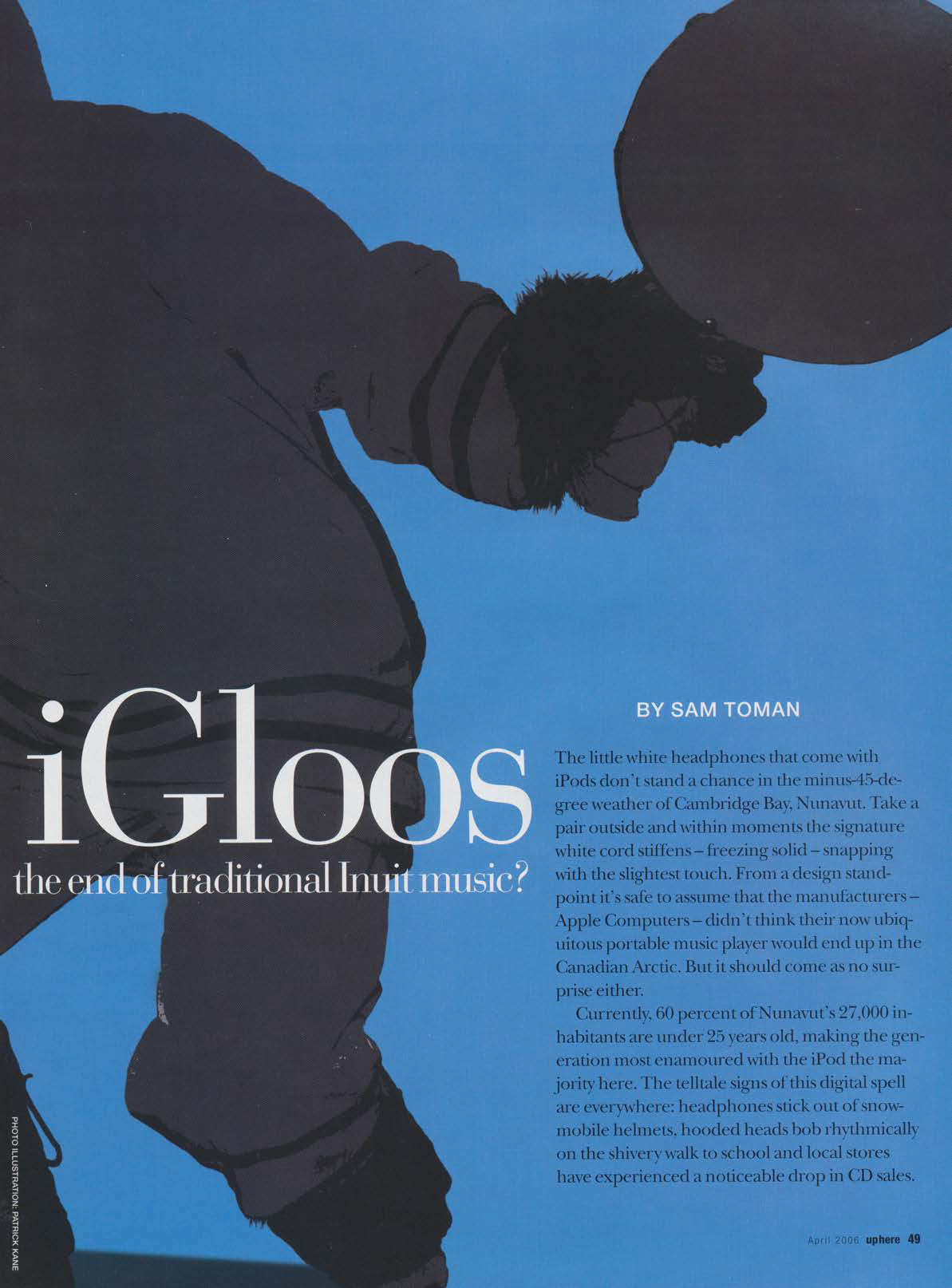
THE LITTLE white headphones that come with iPods don’t stand a chance in the minus-45-degree weather of Cambridge Bay, Nunavut. Take a pair outside and within moments the signature white cord stiffens — freezing solid — snapping with the slightest touch. From a design standpoint it’s safe to assume that the manufacturers — Apple Computers — didn’t think their now ubiquitous portable music player would end up in the Canadian Arctic. But it should come as no surprise either.
Currently, 60 percent of Nunavut’s 27,000 inhabitants are under 25 years old, making the generation most enamoured with the iPod the majority here. The telltale signs of this digital spell are everywhere: headphones stick out of snowmobile helmets, hooded heads bob rhythmically on the shivery walk to school and local stores have experienced a noticeable drop in CD sales.
YOUNG PEOPLE exploit every opportunity, appropriate or not, to pop on their headphones to listen to Green Day, Metallica and controversial American rapper 50 Cent. As a result, teachers at the school voted to ban iPods from classrooms. “It got to the point where it was all too distracting,” says Patti Bligh, a teacher at Kiilinik High School. “[Portable music players] are everywhere, and you can’t always see them.”
But distraction is only part of the problem. The content of the songs, some featuring explicit lyrics about guns, drugs and violence, stand in stark contrast to many of Cambridge Bay’s traditional values, such as living on the land and cooperating as a community. It’s a dilemma teachers and parents are struggling with all over the modern world. But for a culture that has gone from the ice age to the computer age in just two generations, the decision to ban iPods sparked a transgenerational debate, one that established modern music as yet another front in the battle to stop the erosion of Inuit culture. But many kids see it differently. For them, listening to popular music might be the only way to preserve their culture.
ON A DARK JANUARY AFTERNOON in Cambridge Bay, Jordan, Bernice and Jessie Lyall — three generations of a family with deep roots in the community — sit around the kitchen table discussing the current state of music in Nunavut, a popular topic these days.
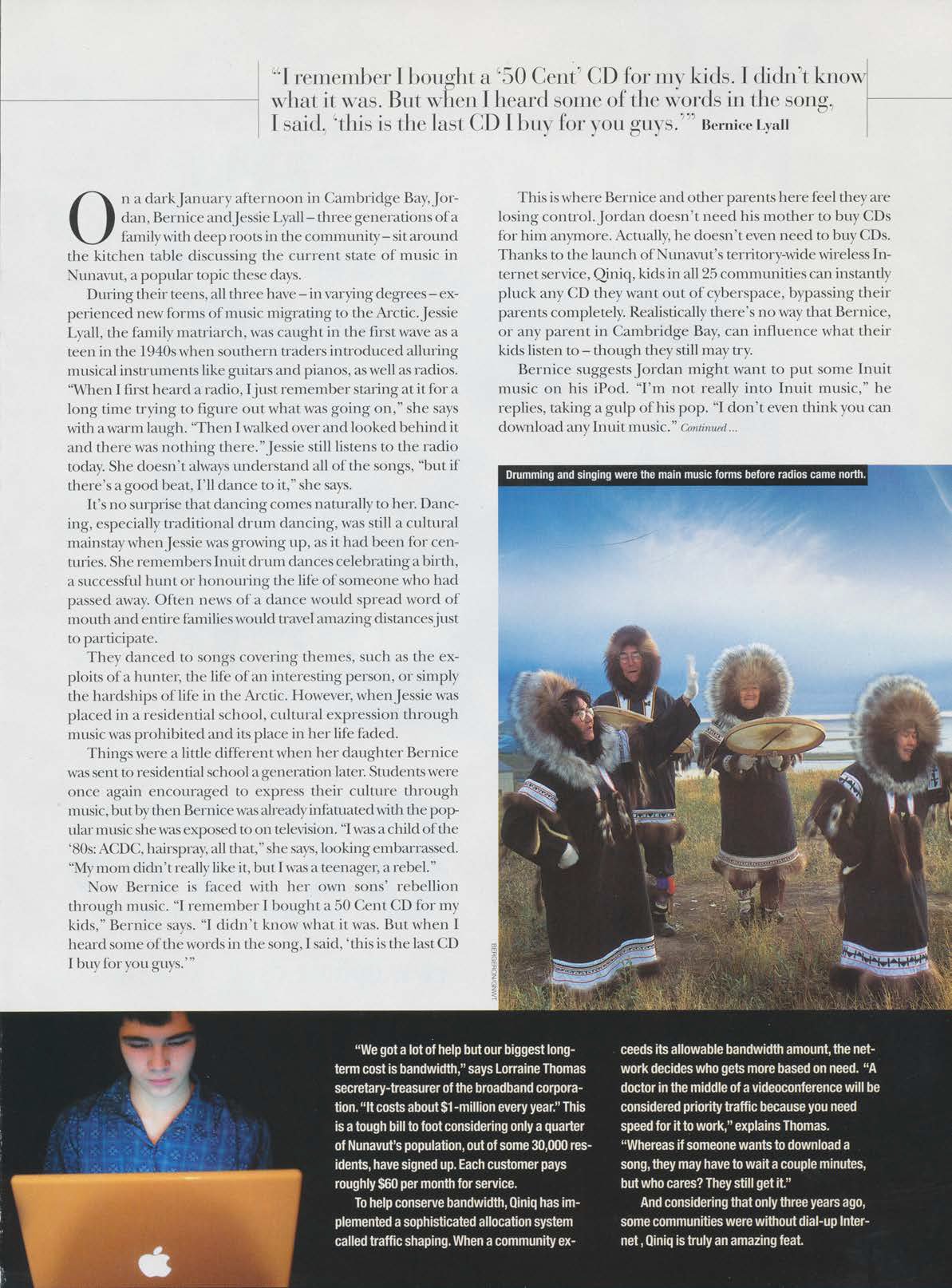
During their teens, all three have — in varying degrees — experienced new forms of music migrating to the Arctic. Jessie Lyall, the family matriarch, was caught in the first wave as a teen in the 1940s when southern traders introduced alluring musical instruments like guitars and pianos, as well as radios. “When I first heard a radio, I just remember staring at it for a long time trying to figure out what was going on,” she says with a warm laugh. “Then I walked over and looked behind it and there was nothing there.” Jessie still listens to the radio today. She doesn’t always understand all of the songs, “but if there’s a good beat, I’ll dance to it,” she says.
It’s no surprise that dancing comes naturally to her. Dancing, especially traditional drum dancing, was still a cultural mainstay when Jessie was growing up, as it had been for centuries. She remembers Inuit drum dances celebrating a birth, a successful hunt or honouring the life of someone who had passed away. Often news of a dance would spread word of mouth and entire families would travel amazing distances just to participate.
They danced to songs covering themes, such as the exploits of a hunter, the life of an interesting person, or simply the hardships of life in the Arctic. However, when Jessie was placed in a residential school, cultural expression through music was prohibited and its place in her life faded.
Things were a little different when her daughter Bernice was sent to residential school a generation later. Students were once again encouraged to express their culture through music, but by then Bernice was already infatuated with the popular music she was exposed to on television. “I was a child of the ‘80s: ACDC, hairspray, all that,” she says, looking embarrassed. “My mom didn’t really like it, but I was a teenager, a rebel.”
Now Bernice is faced with her own sons’ rebellion through music. “I remember I bought a 50 Cent CD for my kids,” Bernice says. “I didn’t know what it was. But when I heard some of the words in the song, I said, ‘this is the last CD I buy for you guys.’”
This is where Bernice and other parents here feel they are losing control. Jordan doesn’t need his mother to buy CDs for him anymore. Actually, he doesn’t even need to buy CDs. Thanks to the launch of Nunavut’s territory-wide wireless Internet service, Qiniq, kids in all 25 communities can instantly pluck any CD they want out of cyberspace, bypassing their parents completely. Realistically there’s no way that Bernice, or any parent in Cambridge Bay, can influence what their kids listen to — though they still may try.
Bernice suggests Jordan might want to put some Inuit music on his iPod. “I’m not really into Inuit music,” he replies, taking a gulp of his pop. “I don’t even think you can download any Inuit music.”
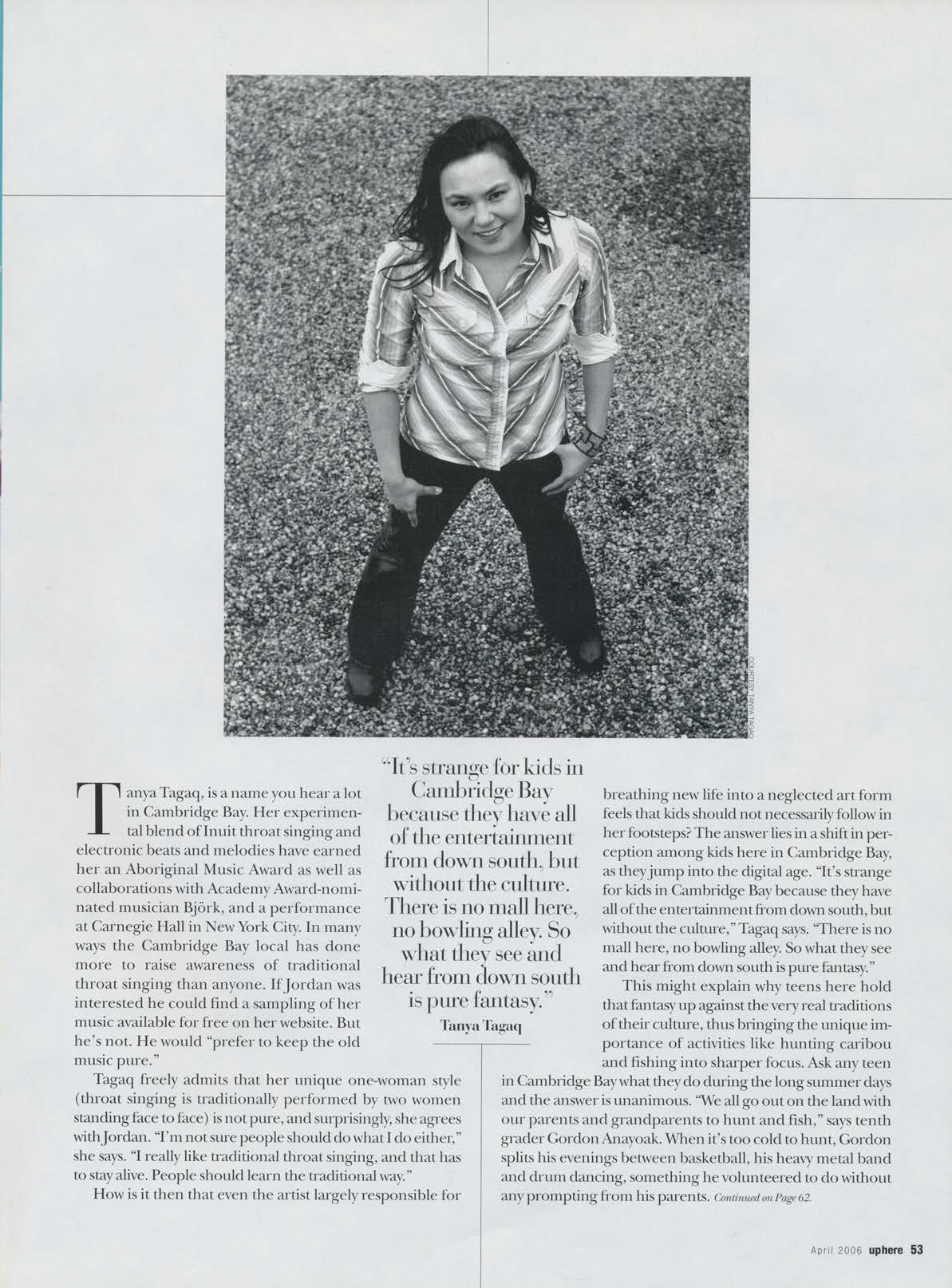
TANYA TAGAQ, is a name you hear a lot in Cambridge Bay. Her experimental blend of Inuit throat singing and electronic beats and melodies have earned her an Aboriginal Music Award as well as collaborations with Academy Award-nominated musician Björk, and a performance at Carnegie Hall in New York City. In many ways the Cambridge Bay local has done more to raise awareness of traditional throat singing than anyone. If Jordan was interested he could find a sampling of her music available for free on her website. But he’s not. He would “prefer to keep the old music pure.”
Tagaq freely admits that her unique one-woman style (throat singing is traditionally performed by two women standing face to face) is not pure, and surprisingly, she agrees with Jordan. “I’m not sure people should do what I do either,” she says. “I really like traditional throat singing, and that has to stay alive. People should learn the traditional way.”
How is it then that even the artist largely responsible for breathing new life into a neglected art form feels that kids should not necessarily follow in her footsteps? The answer lies in a shift in perception among kids here in Cambridge Bay, as they jump into the digital age. “It’s strange for kids in Cambridge Bay because they have all of the entertainment from down south, but without the culture,” Tagaq says. “There is no mall here, no bowling alley. So what they see and hear from down south is pure fantasy.”
This might explain why teens here hold that fantasy up against the very real traditions of their culture, thus bringing the unique importance of activities like hunting caribou and fishing into sharper focus. Ask any teen in Cambridge Bay what they do during the long summer days and the answer is unanimous. “We all go out on the land with our parents and grandparents to hunt and fish,” says tenth grader Gordon Anayoak. When it’s too cold to hunt, Gordon splits his evenings between basketball, his heavy metal band and drum dancing, something he volunteered to do without any prompting from his parents.
JORDAN LYALL spends his summers much the same way, but when he goes out on the land with his grandfather, his iPod stays home. “I love it for the isolation, I wouldn’t want to spoil that,” he says. “It’s quiet, but never boring, plus I can always listen to music when I get home.”
Gordon and Jordan’s attitude puts to rest the long held idea that when confronted with shiny, well-produced mass media, kids will simply abandon their existing culture, a scenario often referred to as cultural imperialism.
“The cultural imperialism model doesn’t really work anymore,” says Dr. Jonathan Burston, a professor of global media and communication at the University of Western Ontario. “There is the worry that kids will listen to music, buy Coca-Cola, move to Calgary and bam! Their culture is gone.”
Inuit culture is deeply rooted in the land, and the ability of generations to personally pass along knowledge of survival and independence is crucial to the maintenance of this culture. That’s why kids like Jordan have an advantage. They live between two different worlds — the traditional and the technological — and teens in Cambridge Bay can hop effortlessly between them without compromising either. For the iPod generation it simply means downloading a Green Day song before joining the family on a caribou hunt.
But that doesn’t mean traditional culture is completely safe. “After awhile quantity does become an issue of quality,” Dr. Burston says. When you have unfettered access to free music, along with a device like an iPod which can deliver it to your ears 24 hours a day, “at some point it’s just too slick and too omnipresent, and you just want it and the lifestyle that comes with it.” Burston admits that any teen wanting to be a famous musician will most likely have to leave Cambridge Bay whether they want to or not.
But, even a southbound quest for musical stardom may yield some surprising cultural benefits.
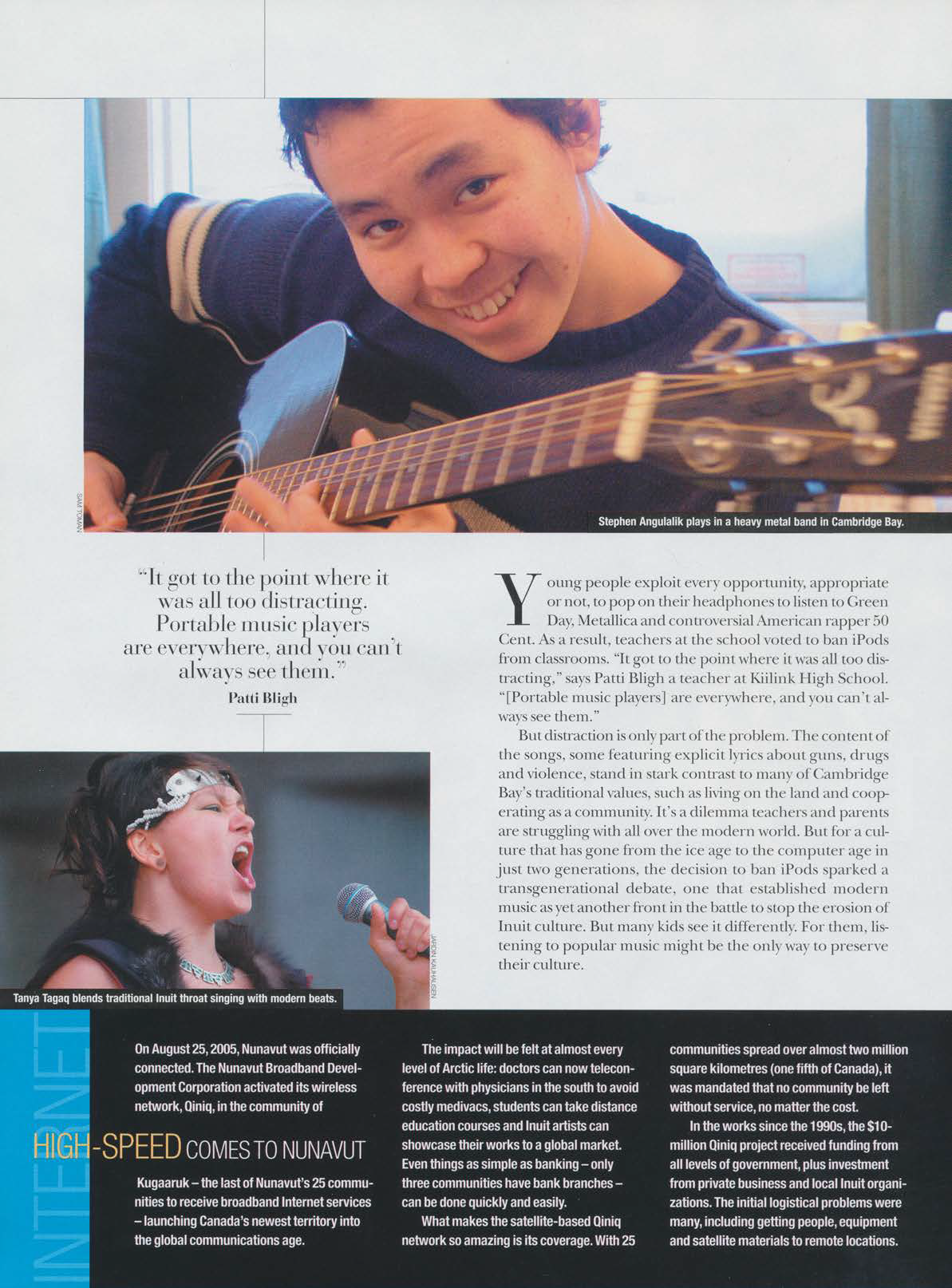
“I’m going to be a rock star,” proclaims 17-year-old Stephen Angulalik sitting in his room, working his way through classic rock riffs on his unplugged electric guitar. Judging by his austere room full of packed boxes, he won’t be doing it here. “This place is boring as anything man,” he scoffs with a charismatic smirk. “I can’t wait to move and join a band with my friends in Edmonton.”
Angulalik’s attitude is understandable. Tanya Tagaq, for instance, remembers going through the same phase. “I spent my whole childhood trying to get out of Cambridge Bay,” she says. But once she left to attend art school in Halifax her experiences with unfriendly people and being deprived of things like country food and the love of her family, she realized something important. “All I wanted to do was get back home.”
She’ll admit though, if she hadn’t left, she probably wouldn’t have made the music that she is so famous for. Tagaq, who now splits her time between Cambridge Bay and Spain, where her husband lives, began throat singing as a way to feel less homesick and reconnect with her home. It was a necessary step in forging her identity, but not an easy one. “I realized early on that nothing can tear me from my home. It’s my heart, it’s where my music comes from.”
Angulalik’s songs come from the heart as well. He writes songs about his late grandmother, pretty girls, and even songs about present day hardship in the Arctic, such as an (understandably) expletive-filled song about having a broken guitar and there being no one for thousands of miles with the knowledge to fix it. It’s not exactly a traditional song, but it’s a specific frustration unique to Angulalik’s Arctic environment.
Angulalik will certainly have no trouble finding someone down south to fix his guitar, but he might also find out that life outside Cambridge Bay isn’t as glamourous as he thought. But he is confident enough in his identity that he’s willing to risk it. “I am Inuk, I write songs. Aren’t those Inuit songs?” he challenges. “And when I make songs, people here will download them, plus I’d come back here to play. And if the songs are good, people would remember them forever.”
Sam Toman was an associate editor at Up Here, who sadly found out first-hand just how long iPod headphones last in the Arctic.